GIES
Case Study on Zhushan Tea Northern Subtropical Low
and Middle Mountains
Liu, S. X.1,2* Fan, Q.3 Li, Y. Y.4 Ren, T. S.5 Zhang, X. F.6 Meng, D.1,2 Yao, T. T.1,2 Yang, L. H.1,2 Ma, J. H.1 Xiong, Y. B.7 Ding, G.8 Zhou, Z. M.9 Gao, X. S.10 Yang,
D. M.10 Chen, B. Q.11 Wang, X. M.10,12 Zhang, Y. Y.10,12 Li, J. Y.10 Shen,
Y. F.13,14 Chen, D. Q.15,16 Lin, H.17 Yang, S.18 Li, R.19 Guo, Y.20 Li, M. H.21 Zhang, J.22 Yang, C. H.23 Cheng, W.10,12 Zhang, C.24
1. Institute of Geographic
Sciences and Natural Resources Research, Chinese Academy of Sciences, Beijing
100101, China; 2. University of Chinese Academy of Sciences, Beijing 100049,
China; 3. The People’s Government of Zhushan County, Zhushan 442200, China; 4. School of Tea Sciences, Anhui
Agricultural University, Hefei 230036, China; 5. College of Land Science and
Technology, China Agricultural University, Beijing 100193, China; 6. Tea
Research Office, Shiyan Economic Crops Research Institute, Hubei Province,
Shiyan 442099, China; 7. United Front Work office of Zhushan
County Committee, Zhushan 442200, China; 8. Office of
Political Consultancy of Zhushan County Committee, Zhushan 442200, China; 9. The Committee of Development and
Reform of Shiyan City, Shiyan 442099, China; 10. The Bureau of Agriculture and
Rural Affairs of Zhushan County, Zhushan
442200, China; 11. The Bureau of Development and Reform of Zhushan
County, Zhushan 442200, China; 12. The Office of Zhushan Tea Industry, Zhushan
442200, China; 13. Zhushan Tea Industry Group
Corporation, Zhushan 442200, China; 14. The Union of Zhushan Tea Industry, Zhushan
442200, China; 15. The Hubei Shengshui Tea Plantation
Co., Ltd., Zhushan 442200, China; 16. The Association
of Tea of Zhushan County in Hubei Province, Zhushan 442200, China; 17. The Xingmeng Tea Co., Ltd., Zhushan 442200, China; 18. The Youhua
Tea Science and Technology Co., Ltd., Zhushan 442200,
China; 19. Shangyong Town, Zhushan
County, Zhushan 442200, China; 20. Chengguan Town, Zhushan County, Zhushan 442200, China; 21. The Agricultural Technology
Extension Service Center of Desheng Town of Zhushan County, Zhushan 442200,
China; 22. The Agricultural Technology Extension Service Center of Baofeng Town
of Zhushan County, Zhushan
442200, China; 23. The Agricultural Technology Extension Service Center of Shangyong Town of Zhushan County,
Zhushan 442200, China; 24. The Center of Integrated
Media Communication of Zhushan County, Zhushan 442200, China
Abstract:
Zhushan County in Hubei Province of China is located in Qinling-Daba
Mountain and the north-south climate transition zone of China with thousands of
years of tea planting history. Survey results show that 59.38% of Zhushan County is in low mountains at an elevation of
500–1,000 m, 65% of the area has a slope of less than 25°, the annual
precipitation is 959 mm, and the average annual temperature is 16 °C. Except
for July, the average daily sunshine duration over multiple years is less than
6 h. All soil and water quality indicators of the tea plantations meet national
standards, and no pesticide residues were detected. Zhushan
tea is characterized by high water extract, high soluble sugar, high amino
acids, selenium content, and a unique aroma. It includes both black tea and
green tea: Zhushan green tea is high in tea
polyphenols and catechins, while Zhushan black tea is
high in theaflavins and relatively high in Theasinensins.
By the end of 2024, the registered population of Zhushan
County was 440,000, among which 200,000 were tea farmers. The comprehensive
output value of Zhushan’s tea industry exceeded 7
billion CNY, accounting for more than half of the county’s GDP. The GIES case
dataset on Zhushan tea from northern subtropical low
and middle mountains includes case area boundary, physical geographic
environment data (elevation classification, slope classification, climate,
soil, water quality, vegetation), tea characteristics, social development,
brand, and culture, etc. The dataset is archived in .shp,
.xlsx, .tif, .docx, and .jpg formats, consisting of
56 data files with a total size of 548 MB (compressed into 1 file of 153 MB).
Keywords: Hubei Province; Zhushan
County; tea; GIES; Case 23
DOI: https://doi.org/10.3974/geodp.2025.04.08
Dataset Availability Statement:
The dataset supporting this paper was published and is
accessible through the Digital Journal of Global Change Data Repository
at: https://doi.org/10.3974/geodb.2025.04.06.V1.
1 Introduction
Zhushan County was
anciently called “Shangyong”,
and was renamed “Zhushan” by Yuan Qin, the abolished
emperor of the Western Wei Dynasty, because of its dense forests, tall bamboos,
and beautiful landscapes. Located in the mountains of the northwestern Hubei
Province, its north part evolves into the Wudang
Mountains and the south part stretches into Daba Mountains. The verdant
mountains of the Qinling-Bashan Mountains and the
clean water flowing along the Du River have cultivated an excellent growth
environment for tea trees, nourishing Zhushan County as
a “national key tea-producing county” and making Zhushan
tea uniquely sweet and refreshing. In the agricultural division of Hubei
Province, Zhushan County is classified as the
high-mountain famous tea production area in northwestern Hubei Province. In
2005, it was officially named as “Hometown of China’s High-Aroma Ecological
Green Tea” by the Organizing Committee of the China Special Product Hometown
Recommendation and Promotion Activity. It has won the titles of “National
County for Quality and Safety of Agricultural Products”, “National
Demonstration County for Tea Assisted by Science and Technology”,
“National Key Tea-Producing County” and “National Standardized Base County for
Green Food Raw Materials (Tea)”, making the tea industry as a business card of Zhushan County.
2 Metadata of the Dataset
The metadata of the GIES case
dataset on Zhushan tea from northern subtropical low
and middle mountains[1] includes dataset name, authors, geographical
region, data formats and sizes, and dataset contents, etc. The detail is shown
in Table 1.
3 Case Area
The case study area is in Zhushan
County (Figure 1), Shiyan City, Hubei Province, between 109°32′E–110°25′E and
31°30′N–32°37′N. It is adjacent to Fangxian County in the east, Yunyang
District in the north, Baihe County of Shaanxi Province in the northwest, Zhuxi County and Xunyang City of
Shaanxi Province in the west, and Shennongjia Linqu and Wuxi County of Chongqing City in the south. The
county is located 158 km southwest of Shiyan urban area and 638 km northwest of
Wuhan. The total area is 3,586 km2.
Table 1 Metadata summary of the GIES case dataset on Zhushan
tea from northern subtropical low and middle mountains
|
Items
|
Description
|
|
Dataset full name
|
GIES case dataset on Zhushan tea from northern subtropical low and middle
mountains
|
|
Dataset short name
|
ZhushanTeaCase23
|
|
Authors
|
Liu, S. X., Institute
of Geographic Sciences and Natural Resources Research, Chinese Academy of
Sciences, liusx@igsnrr.ac.cn
Fan, Q., The People’s
Government of Zhushan County, Hubei Province, China,
903077405@qq.com
Li, Y. Y., School of
Tea Sciences, Anhui Agricultural University, lyy@ahau.edu.cn
Ren, T. S., College
of Land Science and Technology, China Agricultural University,
tsren@cau.edu.cn
Zhang, X. F., Tea
Research Office, Shiyan Economic Crops Research Institute, 510561777@qq.com
Meng, D., Institute
of Geographic Sciences and Natural Resources Research, Chinese Academy of
Sciences, University of Chinese Academy of Sciences, Cher916@163.com
Yao, T. T., Institute
of Geographic Sciences and Natural Resources Research, Chinese Academy of
Sciences, University of Chinese Academy of Sciences, yaott.19b@igsnrr.ac.cn
Yang, L. H., Institute of Geographic Sciences and Natural Resources Research,
Chinese Academy of Sciences, yanglihu@igsnrr.ac.cn
Ma, J. H., Institute of Geographic Sciences and Natural Resources Research,
Chinese Academy of Sciences, majh@igsnrr.ac.cn
Xiong, Y. B., United Front Work office of Zhushan
County Committee, 12936527@qq.com
Ding, G., Office of Political Consultancy of Zhushan
County Committee, 625237406@qq.com
Zhou, Z. M., The Committee of Development and Reform of Shiyan City, China, 807196285@qq.com
Gao, X. S., The Bureau of Agriculture and Rural Affairs of Zhushan
County, China
Yang, D. M., The Bureau of Agriculture and Rural Affairs of Zhushan
County, 335264469@qq.com
Chen, B. Q., The
Bureau of Development and Reform of Zhushan County,
346187662@qq.com
Wang, X. M., The Bureau of Agriculture and Rural Affairs of Zhushan
County, 1050275352@qq.com
Zhang, Y. Y., The Bureau of Agriculture and Rural Affairs of Zhushan County, 787917778@qq.com
Li, J. Y., The Bureau of Agriculture and Rural Affairs of Zhushan
County, 2238978@qq.com
Shen, Y. F., Zhushan Tea Industry Group
Corporation, 174663286@qq.com
Chen, D. Q., The Hubei Shengshui Tea Plantation Limited
Company/The Association of Tea of Zhuanshan County
in Hubei Province, hbshengshui@163.com
Lin, H., The Xingmeng Tea Limited Company, Zhushan
County, Hubei Province, China, 511627395@ qq.com
Yang, S., The Youhua Tea Science and Technology
Limited Company, 2263142056@qq.com
Li, R., Shangyong Town, Zhushan
County, 363286931@qq.com
Guo, Y., Chengguan Town, Zhushan
County, Zhushan 442200, 260253578@qq.com
Li, M. H., The Agricultural Technology Extension Service Center of Desheng Town of Zhushan County,
138728165100@qq.com
Zhang, J., The Agricultural Technology Extension Service Center of Baofeng Town
of Zhushan County, 1793897168@qq.com
Yang, C. H., The Agricultural Technology Extension Service Center of Shangyong Town of Zhushan
County, 814630742@qq.com
Cheng, W., The Bureau of Agriculture and Rural Affairs of Zhushan
County, 1437744907@qq.com
Zhang, C., The Center of Integrated Media Communication of Zhushan
County, 782610092@qq.com
|
|
Geographical region
|
Zhushan County, Shiyan City,
Hubei Province
|
|
Data format
|
.tif,
.xlsx, .docx, .shp, .jpg
|
|
Data size
|
548 MB
|
|
Data files
|
Boundary data of case
area; physical geographic environment data; tea quality and pesticide residue
data; demographic, economic, managerial and cultural data, etc.
|
|
Foundations
|
Ministry of Science
and Technology of P. R. China (2022YFF0801804); Shiyan Development and Reform
Commission of Hubei Province (2024)
|
|
Data publisher
|
Global
Change Research Data Publishing & Repository, http://www.geodoi.ac.cn
|
|
Address
|
No. 11A, Datun Road, Chaoyang District, Beijing 100101, China
|
|
Data sharing
policy
|
(1) Data are openly available and can be free
downloaded via the Internet; (2) End users are encouraged to use Data subject to citation; (3) Users,
who are by definition also value-added service providers, are welcome to
redistribute Data subject to
written permission from the GCdataPR Editorial
Office and the issuance of a Data
redistribution license; and (4) If Data
are used to compile new datasets, the ‘ten per cent principal’ should be
followed such that Data records
utilized should not surpass 10% of the new dataset contents, while sources
should be clearly noted in suitable places in the new dataset[2]
|
|
Communication and
searchable
system
|
DOI, CSTR, Crossref, DCI, CSCD, CNKI, SciEngine,
WDS, GEOSS, PubScholar, CKRSC
|
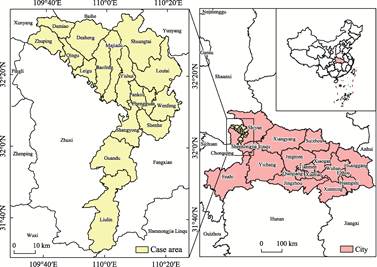
Figure 1 Map of geo-location
of Zhushan County
Covering 16 of 17
towns, Zhushan tea is distributed in 3 major
tea-growing zones around Daguan Mountain, Nvwa
Mountain and Daquan Mountain respectively. Daguan Mountain tea-growing zone
consists of 4 towns (Zhuping, Damiao,
Qingu and Desheng); Nvwa Mountain tea-growing zone consists of 4 towns (Leigu, Baofeng, Majiadu and Yishui); and Daquan Mountain tea-growing zone consists of 8
towns (Pankou, Chengguan, Wenfeng, Shangyong, Shuangtai, Loutai, Shenhe and Guandu). The main tea
processing bases and warehousing & logistics bases are located in Xuanguzhou Village of Pankou Township,
Xiaoyan Village of Baofeng Town, Shengshui Village of
Desheng Town, Chenjiahe
Village of Zhuping Township, Jingquan
Village of Shenhe Township, Daquanshan
Village of Shangyong Town and Xizhuang
Village of Qingu Town, respectively. The main quality
inspection services, electronic sales platforms, tea and agricultural products cold storage base, cold chain
transportation base, tea wholesale markets, and Wudang
Mountain Tea Museum are located in Shangyong Tea Center
in Pankou Township.
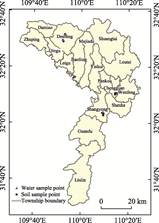
The case area covers 3 major tea-growing zones in Zhushan County, with the sampling conducted at Guoyingchachang Tea Garden and Hejiaba
Tea Garden in Shengshui Village of Desheng Town belonging to the Daguan
Mountain tea-growing zone, Qingquan Tea Garden in
Baofeng Town belonging to the Nvwa Mountain tea-growing
zone, Liujiashan Tea Garden in Chengguan
Town and Daquanshan Tea Garden in Shangyong
Town belonging to the Daquan Mountain tea-growing zone (Figure 2). In addition,
physical geography, population and economic data at the whole of the county
level were also investigated.
4 Geographical and Environmental Data
4.1 Topography
Zhushan County is
located in the hinterland of the Qinling-Daba
Mountains in northwestern Hubei Province. The territory is surrounded by
overlapping mountains, and the landform consists of 3 major terrain areas:
northern, central, and southern parts. The overall terrain is high in the west
and low in the east, steep in the south and gentle in the north, with a river
valley plain in the middle. It is surrounded by mountains, sloping from the
boundary to the center, forming a basin. Based on the ASTER GDEM 30-m DEM data[1], a classify analysis to the
elevation and slope of Zhushan County was conducted.
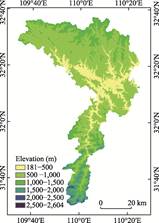
The altitude ranges from 181 m to 2,604 m (Figure 3). About 59.38% of the area is
low mountains with an elevation of 500–1,000 m; areas below 500 m account for
15.34%, mostly being rivers and riparian zones; and areas above 1,000 m account
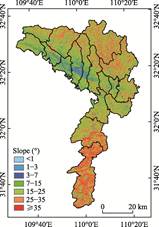
for 25.28%, classified as middle mountains. Additionally, 65% of the county has
a slope of less than 25°, which is consistent with the distribution of
low-middle mountainous areas (Figure 4). Tea plantations are mostly distributed
in the areas with an elevation below 1,800 m and a slope of less than 25°. The
vast low mountain area and gentle slopes below 25° provide an excellent growth
environment for Zhushan tea.
|
|
|
|
|
Figure 2 Distribution map of the sampling
points
|
Figure 3 Map of elevation in Zhushan County
|
Figure 4 Map of land slope in Zhushan County
|
4.2 Climatic Data
Zhushan County is situated in the
transitional zone between northern and southern climates, belonging to the
northern subtropical monsoon continental climate. The entire region enjoys
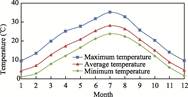
sufficient heat, with an average annual temperature of 16.1 ℃ (2015–2023).
The temperature rises rapidly in early spring with July and August being the
high-temperature period. The temperature decreases gradually in autumn, and
there is no significant extreme low temperature in winter (Figure 5).
Zhushan experiences distinct 4
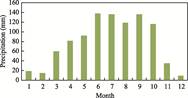
seasons, with synchronized rainfall and heat. The average annual precipitation
is 958.5 mm, which is concentrated from March to October, accounting for 92% of
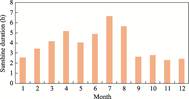
the annual total (Figure 6). The average daily sunshine duration in the months other
than in July is less than 6 h (Figure 7), and the average annual sunshine
duration is 1,428 h, providing an excellent environment to conduct the
photosynthesis for shade-loving tea plants.
Zhushan County exhibits unique radiation conditions. Based on the
documented study[3], Zhushan County has
weak direct radiation. The average annual global radiation in Zhushan from 1981 to 2012 was 3,800–4,100 MJ/m2/year,
which is close to that of the Yunnan-Guizhou Plateau (less than 3,800 MJ/m2/year)—the
region with the lowest global radiation in China—and much lower than that of
the upper reaches of the Yarlung Tsangpo
|
|
|
Figure 5 Monthly average
temperature of Zhushan County (2015–2023)
|
|
|
|
Figure 6 Monthly average
precipitation of Zhushan County (2015–2023)
|
|
|
|
Figure 7 Monthly average daily
sunshine duration of Zhushan County (2015–2023)
|
River
in the Qinghai-Xizang Plateau (more than 6,800 MJ/m2/year), the
region with the highest global radiation in China. The average annual diffuse
radiation from 1981 to 2012 was 2,350–2,450 MJ/m2/year, which is
highly suitable for the production of high-quality tea.
4.3 Soil Conditions Data
The main soil types in Zhushan
County are yellow-brown earths and mountain brown earths[4].
The soil exhibits a vertical zonal distribution pattern: below an elevation of
800 m, the soil is generally fluvo-aquic soil and yellow-
brown earths; between 800–1,500 m, it is yellow-brown earths; and above 1,500
m, it is mountain brown earths[5].
Soil samples were
collected from Shengsui-Guoyingchachang, Daquanshan, Liujiashan, Shengsui-Hejiaba, and Qingquan
Tea Garden. Samples were taken every 20 cm from the surface down to the gravel
layer. The soil pH and heavy metal content were tested by the Physical and
Chemical Analysis Center of the Institute of Geographic Sciences and Natural
Resources Research, Chinese Academy of Sciences (IGSNRR, CAS). The average pH
was 5.1, indicating acidic soil (Table 2). The test results for heavy metals
are shown in Table 3. The heavy metal content at all sampling points in the
case area was lower than the risk screening values (RSV) defined by the national
standard for soil contamination of agricultural land[6].
Table 2 Statistical results of soil
pH tests collected from sampling points
|
Sampling point
|
Longitude (°E)
|
Latitude (°N)
|
pH
|
Sampling point
|
Longitude (°E)
|
Latitude (°N)
|
pH
|
|
P1
|
109.89
|
32.52
|
5.4
|
P8
|
110.24
|
32.17
|
5.1
|
|
P2
|
109.88
|
32.52
|
5.6
|
P9
|
110.25
|
32.18
|
5.2
|
|
P3
|
109.88
|
32.53
|
6.5
|
P10
|
109.87
|
32.49
|
5.8
|
|
P4
|
110.15
|
32.06
|
4.4
|
P11
|
109.87
|
32.48
|
6.1
|
|
P5
|
110.16
|
32.05
|
4.5
|
P12
|
109.96
|
32.27
|
4.3
|
|
P6
|
110.16
|
32.06
|
4.8
|
P13
|
109.95
|
32.27
|
4.2
|
|
P7
|
110.24
|
32.18
|
4.1
|
|
|
|
|
The soil
fertility of Zhushan County was tested in accordance
with the soil nutrient classification standards of the Second National Soil
Survey. The results showed that the soil organic matter content ranged from
6.18 to 31.8 g/kg, and the total nitrogen content ranged from 0.388 to 1.99
g/kg. According to Du, et al. (2023)[7], Zhushan
County is located in a northwest-southeast selenium-rich soil belt within
Shiyan City. The average soil selenium content in Baofeng Town, Yishui Town, and Qingu Town was
0.91 mg/kg, which is higher than the soil selenium background value in national
A horizon (0.29 mg/kg), classifying it as a selenium-rich region[8].
In 2025, the Geological Society of China recognized Baofeng Town, Leigu Town, and Qingu Town in Zhushan County as naturally selenium-rich areas, with an
average soil selenium content of 1.105 mg/kg.
Table 3 Statistical results of heavy metal content
in soil samples
|
Sampling point
|
Cd (mg/kg)
|
Hg (mg/kg)
|
As (mg/kg)
|
Pb (mg/kg)
|
Cr (mg/kg)
|
Cu (mg/kg)
|
Ni (mg/kg)
|
Zn (mg/kg)
|
|
P1
|
–
|
1.1
|
8.2
|
28.2
|
117.4
|
41.5
|
46.0
|
99.3
|
|
P2
|
–
|
0.9
|
2.4
|
28.2
|
112.8
|
46.1
|
55.5
|
153.6
|
|
P3
|
–
|
0.3
|
6.9
|
24.3
|
113.7
|
54.3
|
57.8
|
128.8
|
|
P4
|
–
|
0.0
|
–
|
21.8
|
101.5
|
56.8
|
46.8
|
129.3
|
|
P5
|
–
|
0.0
|
6.5
|
18.7
|
114.3
|
59.2
|
48.0
|
113.4
|
|
P6
|
–
|
–
|
–
|
17.8
|
120.1
|
80.5
|
56.2
|
158.5
|
|
P7
|
–
|
0.5
|
2.5
|
24.6
|
104.2
|
45.4
|
58.8
|
117.3
|
|
P8
|
–
|
0.7
|
0.0
|
27.1
|
127.3
|
46.2
|
60.0
|
128.2
|
|
P9
|
–
|
0.9
|
1.5
|
26.3
|
124.0
|
40.3
|
57.8
|
95.6
|
|
P10
|
–
|
0.7
|
14.8
|
15.8
|
49.4
|
25.5
|
23.5
|
154.3
|
|
P11
|
–
|
0.5
|
6.4
|
13.7
|
51.9
|
25.5
|
22.3
|
158.6
|
|
P12
|
0.2
|
0.6
|
13.9
|
22.7
|
95.2
|
22.6
|
36.7
|
113.0
|
|
P13
|
–
|
0.3
|
–
|
9.2
|
42.8
|
9.6
|
16.6
|
45.7
|
|
Limit (pH≤5.5)
|
0.3
|
1.3
|
40
|
70
|
150
|
150
|
60
|
200
|
|
Limit (5.5<pH≤6.5)
|
0.3
|
1.8
|
40
|
90
|
150
|
150
|
70
|
200
|
Note: “–” indicates that the substance was
not detected (hereinafter the same).
 4.4 Land Use and
Biodiversity Characteristics
4.4 Land Use and
Biodiversity Characteristics
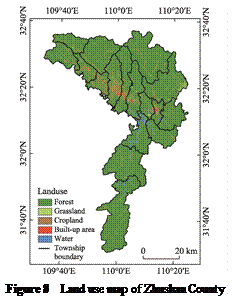
With
reference to the 2020 Global 10-m Land Cover Product produced by the European
Space Agency (ESA) using Sentinel-1 and Sentinel-2 multi-source satellite data
combined with machine learning, the interpretation
and reclassification were performed to obtain the distribution map of major
land use types in Zhushan County (Figure 8). It is
seen that forest land is the dominant land use type in Zhushan
County, accounting for 89.10% of the total area and distributed across most
regions except the plains. Non-forest land accounts for 10.90%, including cropland
(4.75%), grassland (3.99%), built-up land (0.82%), and water areas (1.34%).
With a
thousand-year history of tea cultivation, tea farmers in Zhushan
County mostly adopt an intercropping pattern where tea gardens are interspersed
with forest lands and croplands (Figure 9). In recent years, with the promotion
of ecological and low-carbon tea garden agricultural technologies, attention
has been paid to the configuration of secondary plants in tea gardens, with the
target ecological land being not less than 10%. Those plants which are beneficial
to the tea garden ecosystem, such as osmanthus, ginkgo, cherry, and
metasequoia, are more and more planted around tea gardens, in open spaces, and
along roadsides, at approximately 225 plants per hectare. This has effectively
improved soil and water conservation efficiency, increased and maintained
biodiversity, with pests and diseases prevented to the greatest extent.
Figure 9 The
tea-forest-agriculture intercropping biodiversity landscape in Zhushan County
4.5 Water Conditions Data
Zhushan County is by the Du River, the
largest tributary of the Hanjiang River, which is the
longest tributary of the Yangtze River. It received water flowing from Zhenping County of Shaanxi Province, Zhuxi
County of Hubei Province, and parts of Fangxian
County and Shennongjia Linqu.
The county features overlapping mountains, deep valleys, large river water
surface gradients, and abundant water and hydropower resources. The clean water
flowing in the Du River nourishes the tea-growing mountains, making Zhushan County a core water source area for the
South-to-North Water Diversion Project. There are no large-scale factories in
the area, and thus no wastes discharge from it to the air, soil and water.
According to monitoring record by the Zhushan County
Environmental Monitoring Department, the surface water in Zhushan
County meets the Class Ⅱ standard specified in the Environmental quality
standards for surface water (GB 3838—2002)[9]. The water quality is excellent, being
colorless, odorless, tasteless, and transparent, with a pH range of 5.5–7.5,
arsenic (As) content≤0.05 mg/L,
cadmium (Cd) content≤0.005 mg/L, and
lead (Pb) content≤0.05 mg/L.
Water samples were collected from a stream
in Shengsui-Guoyingchachang Tea Garden, a pond in Shengsui-Hejiaba Tea Garden, a stream in Daquan Mountain
tea-growing zone, a stream in Qingquan Tea Garden, and
the Huohe Reservoir near Liujiashan
Tea Garden. These samples were tested by the Physical and Chemical Analysis
Center of IGSNRR, CAS, with the results presented in Table 4. The content of
elements and ions in the water samples well meets the national surface water
quality standards[9]. It also meets national drinking water
standards[10]. Notably, the selenium content in the water samples
from Daquan Mountain tea-growing zone (0.012 mg/L) and Liujiashan
Tea Garden (0.014 mg/L) is slightly higher than the national drinking water
standard (0.01 mg/L). As previously mentioned, Zhushan
County is located in a selenium-rich geological unit in China. The relatively
high selenium content in the water samples reflects the geological background
of
Table
4 Statistics of element and ion
content in water samples Unit:
mg/L
|
Items
|
Shengshui-
Guoyingchachang
|
Daquanshan
|
Liujiashan
|
Qingquan
|
Shengshui-
Hejiaba
|
GB3838—2002
|
GB 5749—2022
|
|
Al
|
–
|
0.003
|
–
|
0.022
|
–
|
|
0.2
|
|
As
|
0.004
|
–
|
–
|
–
|
–
|
0.1
|
0.01
|
|
B
|
0.017
|
0.001
|
0.004
|
0.003
|
–
|
1
|
1
|
|
Ba
|
0.048
|
0.001
|
0.097
|
0.088
|
0.021
|
|
0.7
|
|
Ca
|
27.823
|
15.695
|
42.150
|
17.410
|
34.665
|
|
|
|
Cd
|
–
|
0.001
|
0.001
|
0.001
|
0.000
|
0.01
|
0.005
|
|
Co
|
–
|
0.000
|
0.000
|
0.001
|
0.000
|
|
|
|
Cr
|
0.001
|
0.001
|
0.001
|
0.000
|
0.001
|
0.1
|
0.05
|
|
Cu
|
0.000
|
0.002
|
0.002
|
0.003
|
0.001
|
1
|
1
|
|
Fe
|
0.004
|
0.001
|
0.001
|
0.027
|
0.000
|
|
0.3
|
|
K
|
2.981
|
0.393
|
1.351
|
0.859
|
0.301
|
|
|
|
Li
|
0.000
|
0.011
|
0.002
|
0.001
|
0.001
|
|
|
|
Mg
|
7.875
|
5.086
|
12.840
|
5.562
|
5.512
|
|
|
|
Mn
|
0.002
|
0.000
|
0.001
|
0.006
|
0.000
|
|
0.1
|
|
Mo
|
0.001
|
0.010
|
0.014
|
0.010
|
0.009
|
|
0.07
|
|
Na
|
5.271
|
12.400
|
4.782
|
6.288
|
5.305
|
|
200
|
|
Ni
|
0.001
|
–
|
0.000
|
0.000
|
–
|
|
0.02
|
|
P
|
–
|
0.008
|
0.000
|
0.009
|
0.007
|
0.02
|
|
|
Pb
|
–
|
0.002
|
0.001
|
0.001
|
0.003
|
|
0.01
|
|
Se
|
0.001
|
0.012
|
0.014
|
0.008
|
0.003
|
0.2
|
0.01
|
|
SiO2
|
11.880
|
15.410
|
5.460
|
0.615
|
8.723
|
0.02
|
|
|
SO42–-
|
35.640
|
3.067
|
23.365
|
12.940
|
14.005
|
|
250
|
|
Sr
|
0.095
|
0.107
|
0.221
|
0.137
|
0.259
|
|
|
|
V
|
–
|
–
|
–
|
–
|
–
|
|
0.01
|
|
Zn
|
–
|
0.001
|
0.001
|
0.076
|
0.007
|
|
1
|
Zhushan County. In
accordance with the National food safety standard—drinking natural mineral water
(GB 8537—2018)[11],
the lower limit of selenium content for selenium-type mineral water is 0.01
mg/L, and the upper limit is 0.05 mg/L. Selenium is an essential trace element
for the human body. The slightly higher selenium content in the natural water
in Zhushan County helps the growth of
selenium-containing tea, which is beneficial to individuals in need of selenium
supplementation.
5 Zhushan Tea Product Quality
Data
5.1 Zhushan Tea Planting
History
Zhushan has a
long-standing tea-planting tradition. In the Eastern Jin Dynasty, Chang Qu
wrote in the book of Huayang Guozhi: Ba Zhi: “When
King Wu in Zhou Dynasty attacked the last King Zhou in the Shang Dynasty
(around 1066 BC), he actually received military support from the states of Ba
and Shu, as documented in the Book of Shang.... Products such as cinnabar,
lacquer, tea, and honey... were all offered as tributes.” This passage records
that more than 3,000 years ago, local tea from the Ba and Shu region was used
as a tribute. There is a famous Chinese idiom “People living in the state of
Yong always disturb themselves”, referring those mean people who always trouble
themselves. The story behind this idiom occurred in 611 BC when the ancient people
at the State of Yong, where current Zhuanshan County
located, overestimated its strength, attempted to conquer the State of Chu, but
was ultimately defeated by a coalition of the States of Chu, Ba, and Qin. From
another perspective, this idiom provides evidence that the tea-farming in Zhushan County had already achieved prosperous as early as
2,600 years ago.
Over the long
course of tea planting and production, tea farmers in successive dynasties have
gradually selected and bred local tea varieties that are highly adapted to the
ecological conditions for tea-growing in Zhushan
County. These varieties have leaf areas of less than 40 cm2,
belonging to small-to-medium leaf tea varieties. Among them, the “Zhushan Black Large Leaf” variety obtained the Registration
Certificate for Non-Major Crop Varieties from the Ministry of Agriculture and
Rural Affairs of P. R. China (Certificate No.807) in 2024.
5.2 Zhushan Tea Quality Data
By
employing gas chromatography/mass spectrometry (GC/MS) analysis, Ding, et al.
(2014)[12] found that Zhushan tea contains
54 aroma components in which geraniol, nerolidol, linalool and its oxygenated
derivatives, juniperol and phytol are main components;
the tea from Shengsui Village, Desheng
Town, exhibited the highest aroma components. The combination of these aroma
substances gives Zhushan tea its unique quality,
characterized by an aroma described as “chestnut fragrance with a hint of
floral aroma”. The product is rich in soluble solids, boasting a strong aroma,
tender color, mellow taste, and elegant shape.
The sensory and
physicochemical qualities of Zhushan green tea and
black tea samples were tested by the Key Laboratory of Tea Science of the
Ministry of Education and the National Engineering and Technology Research
Center for Plant Functional Components Utilization, both of which are affiliated
with Hunan Agricultural University. The evaluation methods included sensory
quality assessment, colorimetry, high-performance liquid chromatography (HPLC),
gas chromatography (GC), and GC/MS, with reference to relevant national
standards and classic scientific literature. The results are presented in Table
5.
In terms of
sensory quality, Zhushan green tea features tight and
uniform strips, a relatively lustrous green color, a yellowish-green and bright
tea soup color, a fresh and lasting aroma, a mellow and refreshing taste, and a
tender and bright color for the leaf after infusions. It is characterized by
high water extract content (reaching 44.08%, compared to the national standard
for ordinary green tea[13] of greater than 34%) and high tea
polyphenol content (reaching 21.75%, compared to the national standard of greater
than 11%). Its catechin content is as high as 13.92% (exceeding the national
standard for ordinary green tea of greater than 7%), imparting a fresh and
refreshing taste without bitterness. This is attributed to the low content of
epigallocatechin gallate (EGCG), an ester-type catechin that contributes to
bitterness, at only 2.95%. Alkaloids in Zhushan green
tea are dominated by caffeine, with a content ranging from medium to high. The
L-theanine content reaches 1.83%, which is
another source of the fresh and refreshing taste of Zhushan
tea, as the taste threshold of L-theanine for the general green tea is merely
0.06%[14].
Additionally, the soluble sugar content is high (reaching 7.45%), equivalent to
that of Grade 1 pan-fried green tea[15].
In terms of sensory quality, Zhushan
black tea exhibits tight and slender strips, a relatively lustrous black color,
an orange-red and bright tea soup’s color, a sweet and lasting floral aroma, a
mellow taste, and a red and uniform soft leaf after infusions. In terms of physicochemical
quality, Zhushan black tea has a high water extract
content (reaching 35.77%), which is higher than the national standard[16]
for Grade 1 small-to-medium leaf black tea. It is high in free amino acids
(reaching 5.29%) and L-theanine (reaching 0.91%), which contribute to its fresh
and refreshing taste. The tea polyphenol content is relatively
Table 5 Statistics of sensory and physicochemical
quality tests of Zhushan tea
|
No.
|
Item
|
Zhushan green tea
|
GB/T 14456.1—2017
|
Zhushan black tea
|
GB/T 13738.2—2017
|
|
1
|
Tea
soup color
|
Yellowish-green and bright
|
|
Orange-red and relatively bright
|
|
|
2
|
Aroma
components
|
Mainly esters and terpenes
|
|
Mainly phenols and aromatic hydrocarbons
|
|
|
3
|
Water
extract (%)
|
44.08
|
≥34
|
35.77
|
≥32 (Grade 1, small-to-medium leaf
variety)
|
|
4
|
Soluble
sugar (%)
|
7.45
|
|
4.06
|
|
|
5
|
Selenium
(μg/kg)
|
29.77
|
|
81
|
|
|
6
|
Free
amino acids (%)
|
5.23
|
|
5.29
|
|
|
6.1
|
L-theanine
(%)
|
1.83
|
|
0.91
|
|
|
7
|
Theaflavins
(%)
|
–
|
|
0.89
|
|
|
8
|
Tea
polyphenols (%)
|
21.75
|
≥11
|
4.51
|
≥7
|
|
8.1
|
Catechins
(%)
|
13.92
|
≥7
|
3.11
|
|
|
8.1.1
|
Simple
catechins (%)
|
4.31
|
|
0.37
|
|
|
8.1.1.1
|
Epigallocatechin (EGC) (%)
|
2.23
|
|
0.36
|
|
|
8.1.1.2
|
D-Catechin
(C) (%)
|
0.16
|
|
–
|
|
|
8.1.1.3
|
Epicatechin
(EC) (%)
|
1.85
|
|
0.01
|
|
|
8.1.2
|
Ester-type
catechins (%)
|
≥9.61
|
|
≥2.74
|
|
|
8.1.2.1
|
Epigallocatechin Gallate (EGCG) (%)
|
2.95
|
|
0.98
|
|
|
8.1.2.2
|
Gallocatechin Gallate (GCG) (%)
|
3.01
|
|
0.14
|
|
|
8.1.2.3
|
Epicatechin Gallate (ECG) (%)
|
3.35
|
|
1.63
|
|
|
9
|
Theasinensins
(%)
|
–
|
|
1.26
|
|
low, and the
alkaloid content is also low, resulting in a mild taste for Zhushan
black tea. One of the reasons for the low tea polyphenol content is the
oxidation of tea polyphenols into theaflavins. The theaflavin content of Zhushan black tea reaches 0.89%, which is superior to that
of domestic small-to-medium leaf black tea (typically ranging from 0.36% to
0.6%)[17]. High theaflavin is the main contributor to the
“brightness” of the tea soup and the fresh taste, and also plays a key role in
forming the “golden rim” of black tea soup. Similarly, in black tea, catechins
are oxidized into polymeric catechins. Zhushan black
tea has a relatively high Theasinensins (TSs)
(1.26%), which is generally ranges from 1.0% to 1.5%[18,19] for ordinary
black tea. The soluble sugar content in Zhushan black
tea reaches 4.06%.
5.3 Safety Indicators
Tea leaves were
sampled in accordance with the national standard[20] and sent to
Jiangsu Anshun Technical Service Co., Ltd. to test
the pesticide residues. The residual of mancozeb (a fungicide), malathion (an
insecticide), bentazone (a herbicide), and fenobucarb (an insecticide) were tested in accordance with
the National food safety standard—maximum residue limits for pesticides in food
(GB 2763—2021)[21]. Residues of other pesticides were tested in
accordance with the National food safety standard—maximum residue limits for 112
pesticides in food (GB 2763.1—2022)[22], covering a total of 111
items. The test results indicated that no pesticide residues exceeding the
maximum limits were detected in either the green tea or black tea, as detailed
in Table 6.
Table 6 Test
results of pesticide residues in Zhushan tea
|
Index
|
Test result
|
Limit (mg/kg)
|
|
1
|
Etofenprox, Tolfenpyrad,
Zineb
|
–
|
50
|
|
2
|
Diflubenzuron, Dinotefuran, Flufenoxuron, Cartap, Cypermethrin and Beta-cypermethrin, Chlorfenapyr, Fluvalinate, Permethrin, Picoxystrobin
|
–
|
20
|
|
3
|
Cyhalothrin and Lambda-cyhalothrin, Etoxazole, Fenazaquin, Hexythiazox
|
–
|
15
|
|
4
|
Pyraclostrobin, Clothianidin, Thiacloprid, Thiamethoxam,
Acetamiprid, Buprofezin, Difenoconazole
(Difenoconazole-1 and Difenoconazole-2), Deltamethrin, Endosulfan,
Chlorothalonil
|
–
|
10
|
|
5
|
Diafenthiuron (Mitrazon),
Carbendazim, Indoxacarb, Carbaryl (Sevin), Bifenthrin, Fenpropathrin,
Pyridaben
|
–
|
5
|
|
6
|
Imidaclothiz
|
–
|
3
|
|
7
|
Chlorpyrifos
|
–
|
2
|
|
8
|
Nitenpyram, Azadirachtin, Cyfluthrin and
Beta-cyfluthrin, Glyphosate
|
–
|
1
|
|
9
|
Imidacloprid, Emamectin,
Benzoate, Profenofos, Fenitrothion, Malathion, Glufosinate
|
–
|
0.5
|
|
10
|
DDT, HCH, Ivermectin, Pymetrozine,
Trichlorfon, Methomyl, Phoxim, Paraquat
|
–
|
0.2
|
|
11
|
Atrazine, Fenvalerate
and S-Fenvalerate, Bentazon
|
–
|
0.1
|
|
12
|
Simazine, Chlorobenzilate,
Chloroneb (Chloromethoxybenzene, Chlorophenyl
Methyl Ether), Acephate, Dimethoate, Fluorodifen, Methidathion (Supracide),
Mevinphos, Batrachotoxin, Methamidophos,
Omethoate, Vernolate, Isocarbophos,
Fenobucarb, Ethoprophos
(Mocap), Demeton, Cycloate, Binapacryl
|
–
|
0.05
|
|
13
|
Phosfolan, Methylphosfolan
|
–
|
0.03
|
|
14
|
Methyl Bromide, Carbofuran (Furadan),
Chlorsulfuron, Methyl Parathion, Chloropropylate, Ethametsulfuron (Methyl Ethametsulfuron),
Metsulfuron-methyl
|
–
|
0.02
|
|
15
|
Chloramben, Chlorophthalic Acid, Chlorfenson, Nitrofen, Cyhexatin, Pentachloronitrobenzene, Fluorodifen,
Ethylene Dichloride, Endosulfan, Dinocap, Dinoseb, Dalapon, Carbosulfan (Marshal), Dicofol, Phorate, Isazofos, Terbufos, Chlorfenvinphos, Chlorothalonil (Chlorophthalate
Methyl Ester), Heptenophos, Indanofan,
Chlorquinox, Dinoterb
|
–
|
0.01
|
6 Management of Zhushan Tea Industry
6.1 Socio-economic Development
of Zhushan County
According to
statistical data from the Zhushan County government,
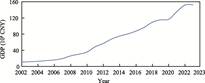
the GDP of Zhushan County has increased steadily from
1.084 billion CNY in 2002 to 15.24 billion CNY in 2023 (Figure 10). As a key
economic crop of Zhushan County, Zhushan
tea has played a significant role in driving the county’s economic development.
Since the late 1990s, Zhushan County has identified
tea as a leading agricultural specialty industry. Since 2017, large-scale tea
plantation development has been carried out, with an annual increase of about 666.67 ha of tea plantations. By the end of
2024, according to statistics from the Zhushan County
Bureau of Agriculture and Rural Affairs, nearly all suitable areas in 220 out
of 242 villages across 16 townships in the county have been planted with tea.
The total area of tea plantations in Zhushan County
is nearly 200 km2, with an annual output of nearly 20,000 t of dry
tea. The average price of dry tea is 60 CNY/kg, while the most premium
pre-Qingming Festival tea is priced at 900 CNY/kg. The comprehensive output
value of the tea industry has exceeded 7 billion CNY, accounting for more than
half of the county’s GDP, indicating that the tea industry has become the
largest and highest value-added competitive industry in Zhushan
County.
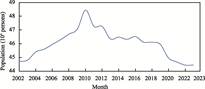
The registered population of Zhushan County showed an upward trend from 2002, peaked in
2010, and subsequently exhibited a downward trend. In recent years, this
downward trend has slowed (Figure 11). Currently, the county’s registered
population is 440,000, with a permanent population of 340,000. Tea plantations
cover 45,000 households in the county, and more than 200,000 people are closely
engaged in the tea industry chain, with an average annual income increase of
7,600 CNY per person derived from the tea industry.
|
|
|
|
Figure 10 Annual GDP change of
Zhushan County
|
Figure 11 Annual population change
of Zhushan County
|
6.2
Cultivation and Management
Traditionally tea
trees in Zhushan County are planted between
mid-to-late October to early-to-mid November or mid-to-late February. Improved tea
varieties were carefully selected to adapt to Zhushan
County’s climate among early, mid, and late-maturing types, to avoid of overly
overlapping of tea picking and processing. For young tea plantations, pruning
is conducted in March: the first topping pruning is performed at a height of 15
cm above the ground, and subsequent pruning is carried out annually with the
height increased by 10 cm. After 3 rounds of pruning, a high-yield tea canopy
is supposed to be achieved. Canopy renovation for mature tea plantations
includes minor pruning, deep pruning, heavy pruning, and stumping. Following
pruning, enhanced fertilizer and water management are implemented, along with
regular pruning and maintenance of the tea trees.
In terms of fertilization, through
the rational combination of base fertilizers and topdressings, ecological and
efficient fertilization technologies are promoted, such as intercropping ecological
manure, soil testing and formulated fertilization, integrated water and
fertilizer management, and partial replacement of chemical fertilizers with
organic fertilizers. Base fertilizers primarily consist of oil cake fertilizer,
cattle and sheep manure, and commercial organic fertilizers, with an
application rate at over 4,500 kg/ha, supplemented by 600 kg of special tea
fertilizer per ha.
In terms of weeding and pest
control, Zhushan County adheres to the principle of
“prevention first, control comprehensively”, based on ecological prevention and
control as well as ecological regulation. Priority is given to agricultural
practices, physical control, and biological control measures, reducing the use
of chemical pesticides to 0. Measures such as inter-row mulching, weed
suppression using native weeds, and mechanical mowing are adopted to control
weed growth. The occurrence of pests and diseases is closely monitored, with a
focus on the ecological control of major pests and diseases such as tea green
leafhoppers, tea geometrids, mites, and tea cake disease. Lime-sulfur mixture
is used for winter disinfection of tea plantations to ensure a safe and
environment-friendly tea products.
In terms of tea plantation
management, efforts are made to promote emission reduction and carbon
sequestration in tea plantations. Practices such as mulching inter-rows with
tea straw and pruning waste are advocated to enhance the soil water retention
capacity. Roads within the plantation areas are centered on tea processing
sections, connecting to tea plots in various locations to facilitate
transportation, mechanical access, and tea plantation management activities
such as picking and fertilization. The integration of agricultural machinery
and agronomic techniques is strengthened, with the selection of appropriate
machinery for tea plantation operations. Mechanized production technologies,
such as mechanical pruning, picking, tillage, and pest control in tea
plantations, are promoted in accordance with local conditions. Mechanized
picking improves the efficiency of tea harvesting while minimizing energy
consumption as much as possible.
Zhushan tea
picking follows clear standards regarding picking time, picking parts, and
picking methods to ensure the quality of fresh tea leaves. Fresh leaf picking
is typically mainly in spring, while efforts are also made to utilize summer
and autumn tea resources to enhance overall benefits.
New tea is picked as “one bud and
one leaf”. The traditional picking method is manual harvesting. In recent
years, Zhushan County has vigorously promoted
mechanical tea picking. A single tea-picking machine can harvest 100 kg of
fresh tea leaves per hour, which is equivalent to the efficiency of 10 manual
workers. Through the introduction of high-efficiency tea-picking machines, the
picking of summer and autumn tea, once characterized by a low input-output
ratio when done manually, has now attracted greater attention from tea farmers,
increasing the income of tea plantation by 30,000 to 45,000 CNY per ha. When
picking fresh leaves, natural containers such as bamboo products are used as
much as possible to avoid the use of plastic products.
There are two processing modes for
picked fresh tea leaves. In mode one, tea farmers first send fresh leaves to
cooperatives (or bases) for initial processing. The processed leaves will then
be further processed by tea famers and become tea to be sold in the market by
tea farmers themselves. In mode two tea farmers sell the fresh leaves to the
enterprises or cooperative bases, where the fresh leaf will be processed and
sold in the market by the enterprises instead by farmers.
Processing procedures include
withering, sun-drying (for black tea), fixation, rolling, and roasting, all of
which adhere to strict technical standards to ensure the quality of color,
aroma, taste, shape of the tea. Food safety and quality control are emphasized
throughout the processing process to meet the demands of both domestic and
international markets. The equipment in tea processing factories is kept clean
and hygienic, and the entire production process is designed to prevent tea from
coming into contact with the ground. The process flow is optimized for
rationality and efficiency, emphasizing continuous and intelligent production,
with processing strictly carried out in accordance with standards.
6.3 Brand Value
Zhushan
County is located to the south of Wudang Mountain in
Shiyan City. Wudang Mountain, renowned as “the
unparalleled scenic spot since ancient times and the top fairy mountain in the
world”, is a well-known World Cultural Heritage site. In the early stage,
Shiyan City launched the “Wudang Dao Tea” brand,
aiming to infuse the tea with the cultural charm of Wudang
Mountain. However, while the “Dao Tea” label endowed the tea with profound
cultural attributes, it also alienated certain customer groups, resulting in not
ideal market performance. Since 2021, Shiyan City has made concerted efforts to
build the regional public brand of “Wudang Mountain
Tea”. Compared with “Wudang Dao Tea”, “Wudang Mountain Tea” has broader inclusiveness, providing
greater development space for tea in Shiyan City, including Zhushan
tea, which belongs to the broader Wudang Mountain
region.
Within the total tea plantation area
of 56,567 ha in Shiyan City, Zhushan County accounts
for nearly 20,000 ha, making it a key tea-producing county in Shiyan City. To
better protect the regional brand, guarantee the sustainable development of
regionally branded tea, and implement the vision of “Wudang
Mountain Tea originates from fragrant Zhushan, and
high-quality Zhushan tea is enjoyed worldwide”, Zhushan County has established a range of county-level
public brand under Wudang Mountain Tea represented
by “Zhushan Selenium Tea”, “Shengsui
Green Tea”, and “Zhushan Black Tea”. It developed a
series products including “Shixing Black Tea”, “Shengshui No.1”, “Zhujingya” and
“Youhua Tea with Orchid Fragrance”. These products
cover multiple categories, including green tea, black tea, dark tea, white tea,
yellow tea, scented tea, tea beverages and tea wine. The local Hubei provincial
standard for “Shengsui Maojian”
has been approved, and “Shengsui Green Tea” has been
recognized as a National Agro-product Geographical Indications by the Ministry
of Agriculture of China. Zhushan tea products have
obtained multiple quality certifications, such as the ISO9001 Quality
Management System, QS Food Quality and Safety, and OTRDC Organic Tea, ensuring
that the products meet both national and international standards.
In December 2024, Zhushan
County issued the Ten policies for supporting the high-quality development of
the tea industry in Zhushan County and the
Implementation plan for the high-quality development of the tea industry in Zhushan County, aiming to guide the high-quality
development of the Zhushan tea industry with high
standards. Efforts are being made to shift from “scattered distribution” to
“concentrated and contiguous” development of tea plantations, and to transform
the growth model from “traditional extensive” to “modern intensive”, so as to
improve the quality and efficiency of the tea industry and drive the long-term
income growth of tea farmers. Tea plantations were mainly planted and managed
by tea farmers. Currently through the “cooperative+base+farmer”
model, enterprises are organized to sign price guarantee agreements with
farmers, ensuring that all fresh leaves picked by farmers are purchased. Led by
leading enterprises, the tea industry drives tea farmers to increase their
income and achieve prosperity, promotes the development of the tea industry,
and meets the needs of consumers in different regions. To promote the brand and
popularization of Zhushan tea, members of this case
study, including leaders from the Zhushan County government,
members from tea associations, scientists, and entrepreneurs, have participated
in numerous international and domestic conferences. Examples include the event “Water
from Shiyan Nourishes Beijing, Premium Products Enter Thousands of Households: Zhushan Theme Day” held in Beijing on October 18, 2024, the
“GIES New Year Fair” held in Beijing on January 10, 2025, and the
“Beijing-Shiyan Counterpart Cooperation and 2025 Shiyan Advantageous Industry
Promotion Conference” held in Beijing on May 8, 2025. By integrating the
characteristics of tea with social development, brand building, and cultural
elements, Zhushan County promotes the development of
tourism, optimizes the agricultural structure, strengthens brand building, and
contributes to sustainable development and the dissemination of tea culture.
6.4 Culture Development
Through the
integration of tea and tourism, Zhushan County has
transformed its tea plantations into tourist attractions, attracting a large
number of tourists for sightseeing, tea-picking, and leisure activities.
Efforts are being made to upgrade the industrial system from a “single business
type” to the “integration of primary, secondary, and tertiary industries”, with
continuous efforts focused on the integration of tea and tourism. The county is
exploring an integrated development model of “tea plantation with cultural and
creative products, research, study, tours, health and wellness activitities”, helding the Wudang Mountain Tea Tourism and Culture Month for 3
consecutive sessions already, promoting a tea tourism brand of “Ten Miles of
Tea Fragrance · Encounter in Zhushan”, and injecting
new vitality into rural revitalization and the transformation and upgrading of
the tea industry. Zhushan County has launched the
annual “Top Ten Most Beautiful Tea Plantations” selection activity. In 2024,
tea plantations such as Shengsui Orgainc
Tea Demonstration Plantation in Desheng Town, Liujiashan Tourist Tea Plantation in Chengguan
Town, and Daquanshan Tea Garden in Shangyong Town were awarded the honor of “Top Ten Beautiful
Tea Plantations”, from which Daguan Mountain tea-growing zone affiliated with Hubei
Shengshui Tea Limited Company has been awarded as one
of the Top Ten Most Beautiful Tea Gardens and Top Ten Premium Tea Tourism
Routes in Hubei Province, and Liujiashan Village in Chengguan Town has been recognized as a National Beautiful
Leisure Village.
6.5 GIES Ground Station for Zhushan
Tea
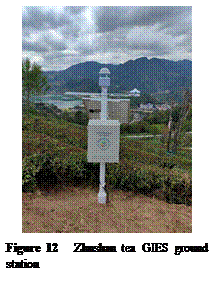 On September 15, 2024, IGSNRR, CAS established
an automatic ground habitat station for Zhushan tea’s
Geographical Indications Environment and Sustainability
(GIES) in
the Liujiashan Tea Garden of Zhushan
County (Figure 12). This station is used for real-time monitoring of various
location-based variables, including precipitation of 5 mm or more, total
radiation, air temperature, humidity, atmospheric pressure, wind speed, PM2.5, PM10,
atmospheric CO2 concentration, noise, and soil moisture and
temperature at depths of 20 cm and 40 cm below the surface. On September 16,
2024, officials from the Food and Agriculture Organization (FAO) of the United
Nations visited Zhushan County and attended the
International Capacity Building Workshop on GIES for Special Agricultural Products (SAPs) Shiyan Zhushan Session. The case study underwent a special
international review, and Zhushan tea received high
praise from international experts.
On September 15, 2024, IGSNRR, CAS established
an automatic ground habitat station for Zhushan tea’s
Geographical Indications Environment and Sustainability
(GIES) in
the Liujiashan Tea Garden of Zhushan
County (Figure 12). This station is used for real-time monitoring of various
location-based variables, including precipitation of 5 mm or more, total
radiation, air temperature, humidity, atmospheric pressure, wind speed, PM2.5, PM10,
atmospheric CO2 concentration, noise, and soil moisture and
temperature at depths of 20 cm and 40 cm below the surface. On September 16,
2024, officials from the Food and Agriculture Organization (FAO) of the United
Nations visited Zhushan County and attended the
International Capacity Building Workshop on GIES for Special Agricultural Products (SAPs) Shiyan Zhushan Session. The case study underwent a special
international review, and Zhushan tea received high
praise from international experts.
7 Discussion and Conclusion
Through this
case, it is clear that Zhushan tea owes its origin to
the suitable weather, beautiful mountains and clean water in Zhushan County. The natural endowments that nurture the
excellent characteristics of Zhushan tea can be
attributed to its northern subtropical features of Zhushan
County. It includes extensive low mountainous areas with gentle slopes (less
than 25°), abundant annual precipitation of nearly 1,000 mm, average annual
temperature of 16 °C, daily sunshine duration of less than 6 h except in July, and
the low total solar radiation in China with suitable diffuse radiation. These scientific
data acquired from this case study support the already high-quality development
of Zhushan tea and offers a new path for leveraging
technology to drive the high-quality development of the local economy.
The detailed data
from this study demonstrated the excellent characteristics of Zhushan tea, including high water extract content, high
soluble sugar content, high amino acid content, selenium enrichment, a unique
aroma, high tea polyphenol and catechin contents in Zhushan
green tea, and high theaflavin and relatively high theasinensins
contents in Zhushan black tea. In recent years, Zhushan County has vigorously promoted ecological and
low-carbon tea plantation technologies, with 20,000 ha of ecological tea
plantations covering 16 townships across the county, an annual output of 20,000
t of dry tea, and a comprehensive output value of 7 billion CNY. In particular,
through policy support and industrial guidance, impoverished households have
been assisted in escaping poverty by engaging in tea planting, and the tea
industry in Zhushan County is closely integrated with
poverty alleviation efforts. The development of the tea industry has driven the
value addition of related industrial chains, including tea processing,
packaging, logistics, and sales. It has also provided a large number of
employment opportunities for local residents, with over 300 tea-related
business entities in the county. Many impoverished households have increased
their family income and improved their living conditions by participating in
tea planting, processing, and sales. A total of 45,000 households had increased
their income through the tea economy, and those who have escaped poverty have
secured a stable source of income from the tea industry. Zhushan
tea has driven the local people toward prosperity, is deeply loved by customers,
and has won numerous national and provincial honors. The tea industry has thus
become a key means for Zhushan County to transform
its “lucid waters and lush mountains” into “mountains of gold and silver”.
Author Contributions
Liu, S. X. was responsible for the
overall design of the study, conducting investigations, sampling, data
collation, and manuscript writing. Fan, Q. provided overall guidance. Li, Y. Y.
offered guidance on tea-related expertise. Ren, T. S. offered guidance on the
analysis of the soil data. Zhang, X. F. offered guidance on the analysis of tea
garden management. Meng, D. created the spatial maps. Yao, T. T. collected and
processed soil and water samples. Yang, L. H. was responsible for the
development and installation of the GIES ground station. Xiong, Y. B., Ding, G.,
Zhou, Z. M., Gao, X. S. and Chen, B. Q. coordinated the investigations and
supported data collection. Yang, D. M., Wang, X. M., Zhang, Y. Y. and Li, J. Y.
were responsible for investigations, sampling, and data collection. The other
authors participated in data collection. All authors contributed to the
discussion of the manuscript.
Acknowledgements
The authors
sincerely thank Professor Liu, C., Professor Song, X. F., and Professor Wang, Z.
B. for providing technical guidance on the Zhushan
case study. Appreciation also extends to Zhang, J. L. of Shiyan City Government
for supporting the field research, and to the Zhushan
County Government, Zhushan Hydrological Station, Zhushan Meteorological Bureau, and Shiyan Ecological
Environment Bureau Zhushan Branch for providing
relevant data and materials.
Conflicts of Interest
The authors
declare no conflicts of interest.
References
[1]
Liu, S.
X., Fan, Q., Li, Y. Y., et al. GIES case dataset on Zhushan
tea from northern subtropical low and middle mountains [J/DB/OL]. Digital
Journal of Global Change Data Repository, 2025. https://doi.org/ 10.3974/geodb.2025.04.06.V1.
[2]
GCdataPR Editorial Office. GCdataPR
data sharing policy [OL]. https://doi.org/10.3974/dp.policy.2014.05 (Updated
2017).
[3]
Zhou,
Y. L., Wu, X. C., Ju, W. M., et al. Modeling the effects of global and
diffuse radiation on terrestrial gross primary productivity in China based on a
two-leaf light use efficiency model [J]. Remote Sensing, 2020, 12(20):
3355.
[4]
Zhushan County Local Chronicles Compilation Committee. Annals
of Zhushan County [M]. Beijing: Fangzhi
Press, 2002: 868.
[5]
Zhushan County Soil Survey Office. Soil records of Zhushan County (No. 56 of the Second National Soil Survey
Data of Hubei Province) [M]. Zhushan: Zhushan County Soil Survey Office, 1985.
[6]
Ministry
of Ecology and Environment of P. R. China, State Administration for Market
Regulation. Soil environmental quality risk control standard for soil
contamination of agricultural land (Trial) (GB 15618—2018) [S]. Beijing: China
Environment Publishing Group, 2018.
[7]
Du,
X., Yang, X., Xu, P., et al. Research on the selenium-enrichment
potential of surface soil in Shiyan City, Hubei Province [J]. Resources,
Environment and Engineering, 2023, 37(3): 281–291.
[8]
Yan, J. L., Yang, J., Ding, X. Y., et al. Study on
the background value of selenium in soils of Hubei Province [J]. Modern Agricultural Science and
Technology, 2016(21): 157.
[9]
State
Environmental Protection Administration, General Administration of Quality
Supervision, Inspection and Quarantine of the P. R. China. Environmental
quality standards for surface water (GB 3838—2002) [S]. Beijing: China
Environmental Science Press, 2002.
[10] State Administration for Market Regulation,
National Standardization Administration. Standards for drinking water quality
(GB 5749—2022) [S]. Beijing: Standards Press of China, 2022.
[11] National Health Commission of P. R. China, State
Administration for Market Regulation. National food safety standard—drinking
natural mineral water (GB 8537—2018) [S]. Beijing: Standards Press of China,
2018.
[12] Ding, G., Li, C. L.,
Li, X. X., et al. Analysis of aroma components in Shengshui
tea from Zhushan County [J]. Hubei Agricultural Sciences, 2015,
54(10): 2404–2407.
[13] General Administration of Quality
Supervision, Inspection and Quarantine of P. R. China, National Standardization
Administration. Green tea–part 1: basic requirements (GB/T 14456.1—2017) [S].
Beijing: Standards Press of China, 2017.
[14] Cai, X., Li, Y. S., Yang, P. X., et al.
Taste characteristic and application prospect of theanine [J]. Bulletin of
Sericulture and Tea, 2017, (6): 31–33.
[15] Liu, X. L. Research progress on
carbohydrates in tea [J]. Fujian Tea, 2004(3): 27–28.
[16] General Administration of Quality
Supervision, Inspection and Quarantine of P. R. China, National Standardization
Administration. Black tea–part 2: gongfu black tea
(GB/T 13738.2—2017) [S]. Beijing: Standards Press of China, 2017.
[17] Fan, J., Wang, Q. S., Qin, D. D., et al.
Research progress on the quality of black tea and its related biochemical
factors [J]. Food Science, 2020, 41(3): 246–253.
[18] Xu, B., Xue, J. J, Jiang, H. Y., et al.
Research progress on theasinensins in tea [J]. Journal of Tea Science, 2014,
34(4): 315–323.
[19] Hashimoto, F., Nonaka, G., Nishioka, I.
Tannins and related compounds. CXIV. Structures of novel fermentation products,
theogallinin, theaflavonin
and desgalloyl theaflavonin
from black tea, and changes of tea leaf polyphenols during fermentation [J]. Chem
Pharm Bull, 1992, 40(6): 1383–1389.
[20] General Administration of Quality
Supervision, Inspection and Quarantine of P. R. China, National Standardization
Administration. Tea–sampling (GB/T 8302—2013) [S]. Beijing: Standards Press of
China, 2014.
[21] National Health Commission of P. R. China,
Ministry of Agriculture and Rural Affairs of P. R. China, State Administration
for Market Regulation. National food safety standard—maximum residue limits for
pesticides in food (GB 2763—2021) [S]. Beijing: China Agricultural Press, 2021.
[22] National Health Commission of P. R. China,
Ministry of Agriculture and Rural Affairs of P. R. China, State Administration
for Market Regulation. National food safety standard—maximum residue limits for
112 pesticides in food (GB 2763.1—2022) [S]. Beijing: China Agriculture Press,
2023.