YANG Xiaohui1,2 KONG Ruixuan1,2 CHEN Manyi3 JIANG Dong1,2 ZHU He1,2* LIU Huaxian1,2
1. Institute
of Geographic Sciences and Natural Resources Research, Chinese Academy of
Sciences, Beijing 100101, China;
2. College of Resources and Environment, University
of Chinese Academy of Sciences, Beijing 100049, China;
3. School of Public Administration, Central South
University, Changsha 410083, China
Abstract:
The construction of cultural ecological protection zones is a core
approach to the holistic regional protection of intangible cultural heritage
(ICH) and also represents an innovative initiative in China’s ICH safeguarding
efforts. Since 2007, China has established 23 national cultural ecological protection
(experimental) zones (CEPZs), while provinces, autonomous regions, and municipalities have promoted
the establishment of 253 provincial CEPZs with distinctive
characteristics. Based on official announcements released by the Ministry of
Culture and Tourism and cultural and tourism departments of provinces, autonomous
regions, and municipalities, this study conducts statistical compilation and
sorting, obtains lists and related attribute information of national and
provincial CEPZs,
and adds specific geographic coordinates for each zone to generate vector data,
thereby constructing the Spatial dataset of cultural ecological protection zones
in China. The dataset includes: (1) the list and geo-location of national-level
CEPZs, and the information covers the name, scope, and approval time of the
CEPZs; (2) the list and geo-location of provincial-level CEPZs, and the
information covers the province, name, establishment time and scope; (3)
statistics of the number of national-level and provincial-level CEPZs in China
by province; (4) statistics of the number of national-level and
provincial-level CEPZs by year of establishment. The dataset is archived in
.shp and .xlsx formats, comprising 17 data files, totaling size of 2.67 MB
(compressed into a single file, 1.61 MB).
Keywords: cultural ecological protection zone;
spatial distribution; China; intangible cultural heritage
DOI: https://doi.org/10.3974/geodp.2026.04.07
Dataset Availability Statement:
The dataset supporting this paper
was published and is accessible through the Digital Journal of Global Change Data Repository
at: https://doi.org/10.3974/geodb.2025.11.08.V1.
1 Introduction
Intangible
cultural heritage (hereinafter referred to as “ICH”) is the most dynamic and
important component of cultural diversity, and represents the crystallization
of human civilization and a valuable shared heritage of humanity[1].
China’s ICH is rich and diverse, serving as a vivid testament to more than
5,000 years of continuous Chinese civilization, a key component of outstanding
traditional Chinese culture, and a precious spiritual treasure of all ethnic
groups. The knowledge and wisdom embedded within it regulate the production and
lifestyles of people, shape value orientations, and function as a cohesive
force for maintaining ethnic unity and promoting integrated and harmonious
cultural development.
Cultural ecological
protection zones take ICH safeguarding as the core objective and emphasize
“holistic and place-based” protection practices within specific regions.
Compared with protection approaches targeting individual heritage items, this
model pays greater attention to the coupling among cultural heritage, the natural
environment, and community production and life, advocating coordinated
development of cultural inheritance, the ecological environment, and social
progress at a regional scale, thereby forming a sustainable protection and
utilization mechanism. Its fundamental characteristics include the coexistence
of processuality and openness, strong inter-element correlations, and prominent
spatial integrity[2]. Therefore, the establishment of cultural
ecological protection zones (CEPZs) not only deepens
China’s ICH protection concepts and practices but also provides locally
grounded experience for international heritage governance.
The theoretical
origin of CEPZs can be traced back to the concept of “cultural ecology”
proposed by Steward in 1955, which regards human culture as a dynamic system
interacting with the natural environment and emphasizes the relationship
between cultural adaptation and ecological balance[3], providing an
analytical framework for understanding the formation mechanisms of regional
cultural characteristics. CEPZs are demarcated by administrative boundaries
while possessing multiple identity attributes centered on culture[4].
Their construction runs through people’s production and daily life practices,
reflecting the cultural logic of ICH protection from regional holistic
protection to the building of a Chinese national community[5],
highlighting the “embedded development” in the process of development and
protection[6]. It is both a process of improving the quality of life
of people of all ethnic groups through various forms of ICH practices[5]
and an important pathway for regional sustainable development.
In 2007, the Minnan
Cultural Ecological Protection Experimental Zone was approved for establishment
at the national level, marking the initiation of cultural ecological protection
(experimental) zone construction in China. As of December 2024, 16 national
cultural ecological protection zones and 7 national cultural ecological
protection experimental zones (a total of 23) have been established at the
national level, covering 17 provinces; at the provincial level, a cumulative
total of 253 provincial cultural ecological protection (experimental) zones
have been established. The Measures for the administration of national CEPZs
define them as specific areas established with the approval of the Ministry of
Culture and Tourism, with ICH protection as the core, implementing holistic
protection of culturally significant and distinctive cultural forms[7].
The measures emphasize principles such as prioritizing protection, holistic
protection, and “seeing people, seeing objects, and seeing life”, and stipulate
that applications for national cultural ecological protection experimental
zones must be based on at least two years of regional holistic protection
practice at the provincial level. This indicates that provincial-level
construction forms an important foundation for national-level construction.
CEPZs, as
important geographical units for cultural ecological protection and key
instruments for the holistic regional protection of ICH, are still at an early
stage of research. Existing studies are mostly grounded in anthropology,
folklore, and sociology, while research from a geographical perspective remains
relatively underdeveloped. Therefore, this study systematically reviews
relevant announcements and official documents issued by the Ministry of Culture
and Tourism, as well as cultural and tourism departments of provinces, autonomous
regions, and municipalities, and compiles and constructs a dataset of cultural
ecological protection (experimental) zones in China. From a spatial
perspective, this study establishes the basic framework for CEPZs, aiming to
provide fundamental data resources and research support for related studies.
2 Metadata
of the Dataset
The metadata of the Spatial dataset of
cultural ecological protection zones in China[8], including the
dataset name, authors, geographic region, year of the dataset, data format,
data size, data files, data publisher, are summarized in Table 1.
Table
1 Metadata
summary of the Spatial dataset of cultural ecological protection zones in China
|
Items
|
Description
|
|
Dataset full name
|
Spatial dataset of cultural ecological
protection zones in China
|
|
Dataset short name
|
CEPZs_China
|
|
Authors
|
Yang, X. H., Institute of Geographic Sciences and
Natural Resources Research, Chinese Academy of Sciences, yangxiaohui4720@igsnrr.ac.cn
Kong, R. X., Institute of Geographic Sciences and Natural Resources Research,
Chinese Academy of Sciences, kongruixuan2024@163.com
Chen, M. Y., Central South University, goodseer@outlook.com
Jiang, D., Institute of Geographic Sciences and Natural Resources Research, Chinese
Academy of Sciences, jiangd@igsnrr. ac.cn
Zhu, H., Institute of Geographic Sciences and Natural
Resources Research, Chinese Academy of Sciences, zhuhe@igsnrr.ac.cn
Liu, H. X., Institute of Geographic Sciences and Natural Resources Research, Chinese Academy
of Sciences, liuhx.16b@igsnrr.ac.cn
|
|
Geographic region
|
China (data for Hong Kong, Macau, and
Taiwan not available)
|
|
Year
|
2006–2024
|
|
Data format
|
.xlsx, .shp
|
|
Data size
|
2.67 MB
|
|
Data files
|
Spatial distribution and related information of
national and provincial cultural ecological protection (experimental) zones;
statistical data by province and by year
|
|
Foundations
|
Xinjiang Science and Technology Department
(2022A03002); National Natural Science Foundation of China (42271248,
42571289)
|
|
Data Publisher
|
Global Change
Research Data Publishing & Repository System, http://www.geodoi.ac.cn
|
|
Address
|
No. 11, Datun Road,
Chaoyang District, Beijing 100101, China
|
|
Data sharing policy
|
(1) Data are openly available and can be free
downloaded via the Internet; (2) End users are encouraged to use Data
subject to citation; (3) Users, who are by definition also value-added
service providers, are welcome to redistribute Data subject to written
permission from the GCdataPR Editorial Office and the issuance of a Data
redistribution license; and (4) If Data are used to compile new
datasets, the “ten percent principle” should be followed such that Data
records utilized should not surpass 10% of the new dataset contents, while
sources should be clearly noted in suitable places in the new dataset[9]
|
|
Communication and
searchable system
|
DOI, CSTR, Crossref, DCI, CSCD, CNKI, SciEngine, WDS,
GEOSS, PubScholar, CKRSC, OARL
|
3 Methods
According to the Measures
for the administration of national CEPZs,
national cultural ecological protection experimental zones are required to
formulate a master plan and submit an application for acceptance after 3 years
of implementation of the plan. Experimental zones that pass the acceptance are
designated as national cultural ecological protection zones and are officially
granted plaques. According to the terminology used in relevant policy
documents, these zones are uniformly referred to as “national cultural
ecological protection (experimental) zones”. The national cultural ecological
protection (experimental) zones included in this study cover all 23 zones
established since the approval of the first national cultural ecological
protection (experimental) zone in 2007.
At the
provincial level, due to significant differences in establishment principles
and standards across provinces—for example, in Yunnan Province, provincial
cultural ecological protection zones are established with village-level
administrative units as the core, whereas in Hebei Province they are based on
county-level administrative units—and due to variations in naming conventions
among provinces, this dataset uniformly adopts the term “provincial cultural
ecological protection (experimental) zones”. It includes a total of 253
provincial cultural ecological protection (experimental) zones established
since 2006, when the Government of Yunnan Province approved the establishment
of ethnic traditional cultural protection zones, up to December 2024 (excluding
Hong Kong, Macao, and Taiwan due to lack of data). The dataset records detailed
information, including the name, announcement time, and location of each
cultural ecological protection zone and experimental zone.
The data
required for this study mainly include basic geographic information and data on
national and provincial cultural ecological protection (experimental) zones.
The basic geographic information data consists primarily of vector data of
administrative divisions at all levels across the country, sourced from the
National Platform for Common Geospatial Information Services. Data on
national and provincial cultural ecological protection (experimental) zones
were obtained from official lists published by the Ministry of Culture and
Tourism and cultural and tourism departments of provinces (excluding Hong Kong,
Macao, and Taiwan)[10–48]. The authors compiled and organized
summary lists of national and provincial cultural ecological protection
(experimental) zones and improved the associated attribute information (such as
scope and approval time). The administrative divisions to which each zone
belongs were determined by the name of the cultural- ecological protection
(experimental) zone, the applying region, or the applying institution.
Meanwhile, with reference to government websites, information released by
cultural and tourism departments, and resources such as the Encyclopedia of China, the spatial scope
of national and provincial cultural ecological protection (experimental) zones
was further specified to municipal, county, township, and, in some cases,
village-level units. Geographic coordinates for each protection zone were
determined and integrated with vector data from the National Platform for
Common Geospatial Information Services, thereby developing the spatial
distribution dataset of CEPZs in China. The administrative divisions used
follow the standard administrative division data of China, GS (2024) 0650.
4.1
Dataset Composition
The dataset in this study is
divided into 2 parts: national cultural ecological protection (experimental)
zone data and provincial cultural ecological protection (experimental) zone
data. Specifically, it includes: (1) the list and geo-location of
national-level CEPZs, and the information covers the name, scope, and approval
time of the CEPZs; (2) the list and geo-location of provincial-level CEPZs, and
the information covers the province, name, establishment time and scope; (3)
statistics of the number of national-level and provincial- level CEPZs in China
by province; (4) statistics of the number of national-level and
provincial-level CEPZs by year of establishment.
4.2 Data Results Analysis
From
the perspective of provincial distribution, Qinghai Province boasts the highest
number of national cultural ecological protection (experimental) zones, with 3
currently, followed by Jiangxi, Fujian, Yunnan, and Henan Provinces, each with 2.
In terms of coverage area, Qinghai Province ranks first for national-level
cultural ecological protection (experimental) zones, with a total area of
297,248.16 km2 for its three zones, followed by Shaanxi Province
with 86,128.13 km2. Regarding the number of provincial cultural
ecological protection (experimental) zones, Yunnan Province has the largest
number, with 85 zones, followed by Shandong, Inner Mongolia, and Hubei, with 17,
13, and 13 zones, respectively. Provinces such as Hainan and Shaanxi have
relatively few, with only one each. For provincial-level cultural ecological
protection (experimental) zones, Inner Mongolia has the largest coverage area,
at 481,692.16 km2, followed by Xizang, Qinghai, and Ningxia, with
361,119.50 km2, 321,586.22 km2, and 316,865.44 km2,
respectively. These differences in quantity, to some extent reflect variations
among provinces in the level of emphasis on ICH protection, the richness of cultural resources, and regional cultural
characteristics (Table 2, 3).
Table 2 Statistics
of the number of CEPZs in China by province
|
Province
|
Number
|
Province
|
Number
|
Province
|
Number
|
|
National
|
Provincial
|
National
|
Provincial
|
National
|
Provincial
|
|
Yunnan
|
2
|
85
|
Heilongjiang
|
0
|
6
|
Shanxi
|
1
|
3
|
|
Shandong
|
1
|
17
|
Sichuan
|
0
|
6
|
Fujian
|
2
|
3
|
|
Inner Mongolia
|
0
|
13
|
Henan
|
2
|
6
|
Jiangxi
|
2
|
3
|
|
Hubei
|
1
|
13
|
Ningxia
|
0
|
5
|
Liaoning
|
0
|
2
|
|
Jiangsu
|
0
|
12
|
Qinghai
|
3
|
5
|
Jilin
|
0
|
2
|
|
Zhejiang
|
1
|
11
|
Xinjiang
|
0
|
5
|
Xizang
|
0
|
2
|
|
Hebei
|
0
|
11
|
Chongqing
|
1
|
4
|
Hainan
|
0
|
1
|
|
Guangdong
|
1
|
9
|
Hunan
|
1
|
4
|
Shaanxi
|
1
|
1
|
|
Guangxi
|
1
|
8
|
Anhui
|
0
|
4
|
Cross-provincial protection zones
|
2
|
0
|
|
Gansu
|
0
|
8
|
Guizhou
|
1
|
4
|
|
|
|
Table
3 Statistics
of the area of CEPZs in China by province
|
Province
|
Area (km2)
|
Province
|
Area (km2)
|
Province
|
Area (km2)
|
|
National
|
Provincial
|
National
|
Provincial
|
National
|
Provincial
|
|
Inner Mongolia
|
0
|
481,692.16
|
Hunan
|
15,477.49
|
48,863.06
|
Zhejiang
|
1,139.76
|
21,806.78
|
|
Xizang
|
0
|
361,119.50
|
Xinjiang
|
0
|
47,996.49
|
Guangdong
|
15,829.12
|
19,180.71
|
|
Qinghai
|
297,248.16
|
321,586.22
|
Shandong
|
15,761.66
|
43,428.18
|
Hebei
|
0
|
18,940.97
|
|
Ningxia
|
0
|
316,865.44
|
Anhui
|
10,787.90
|
42,769.34
|
Yunnan
|
51,522.42
|
17,747.61
|
|
Sichuan
|
33,805.73
|
236,687.23
|
Shaanxi
|
86,128.13
|
41,236.71
|
Shanxi
|
24,674.56
|
13,734.35
|
|
Gansu
|
0
|
148,411.71
|
Hubei
|
29,925.20
|
38,316.46
|
Henan
|
15,955.10
|
10,292.21
|
|
Heilongjiang
|
0
|
147,552.36
|
Fujian
|
44,437.52
|
33,529.33
|
Hainan
|
0
|
9,378.29
|
|
Guangxi
|
33,538.69
|
124,396.13
|
Jiangxi
|
44,686.87
|
32,250.89
|
Chongqing
|
19,796.28
|
8,110.82
|
|
Guizhou
|
30,294.67
|
71,131.12
|
Liaoning
|
0
|
30,976.19
|
|
|
|
|
Jilin
|
0
|
49,265.33
|
Jiangsu
|
0
|
23,254.48
|
|
|
|
From a spatial perspective, based on
China’s division into 7 major geographical regions, Southwest China has a
relatively large number of both national and provincial cultural ecological
protection (experimental) zones. In contrast, Northeast and Northwest China
have relatively fewer zones, both number and spatial density. National cultural-
ecological protection (experimental) zones are distributed across 17 provinces
and exhibit both clustering and dispersion nationwide, spanning all three
topographic steps (Figure 1). Provincial cultural-ecological protection
(experimental) zones also show an uneven distribution: provinces such as Yunnan
and Shandong have more zones, and those in Shanxi and Henan have fewer, more
dispersed zones. This pattern is closely related to factors such as local
historical culture, natural environment, and level of economic development
(Figure 2).
The distribution
patterns of cultural ecological protection (experimental) zones reflect the
spatial characteristics of regional cultural forms. Historically, the origin,
inheritance, and development of traditional and local cultures have been
influenced by multiple factors. Among these, topographic conditions have had a
significant impact on the formation of traditional local cultures. For example,
the plains of the middle and lower reaches of the Yangtze River and the Yellow
River basin benefited from favorable agricultural conditions, leading to the
early emergence of cultural forms. This is reflected in the spatial
distribution of cultural ecological protection (experimental) zones, with a
relatively large number in provinces such as Shandong, Hubei, and the Jiangsu-Zhejiang
region. Similarly, regions such as Huizhou, surrounded by mountains and
historically characterized by low transportation accessibility, have preserved
and transmitted their cultural traditions more effectively[49]. In
contemporary times, the factors influencing cultural inheritance and
distribution have increased, and their relative importance has also changed.
Scholars such as ZENG Mengyu and ZHANG Xuemei[50] have summarized
that the spatial distribution of cultural heritage and traditional culture is
influenced by economic development, urbanization processes, transportation
accessibility, cultural integration, and institutional policies. Taking the
Qiandongnan National Cultural Ecological Protection Zone as an example, the
economy, as a fundamental factor, shapes the survival environment of culture,
while modern industrial development and urbanization also affect its original
ecological and cultural inheritance systems. Meanwhile, cultural integration
can lead to the accumulation and evolution of traditional cultures in certain
regions, resulting in different forms of expression of ICH items in the
peripheral or marginal areas within cultural ecological protection zones.
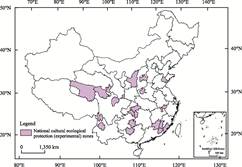
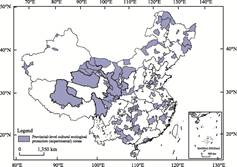
|
Figure 1 Distribution map of national-level CEPZs
|
Figure
2 Distribution map of provincial-level CEPZs
|
This study analyzes the temporal changes
in the number of provincial and national cultural ecological protection
(experimental) zones. For those protection zones whose spatial scope has been
expanded after establishment, statistical calculations are conducted based on
their initial year of establishment, and the results are presented in Figure 3.
From the perspective of the approval and establishment timeline of national and
provincial cultural ecological protection (experimental) zones, since 2006 and
up to 2024, the number of cultural ecological protection (experimental) zones
in China has continuously increased. In
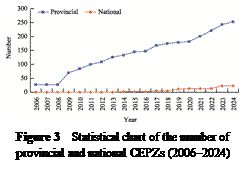 particular, during 2009 and
from 2020 to 2023, the number of newly established provincial cultural
ecological protection (experimental) zones increased significantly. By 2024, a
total of 253 provincial cultural ecological protection (experimental) zones had
been established. National cultural ecological protection (experimental) zones
showed a steady increase from 2014 to 2023, reaching 23 by 2024. This indicates
that in recent years, the level of attention paid to cultural ecological
protection in China has greatly increased, and the work of cultural ecological
protection has been progressively implemented, achieving a certain scale
nationwide.
particular, during 2009 and
from 2020 to 2023, the number of newly established provincial cultural
ecological protection (experimental) zones increased significantly. By 2024, a
total of 253 provincial cultural ecological protection (experimental) zones had
been established. National cultural ecological protection (experimental) zones
showed a steady increase from 2014 to 2023, reaching 23 by 2024. This indicates
that in recent years, the level of attention paid to cultural ecological
protection in China has greatly increased, and the work of cultural ecological
protection has been progressively implemented, achieving a certain scale
nationwide.
5 Conclusion
This
dataset compiles the lists of cultural ecological protection (experimental)
zones published by the Ministry of Culture and Tourism and provincial cultural
and tourism departments from 2006 to 2024, including a total of 276 entries,
consisting of 23 national cultural ecological protection (experimental) zones
and 253 provincial cultural ecological protection (experimental) zones. It
supplements detailed attribute information such as location, Chinese and
English names, spatial scope, and establishment time for these zones, and
systematically organizes the quantity and spatial distribution information of
cultural ecological protection (experimental) zones in China, thereby providing
important data support for research on cultural ecological protection at both
national and regional levels. Analysis of the dataset shows significant
regional differences in the spatial distribution of cultural-ecological
protection (experimental) zones in China. The southwest region has a relatively
large number, whereas the northeast and northwest regions have fewer,
reflecting the close relationship between cultural ecological protection
efforts and regional development levels and cultural resource endowments. From
a temporal perspective, the number of national and provincial cultural
ecological protection (experimental) zones has continued to increase,
indicating that China’s cultural ecological protection construction has developed
rapidly and achieved initial results. This dataset can be integrated with
datasets on intangible cultural heritage and local culture, providing a
fundamental reference for research in this field.
Author Contributions
Yang,
X. H. conducted the overall design of the dataset development; Kong, R. X. was
responsible for writing the data paper, revising the initial draft, and data
visualization; Chen, M. Y., Jiang, D., and Liu, H. X. were responsible for data
collection and organization; Zhu, H. conducted data visualization, carried out
the overall design of the dataset development, and contributed to the revision
of the initial draft.
Conflicts of Interest
The
authors declare no conflicts of interest.
References
[1]
Vecco, M. A definition of cultural heritage: from the
tangible to the intangible [J]. Journal of Cultural Heritage, 2010,
11(3): 321–324.
[2]
Huang, Y. L. Protection of intangible cultural heritage from
the perspective of “cultural ecology” [J]. Cultural Heritage, 2013(5):
1–12+157.
[3]
Helms, M. W. On Julian Steward and the nature of culture [J].
American Ethnologist, 1978, 5(1): 170–183.
[4]
Chu, G. S. Analysis of the current situation and future
trends of the construction of cultural ecological protection zones in China
[J]. Folklore Studies, 2021(3): 88–98.
[5]
Lin, J. F. Promoting the forging of a strong sense of
community for the Chinese nation through the construction of cultural
ecological protection zones [J]. Journal of Hubei Minzu University: Philosophy
and Social Sciences Edition, 2024, 42(1): 134–146.
[6]
Liu, L. Interembedded development pathways in the process of
common modernization in ethnic regions—from the perspective of culture-tourism
integration in cultural ecological protection zones [J]. Journal of North
Minzu University (Philosophy and Social Science), 2024(2): 59–66.
[7]
General Office of the Ministry of Culture and Tourism. Notice
on implementing the Measures for the administration of National Cultural
Ecological Protection Zones: Ban Feiyi Fa [2019] No. 47 [Z]. 2019.
https://www.gov.cn/zhengce/zhengceku/2019-09/25/content_5433100.htm.
[8]
Yang, X. H., Kong, R. X., Chen, M. Y., et al. Spatial
dataset of cultural ecological protection zones in China [J/DB/OL]. Digital
Journal of Global Change Data Repository, 2025. https://doi.org/10.
3974/geodb.2025.11.08.V1.
[9]
GCdataPR Editorial
Office. GCdataPR data sharing policy [OL].
https://doi.org/10.3974/dp.policy.2014.05 (Updated 2017).
[10]
Anyang Municipal Bureau of Culture, Radio, Television, Sports
and Tourism. Reply of the Anyang Municipal Bureau of Culture, Radio,
Television, Sports and Tourism to proposal No. 92 of the first session of the
15th Municipal People’s Congress [EB/OL]. (2023-06-01) [2025-11-20]. https://wgtlj.anyang.gov.cn/ 2023/06-01/2390328.html.
[11]
Department of Culture and Tourism of Anhui Province. Anqing
City establishes the first provincial cultural ecological protection zone in
the province [EB/OL]. (2020-8-21) [2025-11-20]. https://ct.ah.gov.cn/zwxw/
qswlxxlb/8453020.html.
[12]
Department of Culture and Tourism of Anhui Province. Public
notice on the inclusion of the Xuan Paper Cultural Ecological Protection Zone
in the list of Anhui provincial cultural ecological protection zones [EB/OL].
(2021-10-25) [2025-11-20]. https://ct.ah.gov.cn/zwxw/tzgg/8478261.html.
[13]
Department of Culture and Tourism of Anhui Province. Public
notice on the inclusion of the Bozhou Traditional Chinese Medicine Cultural Ecological
Protection Zone in the list of Anhui provincial cultural ecological protection
zones [EB/OL]. (2023-06-15) [2025-11-20]. https://ct.ah.gov.cn/zwxw/tzgg/8778061.
html.
[14]
Department of Culture and Tourism of Anhui Province. Public
notice on establishing the Chizhou Nuo Cultural Ecological Protection Zone as a
provincial cultural ecological protection zone [EB/OL]. (2024-12-20)
[2025-11-20]. https://ct.ah.gov.cn/zwxw/tzgg/80757770.html.
[15]
Dengfeng Municipal People’s Government. Dengfeng Songshan
area selected as Henan cultural ecological protection experimental zone
[EB/OL]. [2025-11-20]. https://www.dengfeng.gov.cn/mtbd/5534718.jhtml.
[16]
Fujian Provincial People’s Government. Reply of the Fujian
Provincial People’s Government on approving the establishment of the Meizhou
Mazu Cultural Ecological Protection Experimental Zone [EB/OL]. (2010-11-09)
[2025-11-20]. https://www.fujian.gov.cn/zwgk/zxwj/szfwj/201011/t20101109_1465374.htm.
[17]
Department of Culture and Tourism of Fujian Province.
Announcement by the Department of Culture and Tourism of Fujian Province on two
provincial cultural ecological protection zones [EB/OL]. (2024-01-02)
[2025-11-20]. https://wlt.fujian.gov.cn/wldt/btdt/202401/t20240102_6370719.htm.
[18]
Guizhou Provincial People’s Government. Public announcement
of the proposed list of provincial cultural ecological protection zones by the
Department of Culture and Tourism [EB/OL]. (2022-12-07) [2025-11-20]. https://www.guizhou.gov.cn/zwgk/zdlygk/jjgzlfz/whly/fwzwhyc/202212/t20221207_77367385.html.
[19]
CRI Online, China Media Group. Weinan: the integration work
of cultural ecological protection zones across the city will be completed by
2025 [EB/OL]. (2023-09-15) [2025-11-20].
https://sn.cri.cn/2023-09-15/114eed0e-4582-6b82-8b81-7d59205a19ef.html.
[20]
Henan Provincial People’s Government.
Hebi: promoting tourism through culture and revitalizing culture through
tourism [EB/OL]. (2021-11-26) [2025-11-20].
https://www.henan.gov.cn/2021/11-26/2355865.html.
[21]
Department of Culture and Tourism of Jilin Province. Reply to
Proposal No. 209 of the third session of the 12th Provincial Committee of the
CPPCC [EB/OL]. (2020-06-02) [2025-11-20].
http://whhlyt.jl.gov.cn/zwgk/jytabl/202007/t20200702_7298051.html.
[22]
Department of Culture and Tourism of Jilin Province. Reply to
joint proposal No. L39 of the fifth session of the 12th Provincial Committee of
the CPPCC [EB/OL]. (2022-11-10) [2025-11-20].
http://whhlyt.jl.gov.cn/zwgk/jytabl/202211/t20221110_8625680.html.
[23]
Department of Culture and Tourism of
Hubei Province. List of provincial cultural ecological protectionzones in Hubei
Province [EB/OL]. (2021-11-03) [2025-11-20].
https://wlt.hubei.gov.cn/bsfw/bmcxfw/fwzwhyc/whstbhq/whstbhqsj/201911/t20191121_1363885.shtml.
[24]
Department of Culture and Tourism of
Hunan Province. Notice of the Department of Culture andTourism
of Hunan Province on publishing provincial cultural ecological protection
(experimental)zones [EB/OL]. (2018-11-16) [2025-11-20].
https://whhlyt.hunan.gov.cn/whhlyt/xxgk2019/xxgkml/tzgg/201811/t20181116_5379048.html.
[25]
Department of Culture and Tourism of Hunan Province. Public
notice on recommending Jiangyong Nvshu
Cultural Ecological Protection Zone as a provincial cultural ecological
protection experimentalzone [EB/OL]. (2024-10-14) [2025-11-20].
https://whhlyt.hunan.gov.cn/whhlyt/xxgk2019/xxgkml/tzgg/202410/t20241014_33474943.html.
[26]
Department of Culture and Tourism of Jiangsu Province. Notice
on publishing the list of the fifth batch of Jiangsu provincial cultural
ecological protection experimental zones [EB/OL]. (2023-11-21) [2025-11-20]. https://wlt.jiangsu.gov.cn/art/2023/11/21/art_699_11077356.html.
[27]
Jiangxi Provincial People’s Government. Relevant government
affairs information [EB/OL]. (2015-03-22) [2025-11-20].
https://www.jiangxi.gov.cn/art/2015/3/22/art_399_197353.html.
[28]
Wen County People’s Government. Taiji Culture (Wen County)
Ecological Protection Zone [EB/OL].(2022-07-20) [2025-11-20].
http://www.wenxian.gov.cn/sitesources/wxdzw/page_pc/xwzx/gzdt/article6f75c595a272456dab35f4aea6e7ff77.html.
[29]
Inner Mongolia Autonomous Region People’s Government. Notice
of the General Office of the People’s Government of Inner Mongolia Autonomous
Region on publishing the third batch of autonomous region-level cultural
ecological protection zones [EB/OL]. (2024-01-18) [2025-11-20].
https://www.nmg.gov.cn/zwgk/zfxxgk/zfxxgkml/zdly/sthj/wj/202012/t20201208_314798.html.
[30]
Information Center, Yunnan Provincial Ethnic and Religious
Affairs Commission. Yunnan comprehensively promotes the systematic protection
and inheritance of intangible cultural heritage [EB/OL]. (2022-06-13)
[2025-11-20]. https://mzzj.yn.gov.cn/html/2022/gongzuodongtai_0613/42980.html.
[31]
Qiannan Prefecture People’s Government. Cultural and
tourism-related work information [EB/OL]. (2024-03-13) [2025-11-20].
https://www.qiannan.gov.cn.
[32]
Qinghai Provincial People’s Government.
Establishment of Hehuang Culture (Xining) Ecological Protection Experimental
Zone [EB/OL]. (2023-08-22) [2025-11-20].
http://www.qinghai.gov.cn/zwgk/system/2023/08/22/030023727.shtml.
[33]
People’s Daily Overseas Edition Sichuan Channel. Sichuan
awards plaques to six provincial cultural ecological protection zones including
Kangba culture [EB/OL]. (2021-04-21) [2025-11-20].
https://www.sc.chinanews.com.cn/bwbd/2021-04-21/147106.html.
[34]
Sanmenxia Municipal Bureau of Culture, Radio, Television and
Tourism. Public data of the cultural, radio, television and tourism industry in
Sanmenxia [EB/OL]. (2024-04-29) [2025-11-20].
http://wglj.smx.gov.cn/29179/616750560/1547071.html.
[35]
Department of Culture and Tourism of Shandong Province.
Public announcement on the approval of the “Planning outline” of the Taishan
Cultural Ecological Protection Experimental Zone [EB/OL]. (2018-04-16)
[2025-11-20].
http://whhly.shandong.gov.cn/art/2018/4/16/art_100579_7257707.html?xxgkhide=1.
[36]
Department of Culture and Tourism of Shandong Province.
Notice of the Department of Culture and Tourism of Shandong Province on
publishing the list of provincial cultural ecological protection experimental
zones [EB/OL]. (2023-12-15) [2025-11-20]. http://whhly.shandong.gov.cn/art/2023/12/15/art_100579_10333278.html.
[37]
Huodian Ditu. Attention! Wuzhishan City expanded and included
in the Central and Southern Hainan Island Ethnic Minority Cultural Ecological
Protection Zone [EB/OL]. (2021-10-19) [2025-11-20].
https://www.sohu.com/a/495980786_121119246.
[38]
Sohu. Announcement of the Gansu Provincial Department of
Culture and Tourism on the proposed list of Gansu provincial cultural
ecological protection zones [EB/OL]. (2022-09-27) [2025-11-20].
https://www.sohu.com/a/589079057_121123783.
[39]
Sina News. List of four Xinjiang
autonomous region-level cultural ecological protection experimental zones announced
[EB/OL]. (2012-12-19) [2025-11-20].
https://news.sina.com.cn/c/2012-2-19/021925841974.shtml.
[40]
Xuexi Qiangguo. Protect and inherit outstanding ethnic
minority culture and solidly carry out ethnic work in the new era [EB/OL].
(2021-09-24) [2025-11-20]. https://dsxx.ynau.edu.cn/info/1038/1768.htm.
[41]
Department of Culture and Tourism of
Zhejiang Province. Public notice of the Department of Culture and Tourism of Zhejiang Province on the selected
list of Zhejiang Cultural Inheritance EcologicalProtection Zones
[EB/OL]. (2022-11-18) [2025-11-20].
https://ct.zj.gov.cn/art/2022/11/18/art_1229678763_5026940.html.
[42]
Chongqing Municipal People’s Government. The first batch of
municipal cultural ecological protection experimental zones announced:
Rongchang, Chongqing selected [EB/OL]. (2024-05-15) [2025-11-20].
https://www.cq.gov.cn/zwgk/zfxxgkml/zdlyxxgk/stbh/hjbh/202405/t20240515_13209271.html.
[43]
Department of Culture and Tourism of Qinghai Province.
Qinghai Province adds one new provincial cultural ecological protection
experimental zone [EB/OL]. (2022-09-27) [2025-11-20].
https://www.mct.gov.cn/whzx/qgwhxxlb/qh/202209/t20220926_936177.htm.
[44]
Department of Culture and Tourism of Guangdong Province.
Announcement of the first batch of provincial cultural ecological protection
zones [EB/OL]. (2023-07-24) [2025-11-20].
https://whly.gd.gov.cn/news_newzwhd/content/post_4223889.html.
[45]
Ministry of Culture and Tourism of China. Announcement of the
Ministry of Culture and Tourism on publishing the list of national cultural
ecological protection zones [EB/OL]. (2019-12-25) [2025-11-20].
https://www.gov.cn/xinwen/2019-12/30/content_5465038.htm.
[46]
Ministry of Culture and Tourism of China. Announcement of the
Ministry of Culture and Tourism on publishing the list of national cultural
ecological protection zones [EB/OL]. (2023-01-28) [2025-11-20].
https://www.gov.cn/zhengce/zhengceku/2023-02/01/content_5739516.htm.
[47]
Ministry of Culture and Tourism of China. Announcement of the
Ministry of Culture and Tourism on publishing the list of national cultural
ecological protection zones [EB/OL]. (2023-07-26) [2025-11-20].
https://www.gov.cn/zhengce/zhengceku/202307/content_6895373.htm.
[48]
Ministry of Culture and Tourism of China. Announcement of the
Ministry of Culture and Tourism on publishing the list of national cultural
ecological protection zones [EB/OL]. (2025-06-10) [2025-11-20].
https://zwgk.mct.gov.cn/zfxxgkml/fwzwhyc/202506/t20250612_960561.html.
[49]
Zhang, S. Discussion on regional protection strategies of
cultural ecology—a case study of the Huizhou Cultural Ecological Protection
Experimental Zone [J]. Journal of Tongji University (Social Science
Edition), 2009, 20(3): 27–35+48.
[50]
Zeng, M. Y., Zhang, X. M. Research on the coordinated
development of traditional villages and intangible cultural heritage—a case
study of the National Qiandongnan Ethnic Cultural Ecological Protection Zone
[J]. Journal of Minzu Normal University of Xingyi, 2025(1): 71–77.