GUO
Shihan1 ZHANG Yang1,2* HE Jianyu1 DU Yuxuan1 LI Wanjun1 ZHENG Xuanzhi1 MEN Yutong3 LIANG Zhanran1 WANG Yitao1 LI Minyi1
1. College of Geography and Planning,
Chengdu University of Technology, Chengdu 610059, China;
2. College of Architecture, Southeast
University, Nanjing 210096, China;
3. College of
Mechanical and Electrical Engineering, Chengdu University of Technology,
Chengdu 610059, China
Abstract: China’s 20th-century architectural
heritage is deeply rooted in the nation’s modern history. It carries rich
material and spiritual memories and holds multidimensional value in historical
testimony, cultural transmission, social
identity, and economic revitalization. To systematically examine the spatial
distribution characteristics and conservation status of such heritage, the
authors compiled a list of 1,000 China’s 20th-century architectural heritage
projects based on 10 batches of recommendations released by the China
20th-Century Architectural Heritage Committee between September 2016 and May
2025. Detailed information for each project was recorded, including its name,
historical period, and batch classification. Address details and geographic
coordinates were collected and verified individually using Google Earth. This
process resulted in the creation of a spatial distribution dataset covering
1,000 20th-century architectural heritage projects in China across 10 batches.
The dataset includes each heritage project’s name, construction period, batch, detailed address, and latitude-longitude
coordinates. It is archived in 2 formats (.shp vector
data and .xls spreadsheet data) to facilitate further
GIS-based spatial analysis and visualization. The dataset consists of 8 data
files with a total size of 3.70 MB (compressed into 1 file of 442 KB).
Keywords: 20th-century
architectural heritage; spatial distribution; China
DOI: https://doi.org/10.3974/geodp.2026.01.09
1 Introduction
Architectural heritage refers to buildings or building
complexes that possess integrated scientific, artistic, social, and historical
values and have survived to the present day[1]. It is also one of
the types of heritage most closely related to the human living environment[2].
The concept of “20th-century architectural heritage” was proposed in Europe in
1989[3]. It is defined by its temporal scope and encompasses
representative buildings produced during the 20th century. As witnesses to
urban evolution and material carriers of social production and lifestyles,
20th-century architectural heritage embodies multiple values, including socio- political,
historical, cultural, scientific-technological, and artistic-aesthetic
dimensions[4]. In China, such heritage is deeply rooted in the
nation’s modern history over the past century. It records major social
transformations since the Opium Wars and bears witness to the path of national
and ethnic revival[5]. Thus, its preservation and research are of
great significance.
In
2014, the China Cultural Relics Society and the Architectural Society of China
jointly established the China 20th-Century Architectural Heritage Committee
(hereinafter referred to as the Committee) and formulated the Criteria for
Identifying 20th-Century Architectural Heritage in China (hereinafter referred
to as the Criteria). Based on the Criteria, the Committee identified and
publicly announced 10 batches totaling 1,000 20th-century architectural
heritage projects between September 2016 and May 2025. This work not only
expands the conservation framework of China’s cultural heritage but also
promotes public attention to and revitalization of modern and contemporary
urban cultural memory[6]. It thus provides a foundational inventory
for related research.
However,
a review of existing scholarship reveals that research on 20th-century
architectural heritage has largely focused on micro-level aspects such as value
assessment, conservation strategies, and adaptive reuse of individual heritage
sites[7–9]. Systematic studies examining chronological formation and
spatial distribution remain insufficient[10]. This research gap is
partly due to a key data bottleneck: the collection and updating of geographic
location data for the numerous 20th-century architectural heritage projects
across China. Therefore, on the basis of the 10-batch recommendation list
released by the Committee, this study collected spatial point data for 1,000
projects and developed the Spatial distribution dataset of China’s ten batches
of 1,000 20th-century architectural heritage projects. This dataset includes
information such as the name, period, batch, detailed address, latitude and
longitude of each architectural heritage project. It provides essential data
support for research in heritage-related fields and facilitates the
conservation of urban and rural historical and cultural heritage.
2 Methods
2.1 Date Sources
The
data used in this study primarily consist of 2 parts: fundamental geographic
information data and the list of 10 batches of recommended China’s 20th-century
architectural heritage projects. The fundamental geographic information data
are vector data of administrative divisions at the provincial, municipal, and
county levels across China for 2024.
The list of recommended Chinese 20th-century architectural heritage projects is
sourced from relevant announcements issued by the China Cultural Relics Society
and the Architectural Society of China.
2.2 Methods
The
recommendation lists for each batch of China’s 20th-century architectural
heritage projects document the name and batch of each heritage item but do not
include geographic coordinates. Detailed addresses and precise geographic
coordinates of each project were obtained using the search function of Google
Earth, uniformly converted to the WGS84 coordinate system, and further
supplemented with attribute information such as the corresponding province,
city, and county-level administrative divisions. For heritage projects
comprising multiple buildings, the geographic location of the most
representative individual structure was typically selected. After integrating
the above information, a spatial distribution dataset for 1,000 China’s
20th-century architectural heritage projects across 10 batches was constructed.
The data were processed and integrated using ArcGIS 10.4.1 software, ultimately
enabling the spatial visualization of China’s 20th- century architectural
heritage projects.
2.3 Data Storage
The
geographic coordinate data of the heritage projects were integrated with
administrative division data to generate a .shp
format file. Attribute information such as name, period, batch, address,
longitude, and latitude was archived in .xls format.
Table 1 lists the field names and examples.
Table 1 Dataset attribute field table
|
Entry
|
Description
|
|
Serial
number
|
0, 1,
2, 3, …, 1,000
|
|
Building
name
|
The
Great Hall of the People, the former site of the National Central Museum, the
Gude Temple, …
|
|
Time
|
From
the Qing Dynasty to the Republic of China, from the 1930s to the 1940s, the
1960s, …
|
|
Address
|
No.
1, Wusi Avenue, Dongcheng
District, Beijing, ...
|
|
Batch
name
|
The
first batch, the second batch, the third batch, …
|
|
Provincial
region name
|
Hubei
Province, Shanghai City, Guangxi Zhuang Autonomous Region, …
|
|
Municipal
region name
|
Nanjing
City, Guangzhou City, Hohhot City, …
|
|
County
region name
|
Yuzhong District, Dingxiang County, Chengguan District, …
|
|
Longitude
|
106.29739,
116.41535, 121.51087, …
|
|
Latitude
|
22.79691,
34.78818, 45.73498, …
|
3 Data Results
3.1 Dataset Composition
The Spatial distribution dataset of China’s ten batches
of 1,000 20th-century architectural heritage projects consists of 2 parts: (1) attribute data of the China’s
20th-century architectural heritage projects, including name, period, batch,
administrative division, detailed address, and latitude-longitude coordinates
(.xls); (2) spatial vector data of the China’s
20th-century architectural heritage projects (.shp).
3.2 Data Results
The
20th-century architectural heritage projects were quantified according to 3
time periods: the Ming-Qing period, the
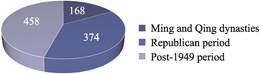
Republican era, and the post-1949 period (Figure 1). The number of architectural heritage projects from the
Ming-Qing period is relatively small,
totaling only 168 sites. This result may be attributed to the substantial loss
of buildings from that period because of prolonged historical changes. The
Republican era saw a slightly higher number of architectural heritage projects,
with 374 sites recorded. After 1949, the large-scale construction efforts left
a considerable number of 20th-century architectural heritage sites, amounting
to 458 in total.
|
Figure
1 Number
of 20th-century architectural heritage projects by decade
|
In
terms of spatial distribution, the 20th-century architectural heritage projects
are widely dispersed across the country, covering 31 provinces, autonomous
regions, and municipalities directly under the central government (Figure 2).
Among them, the top 10 provinces and municipalities by number of heritage
projects are Beijing, Guangdong, Shanghai, Jiangsu, Tianjin, Hubei, Zhejiang,
Shaanxi, Chongqing, and Liaoning (Figure 3). Beijing alone hosts 149 such
projects, accounting for 14.9% of the national total. By contrast, the Ningxia
Hui Autonomous Region has the fewest 20th-century architectural heritage
projects, with only 2 sites. Overall, the spatial distribution of these
heritage projects demonstrates a pronounced clustering pattern to the southeast
of the Hu Line, with the vast majority located in densely populated and
economically developed areas east of this line. Distribution to the northwest
is extremely sparse.
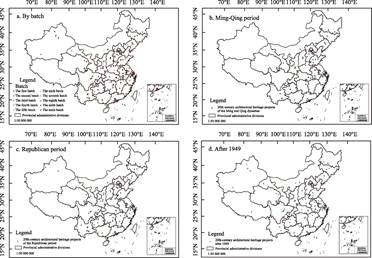
Figure 2 Distribution maps of 20th-century
architectural heritage projects in China
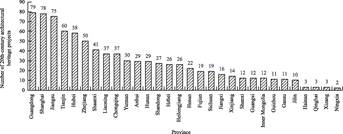
Figure 3 Statistics of 20th-century architectural
heritage projects by province
4 Discussion and Conclusion
Analyzing
and understanding the spatial distribution of China’s 20th-century
architectural heritage projects is important for advancing systematic research
and informing the formulation and optimization of conservation strategies for
historical and cultural heritage represented by such sites. To this end, the
authors compiled the 10-batch recommendation list of China’s 20th-century
architectural heritage projects published between 2016 and 2025, supplementing
it with additional information such as the historical period, address, and
geographic coordinates of each project, and developed the Spatial distribution
dataset of China’s ten batches of 1,000 20th-century architectural heritage
projects. Analysis of the construction periods and spatial distribution
characteristics of these heritage projects reveals 2 key patterns. First, a
large number of projects were constructed after the founding of the People’s
Republic of China. Second, these projects are relatively concentrated to the
southeast of the Hu Line. This dataset provides comprehensive attribute
information for the 10 batches of 20th-century architectural heritage projects
in China. It is intended to serve as essential data support for in-depth
research in fields such as heritage geography studies and conservation planning
practices.
Author Contributions
Zhang, Y. and Guo, S. H. contributed to the overall design of
the dataset development; He, J. Y., Du, Y. X., Li, W. J., Zheng, X. Z., Men, Y.
T., Liang, Z. R., Wang, Y. T., and Li, M. Y. collected and processed the data. Guo,
S. H. wrote the data paper, and Zhang, Y. reviewed the paper.
Conflicts of Interest
The
authors declare no conflicts of interest.
References
[1]
Zhu, X. S. Research on the
reuse model of architectural heritage under the background of urban renewal [J]. Urban Development, 2025(8): 51–53.
[2]
Pietrostefani, E., Holman, N. The politics of conservation planning: a comparative
study of urban heritage making in the Global North and the Global South [J]. Progress
in Planning, 2021(152): 100505.
[3]
European
Council. European Charter of the Architectural Heritage [Z]. 1975-10.
[4]
Shan, J. X. 20th
Century Heritage Conservation [M]. Tianjin: Tianjin University Press, 2015.
[5]
Gao, C. H. Chinese
Architectural Culture Yearbook 2012 [M]. Tianjin: Tianjin People’s Publishing
House, 2014: 243.
[6]
China 20th-Century Architectural Heritage Committee. Introduction to
20th-Century Architectural Heritage [M]. Beijing: Wuzhou Communication Publishing House, 2023.
[7]
Zhang, Z.
X., Fan, X. Post-evaluation of 20th-century architectural heritage based on
analytic hierarchy process: a case study of the Xinjiang People’s Theater
[J]. Urban Architecture, 2024, 21(20): 130–133.
[8]
Yan, B. S. Analysis of the
characteristics and value of the Chongqing Parachute Tower architectural
heritage [J]. Architecture
and Culture, 2023(4): 228–231. DOI: 10.19875/j.cnki.jzywh.2023.04.072.
[9]
Meng, Q. H.,
Lu, M. Evaluation of the heritage value of non-historical city communities from
the perspective of 20th-century architectural heritage: a case study of Hefei
[J]. Construction Economy, 2022, 43(S2): 499–503.
[10]
Liu, J. J.,
Liu, S. R., Ma, M. Q., et al. Characteristics and influencing factors of
the spatiotemporal distribution of China’s 20th-century architectural heritage
[J]. Southern Architecture, 2024(8): 88–97.