SHAO Xinyi LU Chengqi CHEN Xuan ZHENG Shanshan MA Renfeng*
School of Geography and Remote Sensing, Ningbo
University, Ningbo 315211, China
Abstract: WANG Yangming was the foremost synthesizer of the
School of Mind during the Ming Dynasty. His
philosophical legacy, centered on the “unity of knowledge and action”, provides
a vital link between traditional Chinese thought and modern practice. Drawing
on historical sources— including The Extended Chronicle of WANG
Yangming and relevant thematic databases—this study systematically constructs a
database of WANG Yangming’s life trajectories using the semantic framework of
the CIDOC Conceptual Reference Model (CIDOC CRM). His activities are classified
into 4 categories: official career events, military events, teaching events,
and life events. The dataset is intended to provide standardized data and a
methodological reference for research on the dissemination of Yangming Culture,
historical geography, and spatial digital humanities. It contains: (1) Mr. WANG
Yangming’s life activity footprints and classification of key events (.xlsx);
and (2) point data of Mr. WANG Yangming’s life footprints and key event
locations (.shp). The dataset consists of 41 data files with a total size of 584
KB (compressed into one file of 67 KB).
Keywords: Historical Geography; WANG
Yangming; life footprints
DOI: https://doi.org/10.3974/geodp.2026.05.07
Dataset Availability Statement:
The dataset
supporting this paper was published and is accessible through the Digital Journal of
Global Change Data Repository at: https://doi.org/10.3974/geodb.2026.05.05.V1.
1 Introduction
Spatiotemporal dimensions
are fundamental to human society and civilization. However, traditional
scholarship has often emphasized temporal attributes while overlooking spatial
ones[1]. In recent years, scholars
have increasingly incorporated geographical information into historical figure
research. Integrating geographical and historical perspectives around four core
elements—time, place, person, and event—enables researchers to identify key
events and locations across different life stages, understand historical
figures’ experiences, analyze the factors shaping their movements and life trajectories[2], and advance
multidimensional and multilevel historical research.
WANG Yangming, a renowned Ming Dynasty thinker, philosopher, educator,
and military strategist, profoundly influenced Chinese thought through his
School of Mind. Revered for the “Three Immortalities” of enduring virtue, meritorious
service, and influential writings, he led an eventful life and traveled
extensively across China, leaving a rich cultural legacy. In recent years,
increasing attention has been devoted to preserving and promoting the sites
associated with WANG Yangming’s life and cultural heritage. For example, the
Yangming Hometown (Yangming Guli) cultural complex opened in Shaoxing in 2022
to support the development of educational tourism. In
addition, Ningbo issued the Three-Year Action Plan for the Development of
Yangming Culture in Ningbo (2023–2025) in 2023, outlining systematic measures
to promote Yangming culture and establish the city as a “benchmark city for
Yangming culture”[3]. Despite these initiatives, systematic spatial
representations of WANG Yangming’s life and activities
remain limited, and the historical and geographical information in his life
trajectories remains underexplored. To address this gap, this study draws on
the Spatial-temporal dataset of footprints of WANG Yangming’s activity in
Zhejiang Province of China[4,5] and The Extended Chronicle of WANG
Yangming[6], integrating the CIDOC Conceptual Reference Model (CIDOC
CRM)[7] to construct a database of his activities and an event
classification system. This provides standardized data and methodological
support for research on the dissemination of Yangming Culture, historical
geography, and digital humanities.
2 Metadata of the Dataset
Table
1 summarizes the metadata for the Spatial-temporal dataset
of Mr. WANG Yangming’s footprints and activities[8], including
its title, authors, temporal coverage, data formats, etc.
3 Methods
3.1 Data Sources
The
time data are derived from The Extended Chronicle of WANG
Yangming[6] and the official position field is sourced from
Authoritative Name of People-biographical Database[10]. Data for the
event field are collected from the Database for WANG Yangming Subject[11],
the Digital WANG Yangming Resource Base Global Sharing Platform[12],
The Extended Chronicle of WANG Yangming[6],
and The Collated and Annotated Chronicle of WANG Yangming[13]. These
sources cover key events throughout WANG Yangming’s life, systematically
tracing his life course.
3.2 Data Development Methodology
The
CIDOC CRM was developed by the International Committee for Documentation
(CIDOC) of the International Council of Museums (ICOM). It provides a formal
framework for representing fundamental concepts and semantic relationships
through 99 classes and 198 properties, thereby facilitating the semantic
interoperability and integration of cultural heritage data.
This study employs seven CIDOC
CRM classes to represent WANG Yangming’s life events: E5
Event, E7 Activity, E9 Move, E21 Person, E52 Time-Span, E53 Place, and E55 Type
(Table 2). Nine properties are used to model the relationships among WANG
Yangming,
Table 1 Metadata summary of the Spatial-temporal
dataset of Mr. WANG Yangming’s footprints and activities
|
Items
|
Description
|
|
Dataset full name
|
Spatial-temporal
dataset of Mr. WANG Yangming’s footprints and activities
|
|
Dataset short name
|
Wang’sFootprints&EventClassifications
|
|
Authors
|
Shao, X. Y., School
of Geography and Remote Sensing, Ningbo University, China, shaoxenia@163.com
Lu, C. Q., School of
Geography and Remote Sensing, Ningbo University, China, 236000286@nbu.edu.cn
Chen, X., School of
Geography and Remote Sensing, Ningbo University, China, chen_xuan1003@163.com
Zheng, S. S., School
of Geography and Remote Sensing, Ningbo University, China,
236000289@nbu.edu.cn
Ma, R. F., School of
Geography and Remote Sensing, Ningbo University, China, marenfeng@nbu.edu.cn
|
|
Geographical region
|
China (data on Hong
Kong, Macao, and Taiwan are currently unavailable)
|
|
Year
|
1472–1528 (Chinese
lunar calendar)
|
|
Data format
|
.xlsx, .shp
|
|
Data size
|
584 KB
|
|
Data files
|
Mr. WANG Yangming’s
life activity footprints and classification of key events, point data of Mr.
WANG Yangming’s life footprints and key event locations
|
|
Foundations
|
Department of
Education, Department of Science and Technology, Youth League Committee,
Department of Finance in Zhejiang Province (2025R405A051);National Social
Science Foundation of China (22FJLB039)
|
|
Data publisher
|
Global Change
Research Data Publishing & Repository, http://www.geodoi.ac.cn
|
|
Address
|
No. 11A, Datun Road,
Chaoyang District, Beijing 100101, China
|
|
Data sharing policy
|
(1) Data are
openly available and can be freely downloaded via the Internet; (2) End users
are encouraged to use Data subject to citation; (3) Users, who are by
definition also value-added service providers, are welcome to redistribute Data
subject to written permission from the GCdataPR Editorial Office and the
issuance of a Data redistribution license; and (4) If Data are
used to compile new datasets, the “ten percent principle” should be followed
such that Data records utilized should not surpass 10% of the new
dataset contents, while sources should be clearly noted in suitable places in
the new dataset[9]
|
|
Communication and searchable system
|
DOI, CSTR, Crossref, DCI, CSCD, CNKI, SciEngine, WDS, GEOSS, PubScholar,
CKRSC, OARL
|
Table 2 CIDOC CRM classes used in this study
|
Class code
|
Class name
|
Application in this dataset
|
|
E5
|
Event
|
Official post
changes, family situation
|
|
E7
|
Activity
|
Lecturing,
military operations
|
|
E9
|
Move
|
Migration,
assuming office
|
|
E21
|
Person
|
Mr. WANG
Yangming
|
|
E52
|
Time-Span
|
Lunar years,
reign-year chronologies
|
|
E53
|
Place
|
Ancient and
modern place names
|
|
E55
|
Type
|
Event
classification coding
|
relevant
events, locations, and other entities: P2 has type, P4 has time-span, P7 took
place at, P11 had participant, P14 carried out by, P25 moved, P26 moved to, P27
moved from, and P127 has broader term (Table 3).
Because CIDOC CRM
does not provide domain-specific classification vocabularies, this study
extends its framework by using E55 Type as the superclass for the proposed
classification scheme. Events are assigned to specific types through P2 has
type, while hierarchical relationships among event types are represented using
P127 has broader term. On this basis, an event-classification coding system
consisting of 4 major categories and 13 subcategories was developed (Table 4).
The system provides a standardized mechanism for constructing customized
classification schemes within a unified semantic framework.
The coding system has 4 main
advantages: (1) it covers the major types of WANG Yangming’s life activities;
(2) its concise rules facilitate statistical analysis and data filtering; (3)
it is compatible with the CIDOC CRM class E55 Type and links event records to
their types through P2 has type; and (4) it supports multilevel classification
and can be readily extended.
Table 3
CIDOC CRM properties used in this study
|
Property code
|
Property name
|
Direction
|
Application
scenarios in this dataset
|
|
P2
|
has type
|
E1 (E5)→E55
|
Association between events and types
|
|
P4
|
has time-span
|
E2 (E5)→E52
|
Binding events to time-spans
|
|
P7
|
took place at
|
E4 (E5)→E53
|
Association between events and locations
|
|
P11
|
had participant
|
E5→E39 (E21)
|
Association between events and persons
|
|
P14
|
carried out by
|
E7→E39 (E21)
|
Association between activities and performers
|
|
P25
|
moved
|
E9→E19 (E21)
|
Migration, assuming office
|
|
P26
|
moved to
|
E9→E53
|
Destination
|
|
P27
|
moved from
|
E9→E53
|
Origin/departure point
|
|
P127
|
has broader term
|
E55→E55
|
Hierarchical relationships of types
|
Table 4 Event classification coding system for
the dataset
|
Major category
|
Code
|
Subcategory
|
Code
|
Description
|
|
Official career
|
C
|
Assuming office
|
C1
|
Proceeding to
the location of the official post
|
|
Promotion
|
C2
|
Promotion to
a higher official position
|
|
Banishment
|
C3
|
Being demoted
or sent into exile
|
|
Resignation/retirement
|
C4
|
Requesting to
resign from official duties
|
|
Reinstatement/reappointment
|
C5
|
Returning to
an official position
|
|
Military
|
M
|
Expedition/rebellion suppression
|
M1
|
Military
operations and campaigns
|
|
Garrisoning/inspection
|
M2
|
Military
stationing and tours of inspection
|
|
Teaching
|
T
|
Academy lecturing
|
T1
|
Instructing
students at academies (Shuyuan)
|
|
Pursuit of knowledge
|
T2
|
Studying for imperial examinations or seeking the way
|
|
Life
|
L
|
Returning home/visiting relatives/relocation
|
L1
|
Returning to
the ancestral home in Yuyao or Shaoxing; Moving to Shaoxing
|
|
Family events
|
L2
|
Birth,
marriage, and childbirth
|
|
Recuperation/rest
|
L3
|
Rest and
convalescence
|
|
Travel/visit to friends
|
L4
|
Non-official
travel and excursions
|
4 Data Results
4.1 Dataset Composition
The
Spatial-temporal dataset of Mr. WANG Yangming’s footprints and activities
comprises 2 components: a tabular dataset of WANG Yangming’s life activity
footprints and classification of key events, including year, position,
historical and modern place names, event descriptions, and classifications; and
spatial point data of life footprints and key event locations, categorized into
teaching, military, life, and official career events.
4.2 Data Results
Analysis
The
attribute table of Mr. WANG Yangming’s life activity footprints and
classification of key events covers 11 attribute fields
across 4 classes: Person, Event, Time, and Place. In the CIDOC CRM mapping, the
Person class (E21) encompasses key attributes such as age and office position.
The Event class (E5) incorporates pivotal events and human activities (E7);
since the attribute table is structured using an annual recording unit, these
events also manifest mobility characteristics (E9). The Time-Span class (E52)
includes lunar years and reign-year chronologies. The Place class (E53)
comprises modern and ancient place names, reflecting WANG Yangming’s location transitions through toponymic changes. Finally,
the Type class (E55) is categorized into official career, military, teaching,
and life.
Over his 57-year
life, WANG Yangming’s
activities spanned the Chenghua to Jiajing reigns of the Ming Dynasty, ranging
from his hometown Yuyao in Zhejiang to Beijing in the north, the Guangdong and
Guangxi region in the south, and Guizhou in the west. He studied in Zhejiang
and Beijing before entering officialdom through the imperial examinations.
Exiled to Guizhou in his middle years, he experienced the Longchang Enlightenment,
a major intellectual turning point. After reinstatement, he served in Jiangxi
and other regions, demonstrating his military abilities in campaigns against
uprisings and the Rebellion of Prince Ning. In later
years, he returned to Shaoxing to lecture. In terms of event type distribution,
official career events were the most numerous, mainly distributed across
Beijing, Jiangxi, and other posts. Military events were fewer, concentrated in
his middle and later years, particularly in Jiangxi and Fujian. Teaching
evolved from early examination studies to public lecturing after the Longchang Enlightenment,
while life events remained centered in Zhejiang. Overall, each event type
displayed distinct stage-specific patterns across regions and ages (Table 5,
Figure 1).
Table
5 Event types and footprint waypoints of
Mr. WANG Yangming’s life
|
Event type
|
Footprint waypoints
|
|
Official career
|
Beijing, Chuzhou, Ganzhou, Ganzhou (Dayu
County), Guiyang (Xiuwen County), Ji’an, Nanchang, Nanjing, Nanning, Shaoxing
|
|
Military
|
Ganzhou, Heyuan (Heping County), Ji’an,
Nanchang, Nanjing, Shaoxing, Zhangzhou
|
|
Teaching
|
Beijing, Ganzhou, Guiyang, Hangzhou,
Shaoxing
|
|
Life
|
Beijing, Ganzhou (Dayu County), Hangzhou,
Nanchang, Shaoxing, Yuyao
|
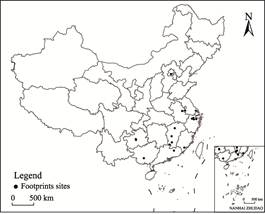
Figure 1
Footprint sites map of Mr. WANG Yangming’s life activities
Key events in WANG
Yangming’s official career are classified into 5 subcategories: assuming
office, promotion, banishment/demotion, resignation/retirement, and
reinstatement/reappointment. Among his life footprints, 30 key events relate to
his official career, including appointments to the Nanjing Ministry of Justice
and Chuzhou; promotions including appointment as Secretary of the Yunnan Bureau
of the Ministry of Justice and elevation to Director of the Bureau of
Evaluations of the Ministry of Personnel; demotion to Longchang after
submitting a memorial to plead for the accused; repeated requests for leave or
retirement, and reinstatement and subsequent promotions following exile.
Key military events are divided into 2 subcategories:
expeditions/rebellion suppression and garrisoning/inspection. A total of 10
such events are identified, including the suppression of the Zhangzhou
uprising, banditry in Hengshui, Tonggang, and Sanli, and the Rebellion of Prince Ning (ZHU Chenhao), among other expeditions
and rebellion-suppression events; and his
appointments as Left
Assistant Censor-in-chief of the Censorate and Grand Coordinator and
Superintendent of Military Affairs in Nan’gan and Tingshao,
and later as Supreme Commander of Military Affairs and Director-general of
Grain and Salt Supplies in Guangdong and Guangxi, and Grand Coordinator in
Guangdong, overseeing military affairs in Si’en and Tianzhou, among other
garrisoning and inspection events.
Key events in the
teaching category are divided into 2 subcategories: academy lecturing and
pursuit of knowledge. The dataset identifies 12 events in this category.
Academy-lecturing events include WANG Yangming’s invitation by XI Shu, the
Surveillance Vice Commissioner and Education Intendant, to lecture at Guiyang
Academy; the period during which he systematically taught the doctrines of the
School of Mind in Shaoxing; and his establishment of Yangming Academy and
subsequent teaching at Jishan Academy. Pursuit-of-knowledge events include his
success in the Zhejiang Provincial Examination and his attainment of the jinshi
(metropolitan graduate) degree.
Key life events are divided into 4 subcategories: returning home, visiting relatives, and relocation; family events;
recuperation and rest; and travel and visits to friends. A total of 21 events are
identified. Events involving his return home, visits to
relatives, and relocation include paying respects at his ancestral tombs in
Yuyao and revisiting former residences. Family events include his birth in Yuyao, marriage to
Lady Zhu, and the birth of his son Zhengyi. Recuperation-and-rest events include the
recurrence of his lung illness, his request for medical
leave to return home, and retreat at Yangming Cave. Travel
and visits to friends include excursions to the mountains
with his disciples.
5 Discussion and Conclusion
This study develops a
dataset of WANG Yangming’s activities in his life. The CIDOC CRM-based event
classification system supports the existing Zhejiang dataset to provide
regional and national data collections for research on the dissemination of the
School of Mind, historical geography, and digital humanities.
The results classify key events into 4 categories:
official career, military, teaching, and life. Official career forms the
backbone of his activities, covering appointment, promotion, banishment, and
reinstatement. Military events reflect local governance and rebellion
suppression; teaching events include study and academy lectures; and life
events cover returning home, family events, recuperation, and travel.
The dataset
nevertheless has certain limitations in the chronological and spatial precision
of some records. Future research could therefore further verify and refine the
temporal and geographical locations associated with WANG Yangming’s life
trajectories.
Author Contributions
Ma, R. F. and Shao, X. Y. did the overall design of the
dataset development. Shao, X. Y., Lu, C. Q., Chen, X. and Zheng, S. S.
contributed to the data collection and processing. Shao, X. Y., Lu, C. Q. and Chen,
X. wrote the data paper, and Ma, R. F. finally reviewed the data and paper.
Conflicts of Interest
The
authors declare no conflicts of interest.
References
[1]
Lin, H., Zhang, J., Yang, P., et
al. Development on spatially integrated humanities and social science [J]. Journal
of Geo-Information Science, 2006(2): 30–37.
[2]
Fu, J., Chen, K. S., Qin, J.
X., et al. Historical Geographical Information System (HGIS): social
trajectories of two Chinese historical figures Su Shi and Zuo Zongtang in
spatial context [J]. Heritage Science, 2024, 12: 357.
[3]
Ningbo Municipal People’s
Government. Notice of the General Office of Ningbo Municipal People’s
Government on printing and distributing the Three-Year Action Plan (2023–2025)
for the construction of Yangming culture in Ningbo [EB/OL]. (2023-11-16) [2026-04-06]
https://www.ningbo.gov.cn/art/2023/11/ 16/art_1229533140_1780839.html.
[4]
Zhu,
J. Y., Hu, X. R., Ma, R. F., et al. Spatial-temporal dataset of
footprints of Wang Yangming’s activity in Zhejiang Province of China [J/DB/OL].
Digital Journal of Global Change Data Repository, 2024.
https://doi.org/10.3974/geodb.2024.04.08.V1.
[5]
Zhu,
J. Y., Hu, X. R., Ma, R. F., et al. Spatial-temporal footprints dataset
of Wang Yangming’s activity in Zhejiang Province [J]. Journal of Global
Change Data & Discovery, 2024, 8 (1): 51–57. https://doi.org/10.3974/geodp.2024.01.06.
[6]
Shu, J. N. The Extended
Chronicle of WANG Yangming [M]. Shanghai: Shanghai Classics Publishing House,
2017.
[7]
CIDOC
CRM Special Interest Group. Volume A: Definition of the CIDOC Conceptual
Reference Model version 7.1.3 [EB/OL]. [2026-04-05].
https://cidoc-crm.org/Version/version-7.1.3.
[8]
Shao,
X. Y., Lu, C. Q., Chen, X., et al. Spatial-temporal dataset of Mr. WANG
Yangming’s footprints and activities [J/DB/OL]. Digital Journal of Global
Change Data Repository, 2026. https://doi.org/10.3974/ geodb.2026.05.05.V1.
[9]
GCdataPR
Editorial Office. GCdataPR data sharing policy [OL].
https://doi.org/10.3974/dp.policy.2014.05 (Updated 2017).
[10]
Institute of History and Philology of
Taiwan. Authoritative Name of People-biographical Database [DB/OL]. [2024-04-05].
https://newarchive.ihp.sinica.edu.tw/sncaccgi/sncacFtp.
[11]
Shaoxing
WANG Yangming Seminar. Database for WANG Yangming Subject [DB/OL].
[2026-04-05]. http://www.wymsjk.com/.
[12]
National
Library of China. Digital WANG Yangming Resource Base Global Sharing Platform
[DB/OL]. [2026-03-15]. https://www.e-yangming.com/.
[13]
Deng, K. The Collated and Annotated
Chronicle of WANG Yangming [M]. Ningbo: Ningbo
Publishing House, 2019.