Global Oasis Distribution Dataset and Cataloguing System
Officially Unveiled at the 5th World Congress of Biosphere Reserves
in Hangzhou, China
Jin, Q.1 Lin, J. W.1,2 Gui, D. W.1,2* Liu, C.3
1. Xinjiang Institute of
Ecology and Geography, Chinese Academy of Sciences, Urumqi 830011, China;
2. University of Chinese
Academy of Sciences, Beijing 100049, China;
3. Institute of Geographic Sciences and Natural
Resources Research, Chinese Academy of Sciences, Beijing 100101, China
DOI: https://doi.org/10.3974/geodp.2025.04.10
The Global oasis distribution dataset and cataloguing
system, which was jointly developed by the Xinjiang Institute of Ecology and
Geography, Chinese Academy of Sciences (XIEG-CAS), Agricultural and Biological
Research Institute of the National Research Centre of Egypt and World Data
System for Global Change Research Data Publishing & Repository (GCdataPR)
of the Institute of Geographic Sciences and Natural Resources Research, Chinese
Academy of Sciences (IGSNRR, CAS), was officially published, released and
distributed on 24 September 2025 during the 5th World Congress of
Biosphere Reserves took place in Hangzhou, China.
The congress, which was hosted by UNESCO and organized by the Chinese
Academy of Sciences and the People’s Government of Zhejiang Province, took
place in Hangzhou from 22 to 27 September 2025 (Figure 1). This was the first
time the conference had been convened in China or the Asia-Pacific region. Over
4,000 delegates from 150 countries participated in the conference. During the
conference, XIEG-CAS hosted the side event entitled “Oasis Biosphere Reserves
Empower the Sustainable Development in Arid Lands”, which was co-organized by
IGSNRR, CAS, World Data System for GCdataPR, and the State Key Laboratory of
Ecological Security and Sustainable Development in Arid Regions (Figure 2).
|
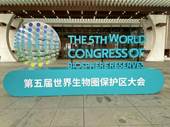
Figure 1 The 5th
World Congress of Biosphere Reserves
|
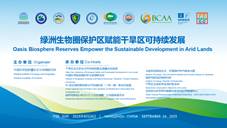
Figure 2 Oasis Biosphere
Reserves Empower the Sustainable Development in Arid Lands (Side event)
|
The event was chaired by Professor Zhang, Yuanming, Director of XIEG-CAS
(Figure 3). The opening remarks were delivered by Wang, Ding, Secretary-General
of the Chinese National Committee for the Man and the Biosphere Program (MAB
China) (Figure 4); Antonio Abreu, Director of the Division of Ecological and
Earth Sciences in UNESCO’s Natural Sciences Sector, and Secretary of the MAB
Program (Figure 5); and Liu, Weidong, Director-General of the Bureau of
International Cooperation at the Chinese Academy of Sciences (Figure 6).
|
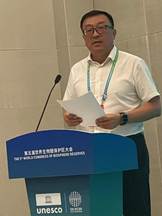
Figure 3 Professor Zhang, Yuanming,
hosted the meeting
|
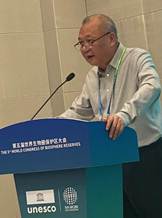
Figure 4 Wang, Ding congratulated on convening the side event
|
|
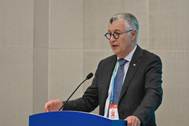
Figure 5 Mr. Antonio Abreu addressed and highly appreciated the convening of the
conference
|
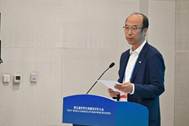
Figure 6 Liu, Weidong addressed on
the conference
|
Wang, Ding highlighted the Global oasis distribution dataset and cataloguing
system as a landmark achievement in China’s contribution to the MAB Program of
UNESCO. He stated that the project provides a unified global framework for
identifying oasis types, distributions, and boundaries and offers foundational
maps and a universal language for future environmental research and sustainable
development. Liu, Weidong emphasized the project’s theoretical and practical
significance, describing it as the world’s first comprehensive,
multidimensional, and interdisciplinary catalogue of oasis ecosystems. He said
that the project affirms the ecological and cultural value of oases, while also
creating a new platform for promoting sustainable development in arid and semi-arid
regions.
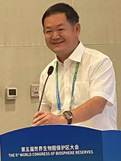
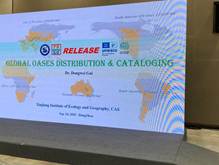
The Principal Investigator Professor Gui, Dongwei
announced the publication of the Global oasis distribution dataset and cataloguing
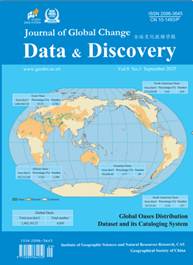
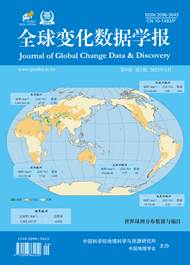
system (Figure 7). The dataset, data paper, and video are published
bilingually (Chinese & English) by GCdataPR. Among them, the dataset is
published as entries in the data encyclopedia, and the video as digital data,
in the Digital Journal of Global
Change Data Repository,
while the data paper is published in the Journal of Global Change Data &
Discovery (Figure 8, 9).
|
|
|
|
Figure 7 Professor Gui, Dongwei, the first author and co-corresponding author of
the Global oasis distribution dataset and cataloguing system announced that
the project’s outcomes
|
|
|
|
|
Figure 9 Publication of the Global oasis distribution dataset
and cataloguing system data paper
|
|
|
|
According to Professor Gui, the project began in 2020 under the guidance
of the Man and the Biosphere Program of the Chinese Academy of Sciences and the
World Data System for GCdataPR. Despite the disruptions caused by the COVID-19
pandemic, the multidisciplinary and multinational research team persevered and
completed the work after 5 years. Using high-resolution satellite imagery from
Google Earth Pro, the team manually identified and delineated the global
distribution of oases through visual interpretation. The resultant
comprehensive dataset used 2020 as the base year. This data reveals that oases
exist on every inhabited continent, spanning 54 countries and covering a total
area of 2,482,193.27 km2. The researchers identified 4,850 distinct
oasis zones. China has the largest oasis area in the world, spanning 275,535.39
km2 and comprising 1,398 individual oases. Other countries with
significant oasis coverage include Pakistan, Iran, the United States,
Kazakhstan, Iraq, Uzbekistan, Australia, Egypt, and Saudi Arabia. Each oasis
larger than 1 km2 was assigned a unique identification code
incorporating 4 key attributes: continent, country, river and area. This system
gives each oasis a digital identity, enabling scientists to track changes in
size and condition over time. The catalogue will be updated periodically to
monitor processes such as oasis expansion and contraction, providing evidence
with which to evaluate ecosystem health and long-term sustainability.
The project’s significance extends far beyond data collection. Over the
past 5 years, the research team has organized a series of academic and public
engagement activities linking digital science with local knowledge and
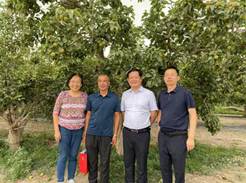
fieldwork. These activities included community discussions with farmers (Figure
10), fieldwork data verification (Figure 11), and participation in
international conferences.
The project team hosted the annual meetings of the Geographic Big Data
Working Committee of Geographical Society of China in Yanchi County, Ningxia,
in 2021 and in Korla City, Xinjiang, in 2023. Both meetings focused on
integrating digital technologies with sustainable development in arid
environments. The team also launched the “Capacity Building Workshop on Big
Data Applications in 100 Universities/Towns” program, which included events at
Ningxia University and the Tarim and Hotan River Basin Water Resources
Management Centers.
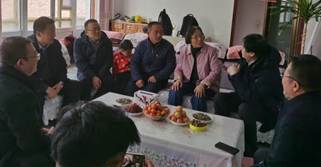
Figure 10 Field meeting with local farmers in
Yanchi County, Ningxia (Jan. 2021)
Through field verification in key regions,
workshops, and engagements with local experts, governments, and communities,
the team systematically completed the global oasis digital catalog. This work
precisely quantifies the global number and area of oases, filling a critical
data gap. It also embeds the concept of digital transformation into oasis
communities, providing a scientific foundation for their sustainable and
high-quality development.
Members of the
research group presented their findings at the 2023 FAO Oasis Symposium in
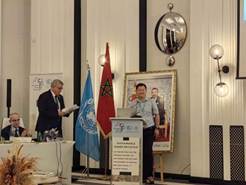
Morocco (Figure 12) and exhibited their work at the 2024 United Nations
Internet Governance Forum. Through these activities, the team sought to
validate the dataset, exchange experiences with local scientists and
governments, and raise global awareness of the importance of oases as
ecological and cultural lifelines.
|
|
|
|
Figure 11
Field Surveys and Data Verification at the Kongque River Oasis, Korla,
Xinjiang by Gui, Dongwei, Liu, Chuang, and Hou, Jianzhu (then Director of the
Science and Technology Bureau of Korla City) (Apr.–Sep. 2021)
|
Figure 12 Professor Gui, Dongwei delivered a keynote
speech at the FAO/UNESCO Oasis Sustainability Symposium, Morocco (Sep. 2023)
|
The Global oasis distribution dataset and cataloguing system project also
provided a platform for training young researchers. Lin, Jingwu, a doctoral
student at XIEG-CAS, was recognized for his meticulous approach to data
verification and his commitment to accuracy. 2 other young scientists, Dr. Liu,
Yunfei and Dr. Liu, Qi, were appreciated for their tenacity and innovative
method (Figure 13). Their persistence during the most challenging stages of data
integration was crucial to the project’s success. Senior members of the team
said that their work represents a new generation of scientific talent committed
to advancing environmental data science and sustainable development in arid
regions.
|
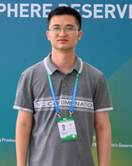
PhD student, Lin, Jingwu
|

Dr. Liu, Yunfei
|
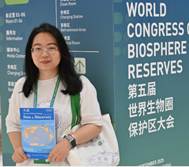
Dr. Liu, Qi
|
Figure 13 Core authors of the global oasis dataset project
At the conference, Professor Liu, Chuang from IGSNRR, CAS presented the
team’s future. She explained that the next stage would focus on developing
intelligent analyses of global oasis dynamics and creating replicable models
for sustainable oasis development around the world. She also mentioned that the
“Geographical Indications Environment & Sustainability (GIES)” methodology
and the data framework proposed by the World Data Center for GCdataPR are
already supporting the FAO’s “One Country One Priority Product” initiative.
Pilot projects are underway in Uzbekistan and Egypt, where oases play a crucial
role in supporting communities and ecosystems (Figure
14). On behalf of Chinese
National Committee for the MAB Program, Han, Qunli
announced the official launch of the “Oasis Biosphere Reserve Initiative”. This
marks the commencement of a new, in-depth phase of global oasis research,
building directly upon the findings of the Global oasis distribution dataset
and cataloguing system project.
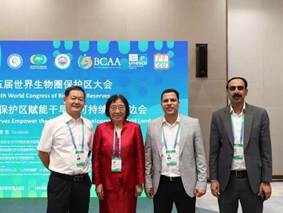
Figure 14 Group
photo of the co-authors Professor Gui, Dongwei,
Professor Liu, Chuang, Dr. Sameh Kotb Abd-Elkader, and Dr. Seeshan Ahmed