Dataset Development of Poyang Lake Herbivorous Wintering
Waterbird Droppings and Carex cinerascens Kükenth. Decomposition (2017)
Zhang, Q. J.1 Xia, S. X.2,3 Wu, D. L.1 Duan,
H. L.2,3* Yu, X. B.2,3*
1. Meteorological Observation
Centre, China Meteorological Administration, Beijing 100081, China;
2. Key Laboratory of Ecosystem Network Observation and
Modeling, Institute of Geographic Sciences and Natural Resources Research,
Chinese Academy of Sciences, Beijing 100101, China;
3. University of Chinese
Academy of Sciences, Beijing 100049, China
Abstract: Based on a litterbag
decomposition experiment on Carex litter and an additive experiment with
droppings from herbivorous wintering waterbirds conducted in 2017 on the
beaches of Poyang Lake, this study systematically collected data on wetland
organic matter decomposition and carbon, nitrogen, and phosphorus cycling. This
work led to the construction of the Dataset of Poyang Lake herbivorous
wintering waterbird droppings and Carex cinerascens Kükenth.
decomposition. The results indicated that the addition of bird droppings
significantly accelerated the decomposition of Carex litter. In the
mixed treatment, the residual rates of dry matter, lignin, and cellulose of Carex
(66.80%, 61.03%, and 44.54% respectively after 150 days) were significantly
lower than those in the single Carex treatment (71.96%, 69.97%, and
62.53%). Furthermore, the nutrient release rates (Relative Return Index) of
carbon, nitrogen, and phosphorus (42.73%, 53.95%, and 14.65% respectively) were
significantly higher than those in the single Carex treatment (34.91%,
17.96%, and 5.7%). The bird droppings themselves decomposed slowly but
exhibited high nitrogen and phosphorus release characteristics. This suggests
that wintering waterbirds, through excretory activities that input
allochthonous nutrients and microbial communities, likely promote the
decomposition of structural components (cellulose, lignin) of Carex and
the net release of carbon, nitrogen, and phosphorus. This is achieved by
altering substrate composition, enhancing nutrient availability, and
stimulating microbial activity, thereby profoundly influencing wetland material cycling
processes and carbon pool dynamics. The dataset includes: (1) geo-location
information of the sample plots; (2) dry matter decomposition rate of samples;
(3) lignin decomposition data; (4) cellulose decomposition data; (5) total
carbon return; (6) total nitrogen return; and (7) total phosphorus return. It
provides a key scientific basis for revising global carbon models and the
managing of wetland ecosystems.
Keywords: dry matter; lignin; cellulose;
carbon, nitrogen, phosphorus; Poyang Lake; waterbirds
DOI: https://doi.org/10.3974/geodp.2025.04.07
Dataset Availability Statement:
The dataset supporting this
paper was published and is accessible through the Digital Journal of Global
Change Data Repository at: https://doi.org/10.3974/geodb.2025.09.02.V1.
1 Introduction
Litter
decomposition is a core process driving organic matter mineralization, which
plays a key regulatory role in global carbon fluxes and ecosystem material cycling[1,2]. Wetlands, as highly
productive ecosystems, lead to the continuous accumulation of wet plant (e.g., Carex)
litter due to their flooded anaerobic environment, forming important carbon and
nitrogen storage pools[3–5].
Decomposition directly regulates nutrient turnover efficiency, soil fertility
maintenance, and biological community construction[6].
Even minor changes in its rate can significantly disrupt the
release-accumulation balance of carbon, nitrogen, and phosphorus elements,
triggering regional to global-scale responses in carbon and nitrogen pool dynamics[7,8].
More than 30% of
plant photosynthetic carbon fixation is stored in cellulose and lignin, whose
decomposition rates profoundly regulate the carbon cycle process[7].
As recalcitrant structural components, their content (especially lignin) is
often negatively correlated with the overall litter decomposition rate[8]. Lignin inhibits
biodegradation by enhancing cell wall resistance and is primarily decomposed by
extracellular enzymes secreted by fungi[9].
Although cellulose dominates the degradation process in the early stages of
decomposition, its main body is physically protected by lignin and can only be
effectively utilized by microorganisms after lignin decomposition[10–12].
The dominant Carex
species on the Poyang Lake (China’s largest freshwater lake) beach exhibit
unique phenological rhythms: they sprout after water recedes in autumn, and the
aboveground parts gradually wither in winter; they undergo secondary sprouting
the following spring, until the aboveground parts die and begin decomposition
during the flooding period in April[13].
This phenological process is highly synchronized with the habitat period of
wintering waterbirds (especially herbivorous Anseriformes), providing them with
key food resources[14], making
this wetland a core hub of the East Asian-Australasian Flyway[15].
Annually, over 400,000 wintering waterbirds visit the area, with Anseriformes
accounting for more than 50% of the population[16,17].
This large bird population inputs allochthonous nutrients and microbial
communities into the wetland through excretory activities[18],
potentially accelerating the biogeochemical cycles of carbon, nitrogen, and phosphorus[19–21].
Based on a
controlled decomposition bag experiment (with 3 treatments: Carex
litter, bird droppings, and a Carex-droppings mixture) conducted from
January to June 2017, the authors systematically quantified the residual
amounts, residual rates, and instantaneous decay coefficients of dry matter,
lignin, and cellulose, as well as the percentages of total carbon, total
nitrogen, and total phosphorus in dry matter, residual amounts, and Relative
Return Indices. By analyzing these indicators, the study aims to reveal: the
differences in the dynamics of carbon, nitrogen, and phosphorus release during
the decomposition of droppings from herbivorous wintering waterbirds and beach Carex
litter; and the regulatory effect of the addition of bird droppings on the
decomposition process of Carex litter. The research results will deepen
the understanding of wetland material cycling mechanisms, provide empirical
data support for the revision of global carbon models, and offer a scientific
basis for formulating adaptive wetland management strategies.
2 Metadata of the Dataset
The metadata for the Dataset of Poyang Lake
herbivorous wintering waterbird droppings and Carex cinerascens Kükenth.
decomposition[22], including the title, authors, geographical region, data format, data
size, data files, etc., is summarized in Table 1.
Table 1 Metadata summary of the Dataset of Poyang Lake herbivorous wintering waterbird
droppings and Carex cinerascens Kükenth. decomposition
|
Item
|
Description
|
|
Dataset full name
|
Dataset of
Poyang Lake herbivorous wintering waterbird droppings and Carex
cinerascens Kükenth. decomposition
|
|
Dataset short
name
|
DecompositionPoyangLake
|
|
Authors
|
Zhang, Q. J., Meteorological Observation Centre, China Meteorological
Administration, zhangqj@cma.gov.cn
Xia, S. X., Institute of Geographic Sciences and Natural Resources Research,
Chinese Academy of Sciences, xiasx@igsnrr.ac.cn
Wu, D. L., Meteorological Observation Centre, China Meteorological
Administration, wudongli666@126.com
Duan, H. L., Institute of Geographic Sciences and Natural Resources Research,
Chinese Academy of Sciences, duanhl@igsnrr.ac.cn
Yu, X. B., Institute of Geographic Sciences and Natural Resources Research,
Chinese Academy of Sciences, yuxb@igsnrr.ac.cn
|
|
Geographical
region
|
Poyang Lake
|
|
Year
|
2017–2018
|
|
Data format
|
.shp,
.xlsx
|
|
Data size
|
96.4
KB
|
|
Data files
|
(1) Sample site
location information; (2) Dry matter decomposition data; (3) Lignin
decomposition data; (4) Cellulose decomposition data; (5) Total carbon
return; (6) Total nitrogen return; (7) Total phosphorus return
|
|
Data publisher
|
Global Change
Research Data Publishing & Repository, http://www.geodoi.ac.cn
|
|
Address
|
No. 11A, Datun
Road, Chaoyang District, Beijing 100101, China
|
|
Data sharing
policy
|
(1) Data are openly available and can be
free downloaded via the Internet; (2) End users are encouraged to use Data subject to citation; (3) Users,
who are by definition also value-added service providers, are welcome to
redistribute Data subject to written permission from the GCdataPR Editorial
Office and the issuance of a Data
redistribution license; and (4) If Data
are used to compile new datasets, the “ten percent principal” should be
followed such that Data records
utilized should not surpass 10% of the new dataset contents, while sources
should be clearly noted in suitable places in the new dataset[23]
|
|
Communication and
searchable system
|
DOI, CSTR,
Crossref, DCI, CSCD, CNKI, SciEngine, WDS, GEOSS, PubScholar, CKRSC
|
3 Methods
3.1 Area of Data Collection
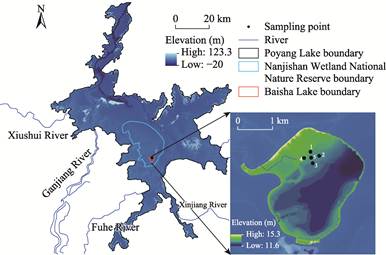
This dataset was sourced from
field collection in Baisha Lake, a typical dish-shaped lake within the Poyang
Lake Nanjishan Wetland National Nature Reserve (Figure 1). The reserve is
located in the frontal delta area of southern Poyang Lake, where 3 tributaries
of the Ganjiang River flow into the lake. The ground elevation ranges between
12 and 16 m (Wusong Elevation System). It belongs to a typical subtropical
monsoon climate zone, characterized by hot, rainy summers and cold, dry
winters. Influenced by the seasonal water level fluctuations of Poyang Lake,
the reserve exhibits distinct alternating hydrological patterns of high-water
season (generally April to September) and low-water season (generally October
to March the following year): during the high-water season, most of the grassy
meadows are submerged; as the low-water season arrives, water levels drop,
revealing a river-lake intertwined beach landscape[24,25].
This periodic hydrological variation shapes the fertile soil and favorable
hydrothermal conditions of the beach shallows, fostering diverse hygrophytic
and aquatic vegetation, with Carex, Triarrhena lutarioriparia,
and Phragmites australis dominating the community[26,27].
Among them, Carex is the most widely distributed dominant plant in
Poyang Lake, covering the beaches from the lakeshore to the waterline, hence it
was selected as the representative beach plant for this study. Carex has
a unique growth cycle: “Autumn grass” sprouts after water recedes in September,
growing until December–March the following year when the aboveground parts
wither; “Spring grass” sprouts beside the incompletely dead autumn grass after
January, growing until April when submerged by lake water, ultimately dying,
becoming dormant, and decomposing underwater[28].
The aforementioned ecological mechanisms provide essential habitat and food for
many rare wintering waterbirds, thereby maintaining the region’s rich avian
diversity. Consequently, the Poyang Lake wetland is known as the “Kingdom of
the Siberian Crane” and the “Paradise for Migratory Birds”, establishing its
ecological status as one of Asia’s most important wintering grounds for
migratory birds.
Figure
1 Location map
of sampling points in the Poyang Lake wetland
3.2 Field Experiment
3.2.1 Plot Setup and Sample Preparation
In late January 2017, based on
preliminary surveys of wetland vegetation and waterbird habitats, this study
established 5 fixed plots (approximately 50 m apart) within Baisha Lake in the
Nanjishan Wetland Reserve. Plot selection was primarily based on the following
principles: minimal human disturbance, frequent activity of herbivorous
waterbirds, dense bird droppings traces, and well-developed vegetation. The
selected beach was about 200 m from the waterline,
dominated by Carex cinerascens Kükenth., with vegetation coverage of
80%–90%, plant height of 40–60 cm, and abundant bird droppings visible on the
ground and plants. 1 decomposition experiment point was set up within each
plot, totaling 5 replicates.
3.2.2 Decomposition Experiment
The litterbag method was used. Decomposition
bags were made of 100-mesh (aperture 0.15 mm), 15 cm×20 cm white nylon
mesh, preventing sample loss while allowing microbial activity.
(1) Carex litter preparation:
Senescent Carex leaves were collected near the plots, rinsed with
deionized water, cut into 10 cm segments and mixed (to eliminate size effects).
They were then oven-killed at 120 ℃ for 1 hour and oven-dried at 60 ℃
to constant weight.
(2) Bird droppings sample preparation: Fresh
goose droppings (<24 h) were collected from the plots. They were oven-dried
at 60 ℃ to constant weight.
(3) Initial nutrient measurement: 10.00 g of
dried samples (6 replicates each for Carex and droppings) were taken to
determine initial nutrients.
(4) Bag loading treatment: The remaining
samples were loaded into bags according to the following 3 treatments: pure
bird droppings (10 g), pure Carex litter (10 g), mixed treatment (Carex
5 g+bird droppings 5 g). A total of 105 decomposition bags were prepared.
3.2.3 Field Deployment and Sampling
Decomposition bags were deployed strictly
according to the experimental design, placing 7 bags at each of the 5 points,
covering all 3 treatments. During fixation, PVC pipes were used to secure the
bags close to the ground, ensuring they did not shift or interfere with each
other, while protecting the integrity of the native litter layer. Samples were
scheduled for retrieval on the 5th, 15th, 30th, 60th, 90th, 120th, and 150th
days after deployment. However, the experiment was terminated early due to flooding
of the plots in June that year, leading to a drastic change in the
hydrological background.
3.3 Laboratory
Experiments
Retrieved decomposition bags were cleaned in
the laboratory (removing soil, algae, etc.). Carex residues in the mixed
treatment samples were separated. All samples were oven-dried at 60 ℃ to
constant weight, and the residual dry weight was measured. Samples were ball- milled
(particle size 0.06 μm) and sealed in numbered polyethylene bags for testing.
The content of lignin and cellulose was
determined referring to the method by Zhang, et al.[29].
The total carbon and total nitrogen content in the samples were measured using
an elemental analyzer (Vario Max CN, Elementar Analysensysteme GmbH, Germany).
Total phosphorus content was determined by inductively coupled plasma optical
emission spectrometry (ICP-OES, Optima 5300 DV, Perkin-Elmer, America).
3.4 Data Processing and Analysis
The sample residual rate was calculated using
the following Equation[13]:
 (1)
(1)
where, Rt represents the residual rate at
time t, Wt and W0 are the sample mass at time t and the
initial mass, respectively, in grams (g), and t is the decomposition
time in days (d).
The instantaneous decay rate (k) was calculated using the
Olson negative exponential decay model:
 (2)
(2)
Transformed to:  (3)
(3)
where, k represents the instantaneous decomposition
rate at time t, A larger k value
indicates a faster decomposition rate.
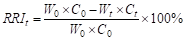
Furthermore, the Relative Return Index
(RRI) was introduced to assess the release or accumulation state of elements,
calculated as:
 (4)
(4)
where, Ct and C0
represent the concentration of an element at time t and the
initial time, respectively. For ease of expression, the RRI for total carbon,
total nitrogen, and total phosphorus are denoted as CRRI, NRRI, and PRRI,
respectively. A positive RRI value indicates net release of the element during
decomposition, while a negative value indicates net accumulation.
4 Data Results
4.1 Dataset Composition
The dataset consists of sample site location
information (.shp) and 1 Excel file. The Excel file includes 6 sheets, named
Dry Matter, Lignin, Cellulose, Total Carbon, Total Nitrogen, and Total
Phosphorus, respectively. These sheets contain monitoring data for these 6
indicators from 5 replicate samples on the 5th, 15th, 30th, 60th, 90th, 120th,
and 150th days of the decomposition experiment, including measured values, mean
values, and standard deviations. Detailed data descriptions for each indicator
are shown in Table 2.
Table
2 Measured indicators and their statistics
|
Indicator
|
Calculated statistics
|
|
Dry
Matter
|
Residual
Amount (g)
|
Residual
Rate (%)
|
Instantaneous
Decay Coefficient
|
Dry
Matter
|
|
Lignin
|
Percentage
of Dry Matter Residual Amount (%)
|
Residual
Amount (g)
|
Instantaneous
Decay Coefficient
|
Residual
Rate (%)
|
|
Cellulose
|
Percentage
of Dry Matter Residual Amount (%)
|
Residual
Amount (g)
|
Instantaneous
Decay Coefficient
|
Residual
Rate (%)
|
|
Total
Carbon
|
Percentage
of Dry Matter Residual Amount (%)
|
Residual
Amount (g)
|
Relative
Return Index (%)
|
Total
Carbon
|
|
Total
Nitrogen
|
Percentage
of Dry Matter Residual Amount (%)
|
Residual
Amount (g)
|
Relative
Return Index (%)
|
Total
Nitrogen
|
|
Total
Phosphorus
|
Percentage
of Dry Matter Residual Amount (%)
|
Residual
Amount (g)
|
Relative
Return Index (%)
|
Total
Phosphorus
|
4.2 Data Results
The
initial contents of lignin, cellulose, total carbon, total nitrogen, and total
phosphorus in the Carex and bird droppings samples are shown in Table 3.
The dynamic changes in dry matter, lignin, cellulose, total carbon, total
nitrogen, and total phosphorus during the decomposition process are shown in
Figure 2.
Table
3 Initial
content of lignin, cellulose, total carbon, total nitrogen, and total
phosphorus in Carex and bird droppings samples
|
Indicator
|
Carex sample(n=6)
|
Bird droppings sample(n=6)
|
|
Mean
|
Standard deviation
|
Mean
|
Standard deviation
|
|
Total
Carbon (%)
|
43.080a
|
0.277
|
36.820b
|
1.308
|
|
Total
Nitrogen (%)
|
1.150a
|
0.060
|
1.330b
|
0.072
|
|
Total
Phosphorus (‰)
|
0.970a
|
0.019
|
2.440b
|
0.093
|
|
Carbon/Nitrogen
|
37.460a
|
0.001
|
27.680b
|
0.001
|
|
Lignin
(%)
|
8.040a
|
0.328
|
4.890b
|
0.425
|
|
Cellulose
(%)
|
8.760a
|
0.581
|
7.860b
|
0.682
|
Note: Significant differences between means were tested using Tukey’s
Honest Significant Difference test. Different letters following the data
indicate significant differences between the two sample types.
As shown in Figure 2a–2c, during the 5–150-d
decomposition period, the residual rates of dry matter, lignin, and cellulose
differed significantly among the 3 sample types (Carex, bird droppings, Carex
in mixture). Throughout the decomposition process, the dry matter and lignin
residual rates were always lowest for the Carex in the mixture, followed
by pure Carex, and highest for bird droppings.
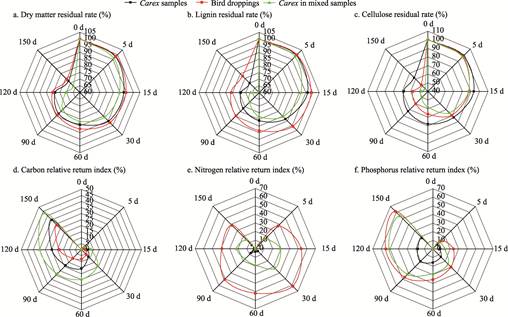
Figure 2 Dynamic
changes in dry matter, lignin, cellulose, total carbon, total nitrogen, and
total phosphorus during the decomposition of the three sample types
After 150 days of decomposition, the dry matter
residual rate was: Carex in mixture (66.80%) < pure Carex
(71.96%) < bird droppings (73.80%); the lignin residual rate was: Carex
in mixture (61.03%) < pure Carex (69.97%) < bird droppings
(77.40%). Throughout the decomposition process, the cellulose residual rate was
always lowest for the Carex in the mixture, followed by bird droppings,
and highest for pure Carex. After 150 days of decomposition, the
cellulose residual rate was: Carex in mixture (44.54%) < bird
droppings (50.83%) < pure Carex (62.53%).
The results of the decomposition experiment (5–150
days) showed (Figure 2d–2f) that the RRI for total carbon, total nitrogen, and
total phosphorus differed dynamically among the 3 sample types. The release
intensity of total carbon showed a clear hierarchical order: the lowest return
index was for bird droppings, followed by pure Carex, and highest for
the Carex in the mixture, a pattern that persisted throughout the
decomposition stage. After 150 days of decomposition, the total carbon return
index was: bird droppings (28.9%) < pure Carex (34.91%) < Carex
in mixture (42.73%). Throughout the decomposition stage, the total nitrogen and
total phosphorus return indices were always lowest for pure Carex,
followed by the Carex in the mixture, and highest for bird droppings.
After 150 days of decomposition, the total nitrogen return index was: pure Carex
(17.96%) < Carex in mixture (53.95%) < bird droppings (61.63%);
the total phosphorus return index was: pure Carex (5.7%) < Carex
in mixture (14.65%) < bird droppings (38.48%).
5 Discussion and Conclusion
Based on the decomposition bag experiment and
bird droppings addition test conducted from January to June 2017, authors
systematically analyzed the decomposition characteristics of 3 sample types: Carex
litter, bird droppings, and the Carex-droppings mixture. The study
measured the residual amount, residual rate, and instantaneous decay
coefficient of dry matter, lignin, and cellulose; simultaneously, it analyzed
the percentage in dry matter, residual amount, and RRI of total carbon, total nitrogen, and total phosphorus. This dataset
can be used to study the dynamics of carbon, nitrogen, and phosphorus release
during the decomposition of droppings from herbivorous wintering waterbirds and
typical beach wetland plant litter in Poyang Lake, as well as the impact of
bird droppings addition on the decomposition process of Carex litter.
The research results indicate: (1) Bird
droppings addition significantly promoted Carex decomposition. The
residual rates and decomposition rates of dry matter, cellulose, and lignin of Carex
litter and that in the mixture showed extremely significant differences.
Throughout the decomposition process, the residual rate of Carex in the
mixture was always lower than that of the single Carex sample, while the
decomposition rate was always higher, indicating that bird droppings addition
had a continuous and significant promoting effect on Carex
decomposition. (2) Element release patterns and return. Carbon, nitrogen, and
phosphorus elements overall exhibited a net release pattern. The carbon,
nitrogen, and phosphorus return indices for the Carex in the mixture
were significantly higher than those for the single Carex sample,
indicating that bird droppings addition also significantly promoted the release
and return of nutrient elements from Carex. (3) Analysis of promotion
mechanisms. The addition of bird droppings likely promotes the decomposition of
cellulose and lignin in Carex litter by altering the original component
ratio of the litter, increasing nutrient availability in the environment,
enhancing microbial colonization capacity, and stimulating the production of
extracellular degrading enzymes[20,21].
This dataset deepens the understanding of the
wetland plant litter decomposition process, and helps elucidate the ecological
role of wintering waterbirds in wetland litter decomposition and carbon,
nitrogen, and phosphorus cycling, and provides a scientific basis and data
support for optimizing habitat restoration and wetland management strategies
for waterbirds in Poyang Lake.
Author Contributions
Zhang. Q. J. designed
and implemented the field experiment, was responsible for sample collection,
laboratory analysis, data processing, and data paper writing; Xia, S. X. and
Duan, H. L. guided and assisted in the field experiment design and sample collection;
Wu, D. L. guided data quality control and data paper writing; Yu, X. B.
provided overall design for the dataset development, and guided and supervised
the experiment implementation.
Conflicts
of Interest
The
authors declare no conflicts of interest.
References
[1]
Berg,
B., Mcclaugherty, C. Plant Litter: Decomposition, Humus Formation, Carbon
Sequestration [M]. New York: Springer Berlin Heidelberg, 2014.
[2]
Górski,
A., Błońska, E., Lasota, J. Decomposition rate and property changes of deadwood
across an altitudinal gradient: a case study in the Babia Góra Massif, Poland
[J]. Scientific Reports, 2025, 15(1): 28160.
https://doi.org/10.1038/s41598-025-14019-7.
[3]
Matthews,
E., Fung, I. Methane emission from natural wetlands: global distribution, area,
and environmental characteristics of sources [J]. Global Biogeochemical
Cycles, 1987, 1(1): 61‒86.
[4]
Roehm,
C. Respiration in Wetland Ecosystems [M]. New York: Oxford University Press,
2005.
[5]
Yang,
T. W., Sun, J. J., Li, Y. F., et al. Impact of climate-induced
water-table drawdown on carbon and nitrogen sequestration in a Kobresia-dominated
peatland on the central Qinghai-Tibetan Plateau [J]. Communications Earth &
Environment, 2025, 6: 188. https://doi.org/10.1038/s43247-025-02168-6.
[6]
Xiong,
S. J., Christer, N. The effects of plant litter on vegetation: a meta-analysis
[J]. Journal of Ecology, 1999, 87(6): 984‒994.
[7]
William,
D., Reddy, K. Litter decomposition and nutrient dynamics in a phosphorus
enriched Everglades Marsh [J]. Biogeochemistry, 2005, 75(2): 217.
[8]
Davis,
S., Corronado-molina, C., Childers, D., et al. Temporally dependent C,
N, and P dynamics associated with the decay of rhizophora mangle L. leaf litter
in oligotrophic mangrove wetlands of the Southern Everglades [J]. Aquatic
Botany, 2003, 75(3): 199‒215.
[9]
Schwarz,
W. H. The cellulosome and cellulose degradation by anaerobic bacteria [J]. Applied
Microbiology and Biotechnology, 2001, 56(5): 634.
[10]
Berg,
B., Laskowski, R. Litter fall [J]. Advances in Ecological Research,
2005, 38(38):19‒71.
[11]
Swift,
M., Heal, O., Anderson, J. Decomposition in Terrestrial Ecosystems [M]. Oxford:
Blackwell Scientific, 1979.
[12]
Pauly,
M., Keegstra, K. Cell-wall carbohydrates and their modification as a resource
for biofuels [J]. The Plant Journal, 2008, 54(4): 559‒568.
[13]
Zhang,
Q. J., Yu, X. B., Hu, B. H. Study on the distribution characteristics of plant
communities in the Nanji Wetland of Poyang Lake [J]. Resources Science,
2013, 35(1): 42‒49.
[14]
Guan,
L., Wen, L., Feng, D. D., et al. Delayed flood recession in central
Yangtze floodplains can cause significant food shortages for wintering geese:
results of Inundation experiment [J]. Environmental Management, 2014,
54(6): 1331‒1341.
[15]
Xia,
S. X., Liu, G. H., Yu, X. B., et al. Habitat evaluation for wintering
waterbirds in Poyang Lake [J]. Journal of Lake Sciences, 2015, 27(4):
719‒726.
[16]
Tu,
Y. G., Yu, C. H., Huang, X. F., et al. Distribution and quantity of
wintering geese and ducks in Poyang Lake region [J]. Acta Agriculturae
Universitatis Jiangxiensis, 2009, 31(4): 760‒764+771.
[17]
Manny,
B., Johnson, W., Wetzel, R. Nutrient additions by waterfowl to lakes and reservoirs:
predicting their effects on productivity and water quality [J]. Hydrobiologia,
1994, 279‒280(1): 121‒132.
[18]
Chaichana,
R., Leah, R., Moss, B. Birds as eutrophicating agents: a nutrient budget for a
small lake in a protected area [J]. Hydrobiologia, 2010, 646(1):
111‒121.
[19]
Hahn,
S., Bauer, S., Klaassen, M. Quantification of allochthonous nutrient input into
freshwater bodies by herbivorous waterbirds [J]. Freshwater Biology, 2010, 53(1):
181‒193.
[20]
Zhang, Q. J., Zhang, G. S., Wan, S. X., et al. Effects of droppings from herbivorous
wintering waterbirds on decomposition process and carbon, nitrogen, phosphorus
release of Carex litter in beach wetland of Poyang Lake [J]. Journal
of Lake Sciences, 2019, 31(3): 814‒824.
[21]
Zhang,
Q. J., Zhang, G. S., Yu, X. B., et al. How do droppings of wintering
waterbird accelerate decomposition of Carex cinerascens Kükenth. litter
in seasonal floodplain Ramsar Site? [J]. Wetlands Ecology and Management,
2021, 29(4): 581‒597. DOI: 10.1007/s11273-021-09804-w.
[22]
Zhang,
Q. J., Xia, S. X., Wu, D. L., et al. Dataset of Poyang Lake herbivorous wintering waterbird
droppings and Carex cinerascens Kükenth. decomposition [J/DB/OL]. Digital Journal of Global Change Data Repository, 2025.
https://doi.org/10.3974/geodb.2025.09.02.V1.
[23]
GCdataPR Editorial Office. GCdataPR
data sharing policy [OL]. https://doi.org/10.3974/dp.policy.2014.05 (Updated
2017).
[24]
Liu,
X. Z., Hu, B. H. Comprehensive Scientific Survey of Jiangxi Nanjishan Wetland
Nature Reserve [M]. Beijing: China Forestry Publishing House, 2005.
[25]
Editorial
Committee of “Poyang Lake Research”. Poyang Lake Research [M]. Shanghai:
Shanghai Science and Technology Press, 1988.
[26]
Wang, Y. Y., Yu, X. B., Zhang, L., et al. Seasonal variability in baseline δ15n
and usage as a nutrient indicator in Lake Poyang, China [J]. Journal of
Freshwater Ecology, 2013, 28(3): 365‒373.
[27]
Zhang,
Q. J., Yu, X. B., Qian, J. X., et al. Distribution characteristics of
dominant plant communities and soil organic matter and nutrients in the Nanji
Wetland of Poyang Lake [J]. Acta Ecologica Sinica, 2012, 32(12):
3656‒3669.
[28]
Zhang, Q. J., Yu, X. B., Zhang,
G. S. Decomposition process and carbon and nitrogen isotope fractionation
characteristics of litter from three dominant plants in Poyang Lake wetland
[J]. Journal of Lake Sciences, 2023, 35(5): 1694‒1704.
[29] Zhang, G. S., Yu, X. B., Xu, J. Effects
of environmental variation on stable isotope abundances during typical seasonal
floodplain dry season litter decomposition [J]. Science of the Total
Environment, 2018, 630(1): 1205‒1215.