GIES Support FAO OCOP Implementation: Speech at the
High-Level Event of Implementation of FAO OCOP Initiative
LIU Chuang
Institute of Geographic Sciences and Natural Resources
Research, Chinese Academy of Sciences, Beijing 100101, China
Abstract: On October 15, 2025, FAO held a high-level event on the
implementation of the OCOP (One Country One Priority Product) Initiative at its
headquarters in Rome, as part of FAO’s 80th anniversary celebration.
Experts and leaders from across the world shared insights during the high-level
event. Professor LIU Chuang was invited to deliver a speech on GIES support FAO
OCOP implementation. She introduced how the innovative GIES toolchain works for
OCOP implantation and how the open science, free technology transfer and
capacity building for Four Betters with triple-win model benefit famers,
consumers and environment.
Keywords: FAO; 80th anniversary; OCOP; GIES; open
science; triple-win
DOI: https://doi.org/10.3974/geodp.2026.01.02
Dataset Availability
Statement:
The
video supporting this paper was published and is accessible through the Digital
Journal of Global Change Data Repository at: https://doi.org/10.3974/geodb.2026.01.04.V1.
Dear Excellences, distinguished guests, ladies and
gentlemen, good day!
I am so proud to be here and would be very happy
to share my experience about GIES support FAO OCOP implantation (Figure 1).
We all know, there are abundance of Special
Agriculture Products (SAPs) in the world, such as tea in China, quinoa in
Bhutan, jackfruit in Bangladesh. Some of them are Geographical Indication (GI)
products and some of them are potential GIs.
The challenge is how to capitalize socio- economic
benefit of SAPs while balancing and achieving environmental sustainability.
Challenge comes from famers: good agriculture
product, but low price in market; beautiful environment, but less development;
a lot of famers, but small-scattered-weak businesses.
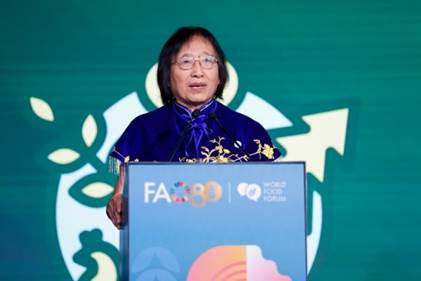
Figure 1 Professor
LIU Chuang delivered her speech at the High-Level Event of OCOP Implementation
of FAO 80th Anniversary ©FAO/Giulio Napolitano
Challenge comes from market: the dealers always
advertise their products are perfect, however, not clear the product’s origin,
sometimes mixed good and bad, or even mixed fictitious with genuine (put fish
eyes as pearls).
Another challenge comes from consumers: more
people need quality products; affordable people have little knowledge how to
get them; in many cases, customers do not trust market advertising.
In summary, the issues are: (1) the special
agriculture products are not well geo-located; (2) the special
geo-bio-eco-socio system which the products of origins are not illustrated
clearly and not well-known by consumers; and (3) the intellectual properties or
brands of these SAPs have not been established or well protected.
We need solution. One of the solutions is GIES.
The full name of GIES is Geographical Indications Environment and
Sustainability. It is a comprehensive package or toolchain regarding
geographical products and their origin environment traceable and acknowledgeable
based on open science principles and big data and internet of things
technology.
Geographical indications here include
Geographical Indication products, which are already approved by government, and
some of them are the potential GIs, including Geographical specific products,
Geographical traditional products (Figure 2).
High quality focused on Four Betters: product,
nutrition, environment and life with data and knowledge to evaluate in species,
quality, appearance, brand, morality, culture aspects (Figure 3).
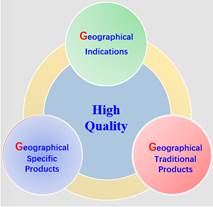
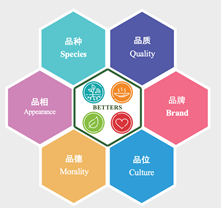
Figure 2 Term of GIES products
Figure 3 High quality elements of a GIES case
More important, the GIES is focused on the
impact. A successful GIES case is in triple-win model: famers win in
richness, consumers win in health, environment win in beautiful sustainability.
GIES has 5 action lines in action, they
are science, technology, engineering, management and culture. Science is needed
to describe what is the geographical product and why it is good in the special
region; we use technology of big data, and Internet of Things to trace its
origin, and take each case as an engineering, together with management
(particularly standards) and culture. Who do this? We need partners. I
appreciate FAO plays leader role of this action, we need local governments,
scientists, university professors, communities and private sectors, publishers
also. Between the producers and consumers, the GIES provide services of
registration and certificates, in this way, we help SAPs to add their brand
value and protect its intellectual property.
One of the GIES’s keys is to network these
data, information, products and all related elements together, including QR
system. Any people in the world can scan the QR code, and then he/she can get
all this information equally in anywhere, and at any time. Up to now, there are
27 GIES cases in China. Most of them get income increased, some of them double
and triple or even more. Last year, FAO signed MoU on GIES with the Institute of Geographic Sciences and
Natural Resources Research, Chinese Academy of Sciences (IGSNRR, CAS). “This
agreement between FAO and IGSNRR, CAS will benefit not only the countries where
we are working in, but farmers themselves”, Dr. Beth Bechdol, FAO Deputy
Director-General, indicated at the welcoming participants to the signature ceremony.
We
promised 3 things, GIES data and knowledge sharing including visibility events,
food/trade fair, etc.; free technology transfer including supporting for field
application; and provide services of capacity building, including training,
field visit and study tour in CAS/China; capacity building in OCOP countries;
field capacity building in villages in OCOP countries as well as education
program.
Based
on the MoU, the international capacity building workshops on technology
transfer on GIES for OCOP implementation were co-organized by FAO
and IGSNRR, CAS during the last 3 years from 2023–2025.
l
August
2023, 20 focal points from 5 countries and FAO officers participated the event
held in Zhejiang, Jiangsu, Beijing of China;
l
September
2024, 50+ focal point, FAO officers and experts from 22 countries participated
the event held in Shanxi, Hubei, Jilin and Beijing of China (Figure 4);
l
September
2025, 22 focal point, FAO officers and experts from 12 countries participated
the event held Fujian and Beijing of China.
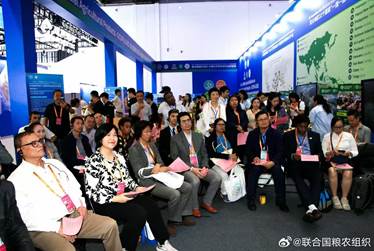
Figure
4 International capacity
building workshop on GIES technology free transfer (2024,Beijing,
China)
Besides, the hands-on training in Bhutan, Panama and Nepal
were very successful held (Figure 5, 6).
In the following years, we will keep going on GIES
technology free transfer and capacity building for OCOP implementation and to
have the joint actions to enhance the impacts of OCOP GIES products in
triple-win model.
|
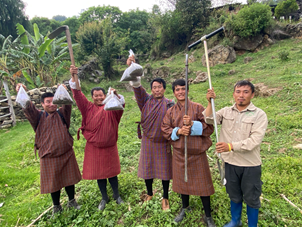
Figure 5 Hands-on training on GIES technology
free transfer in Bhutan (2024, Tashigang)
|
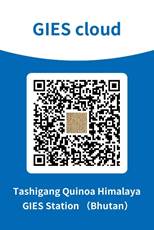
Figure 6 Tashigang
Quinoa Himalaya GIES station (Bhutan) was established (Sep. 1, 2025)
|
Ladies
and gentlemen,
GIES
is an innovative S&T toolchain. It is technology, but not only, for OCOP,
it is accelerator! It can help people to understand OCOP more in their
knowledge, to taste OCOP more in their daily life, to feel OCOP more in their
culture, and even more, to touch OCOP more in their souls and hearts. I am
confidence and sincerely believe and trust: OCOP GIES, we are one!
Thank
you!
References
[1]
FAO.
High-level event on the implementation of the FAO One Country One Priority Product
(OCOP)Initiative [EB/OL]. (2025-10-15) [2025-12-05]. https://www.fao.org/one-country-one-priority-product/news-and-events/events/events-detail/high-level-event-on-the-implementation-of-the-fao-one-country-one-priority-product-(ocop)-initiative/en.
[2]
FAO.
EM07-High-Level Event on the Implementation of the FAO One Country One Priority
Product (OCOP) Initiative [Z/OL]. (2025-10-15)
[2025-12-05]. https://www.fao.org/webcast/detail/em07-high-level-event-on-the-implementation-of-the-fao-one-country-one-priority-product-(ocop)-initiative/en.
[3]
FAO. WFF 2025: Special event
boosts momentum for the implementation of the One Country OnePriority Product
(OCOP) Initiative [EB/OL]. (2025-10-15) [2025-12-05]. https://www.fao.org/newsroom/detail/wff-2025--special-event-boosts-momentum-for-the-implementation-of-the-one-country-one-priority-product-(ocop)-initiative/en.
[4]
FAO. Photos of High-level event
on the implementation of the FAO One Country One Priority Product (OCOP)
Initiative [Z/OL]. (2025-10-15) [2025-12-05]. https://digital-media.fao.org/Share/2673nb87u2jt2hx5dgob8k8d8d5xh54k.
[5]
FAO. High-level event
underscores progress of One Country One Priority Product Initiative
[Z/OL].(2025-10-16) [2025-12-05]. https://www.fao.org/one-country-one-priority-product/asia-pacific/news/detail/high-level-event-underscores-progress-of-one-country-one-priority-product-initiative/en.
[6]
Liu, C. GIES Support FAO OCOP implementation:
speech at the High-Level Event of Implementation of FAO OCOP Initative at the
FAO 80th Anniversary [J/DB/OL]. Digital Journal of Global Change
Data Repository, 2026. https://doi.org/10.3974/geodb.2026.01.04.V1.
[7]
Li,
X., Liu, C. MoU between FAO and IGSNRR on GIES supporting OCOP [J]. Journal
of Global Change Data & Discovery, 2024, 8(3): 223–229.
https://doi.org/10.3974/geodp.2021.03.01.
[8]
FAO.
The Global Action on Green Development of Special Agricultural Products: One
Country One Priority Product: Action Plan 2021–2025 [M/OL]. Rome: FAO, 2022.
https://doi.org/10.4060/cc0608en.
[9]
Liu, C., Gong, K., Liu, Y. H., et al. An
innovative solution on Geographical Indications Environment & Sustainability (GIES) [J]. Journal
of Global Change Data & Discovery, 2021, 5(3): 237–248.
https://doi.org/10.3974/geodp.2021.03.03.
[10]
Wang,
S. L. A new milestone of high-level cooperation between FAO and IGSNRR-CAS [J].
Journal of Global Change Data & Discovery, 2024, 8(3): 230–231.
https://doi.org/10.3974/geodp.2021.03.02.