GIES Case Study on Fangxian
Black Fungus Interforest Facility Agriculture
Yang, L. H.1,2* Yang, D. H.3 Lin, Y. G.3 Deng, J.4 Liu, M. D.5 Cheng, X. Y.1,2 Tian, M. C.6 Chen, Z. H.7 Shi, Z.5 Yang, Y. L.7 Liu, R.7 Yang, F.1,2 Jiang, C.1,2 Bian, Y. B.8 Zhang, F. G.9 Meng, T. L.10 Wang, M. A.7 Fang, S. H.7 Ma, J.11 Chen, Y. B.12 Tang, L.13 Guan, J.14 Tang, S. B.15 Xie, R.16 Wang, H.17 Deng, M.18 Liu, J.19
1.
Institute of Geographic Sciences and Natural Resources Research, Chinese
Academy of Sciences, Beijing 100010, China; 2. University of Chinese Academy of
Sciences, Beijing 100049, China; 3. People’s Government of Fangxian County,
Fangxian County 442100, China; 4. Agriculture and Rural Affairs Bureau of
Fangxian County, Fangxian County 442100, China; 5. Development and Reform
Bureau of Fangxian County, Fangxian County 442100, China; 6. Forestry Bureau of
Fangxian County, Fangxian County 442100, China; 7. Vegetable Service Center of
Fangxian County, Fangxian County 442100, China; 8. College of Plant Science and
Technology, Huazhong Agricultural University, Wuhan 430072, China; 9.
Meteorological Bureau of Fangxian County, Fangxian County 442100, China; 10. Agricultural
Technology Extension Service Center of Fangxian County, Fangxian County 442100,
China; 11. Fangxian County Xincai
Capital Operation Group Co., Ltd., Fangxian County
442100, China; 12. People’s Government of Tucheng Town, Fangxian County,
Fangxian County 442115, China; 13. People’s Government of Qingfeng Town,
Fangxian County, Fangxian County 442101, China; 14. People’s Government of
Jundian Town, Fangxian County, Fangxian County 442104, China; 15. People’s
Government of Baihe Town, Fangxian County, Fangxian County 442100, China; 16.
People’s Government of Mengusi Town, Fangxian County, Fangxian County 442108,
China; 17. People’s Government of Zhongba Township, Fangxian County, Fangxian
County 442109, China; 18. People’s Government of Wanyuhe Township, Fangxian
County, Fangxian County 442102, China; 19. People’s Government of Shahe
Township, Fangxian County, Fangxian County 442102, China
Abstract: Fangxian
black fungus is a specialty product of Fangxian County in Hubei Province, China.
It is Geographical Indication product of China, and it
was listed at the EU-China GI Agreement products, renowned for its unique
quality and nutritional value. The ecological environment, cultivation
techniques, product quality, and business management of Fangxian black fungus
was investigated. A model of habitat conservation and sustainable development
for black fungus interforest facility agriculture was explored. The case area
lies between the Daba and Wudang Mountains and is characterized as a hilly-mid-mountain
region. The black fungus planting areas utilize 2 cultivation methods:
log-grown black fungus and bag-grown black fungus. The substrate is rich in
organic matter, and the water used for spraying meets higher quality standards
than those specified in the Standard for irrigation water quality (GB
5084—2021), the product quality meets or exceeds the national standard. The
case dataset consists of 4 parts: case-area boundary, physical geographic data,
black fungus variety characteristics, and management and cultural traditions.
The data are archived in .shp, .xlsx, .docx, .jpg, .txt and .tif formats.
Keywords: Fangxian County; black fungus;
facility agriculture; GIES; Case 27
DOI: https://doi.org/10.3974/geodp.2025.04.09
Dataset Availability Statement:
The dataset supporting
this paper was published and is accessible through the Digital Journal of
Global Change Data Repository at: https://doi.org/10.3974/geodb.2025.09.06.V1.
1 Introduction
With
the growing demand for healthy foods, black fungus, as an edible mushroom with
high nutritional value, has gradually become a popular product in the market[1]. Fangxian County is located
in the northwest of Hubei Province, in the hilly-mid-mountain area between the
Daba and Wudang Mountains. It lies in the northern subtropical zone, with a
mild climate and abundant rainfall, which are highly suitable for the growth of
black fungus.
Fangxian black
fungus, with its unique texture and rich nutrient content, has become an
important source of production and livelihood for local farmers. The ecological
environment, cultivation techniques, product quality, and business management
of Fangxian black fungus was investigated. A model of habitat conservation and
sustainable development for black fungus interforest facility agriculture was
explored.
2 Metadata of the Dataset
The
metadata of the GIES case dataset on Fangxian black fungus interforest facility
agriculture[2]
is summarized in Table 1. It includes the dataset full name, short name,
authors, year of the dataset, data format, data size, data files, data
publisher, and data sharing policy, etc.
Table
1 Metadata summary of GIES case dataset on Fangxian black fungus
interforest facility agriculture
|
Items
|
Description
|
|
Dataset full name
|
GIES case dataset on Fangxian black fungus interforest facility
agriculture
|
|
Dataset short name
|
FangxianBlackFungusCase27
|
|
Authors
|
Yang. L. H., Institute of Geographic
Sciences and Natural Resources Research, Chinese Academy of Sciences, yanglihu@igsnrr.ac.cn
Yang, D. H., People’s Government of
Fangxian County
Lin, Y. G., People’s Government of
Fangxian County
Deng, J., Agriculture and Rural
Affairs Bureau of Fangxian County
Liu, M. D., Development and Reform
Bureau of Fangxian County
Cheng, X. Y., Institute of Geographic
Sciences and Natural Resources Research, Chinese Academy of Sciences,
1163716758@qq.com
Tian, M. C., Forestry Bureau of
Fangxian County
Chen, Z. H., Vegetable Service Center
of Fangxian County
Shi, Z., Development and Reform
Bureau of Fangxian County
Yang, Y. L., Vegetable Service Center
of Fangxian County
Liu, R., Vegetable Service Center of
Fangxian County
Yang, F., Institute of Geographic
Sciences and Natural Resources Research, Chinese Academy of Sciences, 1228382850@qq.com
Jiang, C., Institute of Geographic
Sciences and Natural Resources Research, Chinese Academy of Sciences, jiangchao23@mails.ucas.ac.cn
Bian, Y. B., College of Plant Science
and Technology, Huazhong Agricultural University,
bianyinbing@mail.hzau.edu.cn
Meng, T. L., Edible Mushroom Industry
Association of Fangxian County
Wang, M. A., Vegetable Service Center
of Fangxian County
Fang, S. H., Vegetable Service Center
of Fangxian County
Ma, J., Fangxian
County Xincai Capital
Operation Group Co., Ltd.
Chen, Y. B., People’s Government of
Tucheng Town, Fangxian County
|
(To be continued on the next
page)
(Continued)
|
Items
|
Description
|
|
|
Tang, L., People’s Government of
Qingfeng Town, Fangxian County
Guan, J., People’s Government of Jundian Town, Fangxian County
Tang, S. B., People’s Government of
Baihe Town, Fangxian County
Xie, R., People’s Government of Mengusi
Town, Fangxian County
Wang, H., People’s Government of
Zhongba Township, Fangxian County
Deng, M., People’s Government of
Wanyuhe Township, Fangxian County
Liu, J., People’s Government of Shahe
Township, Fangxian County
|
|
Geographical region
|
Fangxian County, Shiyan City, Hubei
Province
|
|
Year
|
2000–2025
|
|
Data format
|
.shp, .xlsx, .docx, .jpg, .txt, .tif
|
|
Data size
|
90.4 MB
|
|
|
|
Data files
|
Case area boundary, physical
geographic data, black fungus variety characteristics, and management and
cultural traditions
|
|
Data publisher
|
Global Change Research Data
Publishing & Repository, http://www.geodoi.ac.cn
|
|
Address
|
No. 11A, Datun Road, Chaoyang
District, Beijing 100101, China
|
|
Data sharing policy
|
(1) Data are openly available and can be free downloaded via the
Internet; (2) End users are encouraged to use Data subject to citation; (3) Users, who are by definition also
value-added service providers, are welcome to redistribute Data subject to written permission
from the GCdataPR Editorial Office and the issuance of a Data redistribution license; and (4) If Data are used to compile new datasets, the “ten percent
principal” should be followed such that Data
records utilized should not surpass 10% of the new dataset contents, while
sources should be clearly noted in suitable places in the new dataset[3]
|
|
Communication
and searchable system
|
DOI, CSTR,
Crossref, DCI, CSCD, CNKI, SciEngine, WDS, GEOSS, PubScholar, CKRSC
|
3 Case Dataset Development
3.1 Case Area
The
black fungus cultivation area in Fangxian County is located in the northwest of
Hubei Province and the southern part of Shiyan City, between the Daba and
Wudang Mountains. It is a hilly and mountainous region and one of China’s
famous black fungus production bases, known as the “Hometown of Black Fungus”[4].
Due to the diversity of terrain and landforms, the advantage of microclimate is
obvious, which is very suitable for the growth of edible fungi.
The case area
includes 8 townships: Tucheng Town, Qingfeng Town, Jundian Town, Baihe Town,
Mengusi Town, Zhongba Township, Wanyuhe Township, and Shahe Township (Figure
1). The total area is about 2,600 km2, with a total population of
191,419, including 22,534 in Tucheng, 35,339 in Qingfeng, 38,792 in Jundian,
32,833 in Baihe, 33,837 in Mengusi, 11,284 in Zhongba, 8,112 in Shahe, and
8,688 in Wanyuhe (Table 2).
3.2 Topography
The terrain of Fangxian
County is high in the west and low in the east, steep in the south and gentle
in the north, with valley plains in the middle. Based on analysis of ASTER
(Advanced Spaceborne Thermal Emission and Reflection Radiometer) DEM data, the
elevation in Fangxian County ranges from 160 m to 2,470 m (Figure 2). Taking
the Qingfeng fault zone as a boundary, the northern mountainous area has
elevations of 800–1,000 m, with mountain ranges mainly oriented east-west,
northeast, or southeast. The ridges are broad and the mountaintops are
table-like, with interspersed valley basins that are the main production areas
of maize, rice, wheat and black fungus. A narrow and elongated faulted basin is
formed in the central region centered on the Malan River Valley, with an
altitude of 400–600 m. It is
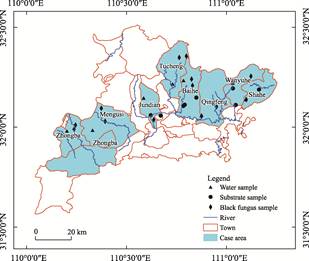
Figure 1 Geo-location,
boundary and sampling-point distribution map of the case area in Fangxian
County
Table 2 Statistics of area and total population
of the 8 townships in the case area (2024)
|
Item
|
Tucheng
|
Qingfeng
|
Jundian
|
Baihe
|
Zhongba
|
Mengusi
|
Shahe
|
Wanyuhe
|
Total
|
|
Population (person)
|
22,534
|
35,339
|
38,792
|
32,833
|
11,284
|
33,837
|
8,112
|
8,688
|
191,419
|
|
Area (km2)
|
353.01
|
415.00
|
160.70
|
228.79
|
224.00
|
306.00
|
236.00
|
192.40
|
2,115.9
|
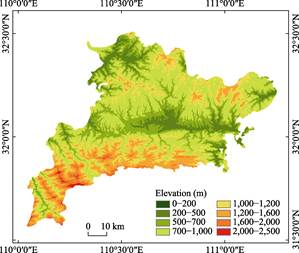
Figure 2 Elevation-classification
map of Fangxian County
not
only an important grain producing area, but also a major base for the
development of fruit and wood orchards[5]. The southern part is a
high-mountain area, mostly above 1,000 m, with steep terrain. It is the main
production area of maize, miscellaneous grains, and timber forests.
The altitude
difference in the whole county is significant, with the highest point Shangkan
Guanjiaya in the southwest (2,485.6 m) and the lowest point Damujiangjiapo (180
m), with a relative height difference of 2,306 m. This unique combination of
terrain and climate conditions provides an important natural basis for the
spatial differentiation of agricultural production in Fangxian County[6].
The terrain
slope of Fangxian County presents a feature of low in the middle and high
around, and the overall terrain gradually rises from the central valley plain
to the surrounding mountains. This pattern is mainly shaped by tectonic
movements in the Qinling-Daba Mountains and the
long-term fluvial incision of the Hanjiang River system, forming a basin-like
landform structure centered on the Fangxian County Basin and surrounded by
medium-low mountains.
The central area
is relatively flat, with slopes mostly below 15 ° (Table 3 and Figure 3), and
is the main area of town agglomeration and cultivated agriculture. The
surrounding area is mostly mountainous with an angle of over 15 °, and high
forest coverage.
Table 3 Statistics of
slope-class areas
|
Slope (°)
|
Area (km2)
|
Slope (°)
|
Area (km2)
|
Slope (°)
|
Area (km2)
|
|
<1
|
21.01
|
[7,15)
|
1,016.63
|
[25,35)
|
1,271.99
|
|
[1,3)
|
100.10
|
[15,25)
|
1,870.97
|
≥35
|
570.56
|
|
[3,7)
|
284.27
|
|
|
|
|
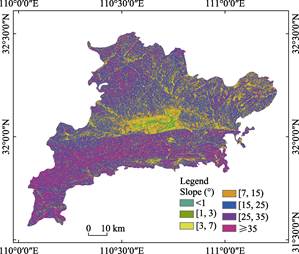
Figure 3 Slope-classification
map of Fangxian County
3.3 Climatic Data
Fangxian
County is located in the subtropical monsoon climate zone and exhibits distinct
vertical climatic characteristics. The region has long winters and short
summers, distinct 4 seasons, and a pronounced vertical climate gradient.
According to data from the Fangxian County Meteorological Station on the China
Meteorological Data Service Center for 2000–2024, the
annual mean relative humidity in the area is 75.1% (Figure 4), the annual mean
temperature is 15.0 ℃, and annual sunshine duration is 1,376–1,938 h. The
frost-free period is 223 d. Annual precipitation is 550.2–1,237.0 mm,
concentrated from April to October, which accounts for 86.3% of the total
annual precipitation, showing a gradient of increase from north to south. The
number of rainy days ranges from 101 to 137, with a mean of 121 d per year.
Major agrometeorological disasters in the area include late spring cold spells,
summer droughts (“neck-choking drought”), and cool/wet weather in autumn, all
of which have significant impacts on crop growth.
3.4 Land-use and
Vegetation Coverage
Based
on Sentinel-2 L2A imagery of Fangxian County in 2022 (cloud cover < 30%), monthly
median composites were generated after cloud-mask processing. 10 spectral bands
(B2–B8A, B11–B12), 4 vegetation indices (NDVI, NDWI, EVI, SAVI), and their
annual statistics (median, mean, standard deviation, extrema) were extracted as
features. A random-forest classifier was then used to carry out land-use
classification for Fangxian County (Figure 5).
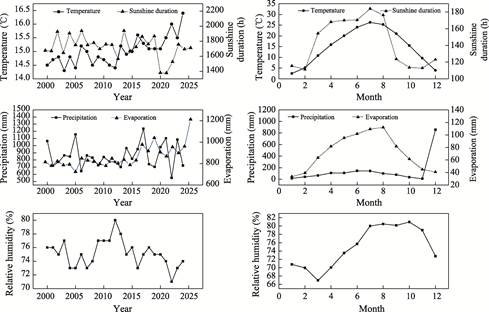
Figure 4 Statistics of climatic
characteristics in Fangxian County
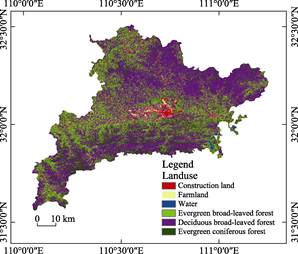
Figure 5 Land-use and
forest-distribution map of Fangxian County
The evergreen
broad-leaved forests in Fangxian County are mainly distributed in the central,
northwestern, and southwestern mountainous areas, the deciduous broad-leaved
forests are mainly distributed in the northwestern and southern mountainous
areas, and the evergreen coniferous forests are mainly distributed in the
southern mountainous areas. The total area of forest land is 4,355.5 km2,
with forest area of 3,941.9 km2 and forest cover of 84.6%. The
forests (mainly Quercus variabilis) used for log-grown black fungus belong to
deciduous broadleaf forests, with an area of 1,632.8 km2 and an
annual timber increment of 220,000 m3. On average, Fangxian County
produces 65,000 racks of logs per year for log cultivation, consuming about
13,000 m3 of timber, which accounts for 5.9% of the annual increment
of oak resources. All timber is sourced from within Fangxian County. In
addition, 15.8 million cultivation bags are produced annually, using 13.8
million kg of substrate materials, of which 87.4% are locally supplied.
3.5 Physicochemical
Analysis of Cultivation Substrates
The
cultivation substrates of Fangxian black fungus are mainly of 2 types:
bag-grown substrate and logs. According to the cultivation distribution in the
case area, samples of both bag substrate and logs were collected by the authors
in December 2024 (Figure 1) and sent to the Physicochemical Analysis Center of
the Institute of Geographic Sciences and Natural Resources Research, Chinese
Academy of Sciences (IGSNRR, CAS), for testing.
The testing
indicators included As, Cd, Pb, Cr, Ni, Cu, Zn, Hg, TN, TC, C/N, and organic
matter. The nitrogen content in the bag substrate and logs used for cultivation
ranged from 0.42% to 1.99%, and carbon content from 39.90% to 53.00%, with C/N
of 20.25–106.55, indicating relatively high nitrogen and carbon contents.
Organic matter content ranged from 68.79% to 91.38%, showing rich organic
matter. The heavy-metal contents (in both bag substrate and logs) were much
lower than the agricultural-land soil-pollution risk screening values in the
Soil environmental quality risk control standard for soil contamination of
agricultural land (Trial) (GB 15618—2018)[7] (Table 4).
Table 4 Statistics of the physicochemical
indicators in log/bag substrates in the case area
|
Test item
|
Max.
|
Min.
|
Avg.
|
GB 15618—2018 limiting
value[7]
|
Test item
|
Max.
|
Min.
|
Avg.
|
GB 15618—2018 limiting
value[7]
|
|
As (mg/kg)
|
ND
|
ND
|
ND
|
≤ 30
|
Zn (mg/kg)
|
113.08
|
25.79
|
50.32
|
≤ 250
|
|
Cd (mg/kg)
|
ND
|
ND
|
ND
|
≤ 0.3
|
Hg (mg/kg)
|
ND
|
ND
|
ND
|
≤ 2.4
|
|
Pb (mg/kg)
|
5.95
|
2.09
|
3.56
|
≤ 120
|
TN (%)
|
1.99
|
0.42
|
0.85
|
|
|
Cr (mg/kg)
|
72.54
|
14.80
|
28.11
|
≤ 200
|
TC (%)
|
53.00
|
39.90
|
43.48
|
|
|
Ni (mg/kg)
|
3.04
|
0.00
|
0.89
|
≤ 100
|
C/N
|
106.55
|
20.25
|
62.02
|
|
|
Cu (mg/kg)
|
11.21
|
3.00
|
6.74
|
≤ 100
|
Organic matter
(%)
|
91.38
|
68.79
|
74.96
|
|
Note: “ND”
indicates “not detected”.
3.6 Water Conditions
Data
Fangxian
County is relatively rich in water resources. There are 1,261 rivers of various
sizes with a total length of 3,455 km. There are mainly 4 major rivers in
Fangxian County, namely Nanhe, Duhe, Beihe, and Guanshan rivers, with a total
length of 2,612 km. The Panyu, Ximen, Shagou, Baojia, and Malan rivers converge
in the central urban area, with a drainage area accounting for 100% of Fangxian
County. There are 77 reservoirs of Grade-II or above in the county, including 1
large, 4 medium, 13 small-I and 59 small-II reservoirs, with a total storage
capacity of 584.27 million m³. The theoretical hydropower potential is 350,000
kW, of which more than 316,200 kW can be developed.
In August 2025, 8
sampling sites were set up in the case area (Figure 1) to collect water samples
used for spraying. Water quality was analyzed according to the basic control
indicators in the Standard for irrigation water quality (GB 5084—2021)[8].
The test results (Table 5) show that pH ranged from 7.1 to 7.9, and that all 16
basic indicators, including water temperature, suspended solids, BOD5,
COD, anionic surfactants, Cl, S, total salinity, Pb, Cd, Cr, Hg, As, fecal
coliform count, and helminth eggs, were below the limit values in the Standard
for irrigation water quality. The water quality also fully met the Standards
for drinking water quality (GB 5749—2022)[9], indicating the
excellent quality of water used in black fungus cultivation.
Table 5 Summary of
water-quality indicators in the case area
|
Test item
|
Max.
|
Min.
|
Avg.
|
GB5084—2021 limiting value[8]
|
GB5749—2022 limiting value[9]
|
|
pH
|
7.9
|
7.1
|
7.5
|
5.5–8.5
|
6.5–8.5
|
|
Water temperature (℃)
|
28.6
|
24.0
|
26.5
|
35
|
|
|
Suspended solids (mg/L)
|
7.0
|
0.0
|
0.9
|
60
|
|
|
BOD5 (mg/L)
|
2.1
|
0.9
|
1.4
|
40
|
|
|
COD (mg/ L)
|
10
|
4
|
6.6
|
100
|
|
|
Anionic surfactant (mg/L)
|
0.06
|
ND
|
0.01
|
5
|
|
|
Cl (mg/L)
|
8.4
|
1.8
|
4.6
|
350
|
250
|
|
S (mg/L)
|
ND
|
ND
|
ND
|
1.0
|
|
|
Total salt content (mg/L)
|
210
|
38
|
123.0
|
1,000
|
|
|
Pb (mg/L)
|
0.008
|
0.000
|
0.004
|
0.2
|
0.01
|
|
Cd (mg/L)
|
0.001
|
ND
|
0.000
|
0.01
|
0.005
|
|
Cr (mg/L)
|
0.0
|
ND
|
0.000
|
0.1
|
50
|
|
Hg (mg/)
|
ND
|
ND
|
ND
|
0.001
|
0.001
|
|
As (mg/L)
|
0.010
|
ND
|
0.003
|
0.1
|
10
|
|
Number of fecal coliforms (MPN/L)
|
5,400
|
230
|
1,585
|
20,000
|
|
|
Number of ascaris eggs (per 10L)
|
ND
|
ND
|
ND
|
20
|
|
Note: “ND”
indicates “not detected”.
3.7 Product Quality Data
The
testing data for Fangxian black fungus fully demonstrate its outstanding
quality characteristics and nutritional value. Based on testing of log-grown
and bag-grown samples from townships in the case area (Tables 6 and 7), the
nutritional features can be summarized as follows. The dry-to-fresh ratio of
log-grown black fungus had a mean of 1:11.2, and that of bag-grown black fungus
1:9.6, both meeting the national standard for black fungus (GB/T 6192—2019, ≥1:9)[10],
with log-grown black fungus having a higher rehydration ratio than bag-grown
fungus. Ash content ranged from 4.40% to 5.30% (mean 4.85%), which is within a
reasonable range and reflects that necessary mineral components are retained
after scientific processing, indicating precise process control.
Nutritional
indicators were particularly remarkable. Total sugar (as invert sugar) in
log-grown black fungus was 45.50%–56.50% (mean 52.1%), and in bag-grown black
fungus 47.8%–62.6% (mean 55.4%), more than twice the minimum requirement (≥22%)
in GB/T 6192—2019[10]. Crude protein averaged 9.8% (maximum 10.9%)
in log-grown and 9.6% (maximum 9.8%) in bag-grown samples, which is high among
edible fungi and confirms that black fungus is a high-quality source of plant
protein. Crude fat content was 0.40%–0.50% (mean 0.42%), satisfying modern
dietary demands for low-fat foods. Crude fiber ranged from 3.1% to 5.8% (mean
4.6%), ensuring both dietary-fiber health benefits and good palatability.
Food-safety
indicators showed that methyl mercury (as Hg) was 0.01–0.02 mg/kg, arsenic
0.02–0.08 mg/kg, lead (Pb) 0.16–0.41 mg/kg, and cadmium 0.04–0.26 mg/kg, all
far below the national limits for edible fungi in the National food safety
standard—maximum levels of contaminants in food (GB 2762—2022)[11]
(Hg ≤ 0.1 mg/kg, As ≤ 0.5 mg/kg, Pb ≤ 1.0 mg/kg, Cd ≤ 0.5 mg/kg). The pesticide
residues DDT and HCH were not detected, meeting the local standard for
geographical indication product Fangxian black fungus (DB42/T 598—2010)[12].
Overall,
Fangxian black fungus achieves a dual guarantee of nutrition and safety through
strict quality control. The synergy of multiple indicators provides it with
high nutritional value, functional properties, and food safety, making it a
typical example of high-quality edible fungi. With its “high protein, high
fiber, low fat, and low sugar” nutritional profile and significant spatial
differentiation in ash content, Fangxian black fungus not only meets modern
dietary needs, but also supports its uniqueness and certification feasibility
as a high-quality geographical-indication product at the biochemical-indicator
level.
Table 6 Statistical results of quality indicators
of log-grown black fungus in the case area
|
Test item
|
Max.
|
Min.
|
Avg.
|
GB/T 6192—2019 limiting value[10]
|
DB42/T 598—2010 limiting value[12]
|
|
Dry-wet ratio
|
1:10.6
|
1:11.8
|
1:11.2
|
1:9 or above
|
1:12
|
|
Water content (%)
|
11.5
|
11.9
|
11.7
|
≤12.0
|
≤14.0
|
|
Ash (by dry weight) (%)
|
4.8
|
5.3
|
5.0
|
≤6.0
|
≤6.0
|
|
Total sugar (by converted sugar) (%)
|
45.5
|
56.5
|
52.1
|
≥22.0
|
≥23.0
|
|
Crude protein (%)
|
9.3
|
10.9
|
9.8
|
≥7.0
|
≥7.0
|
|
Crude fat (%)
|
0.4
|
0.4
|
0.4
|
≥0.4
|
|
|
Lead (by Pb) (mg/kg)
|
0.298
|
0.382
|
0.344
|
≤1.0
|
≤0.5
|
|
Cadmium (by Cd) (mg/kg)
|
0.040
|
0.249
|
0.128
|
≤0.5
|
≤0.8
|
|
Inorganic arsenic (by As) (mg/kg)
|
0.022
|
0.084
|
0.051
|
≤0.5
|
≤0.5
|
|
Methyl mercury (by Hg) (mg/kg)
|
0.008
|
0.015
|
0.012
|
≤0.1
|
≤0.15
|
|
DDT (mg/kg)
|
ND
|
ND
|
ND
|
|
≤0.1
|
|
Hexachlorocyclohexane (mg/kg)
|
ND
|
ND
|
ND
|
|
≤0.2
|
Note: “ND”
indicates “not detected”.
Table 7 Statistical results
of quality indicators of bag-grown black fungus in the case area
|
Test item
|
Max.
|
Min.
|
Avg.
|
GB/T 6192—2019 limiting value[10]
|
DB42/T 598—2010 limiting value[12]
|
|
Dry-wet ratio
|
9.3
|
9.9
|
9.6
|
1:9 or above
|
1:12
|
|
Water content (%)
|
11.5
|
11.9
|
11.8
|
≤12.0
|
≤14.0
|
|
Ash (by dry weight) (%)
|
4.4
|
4.9
|
4.6
|
≤6.0
|
≤6.0
|
|
Total sugar (by converted sugar) (%)
|
47.8
|
62.6
|
55.4
|
≥22.0
|
≥23.0
|
|
Crude protein (%)
|
9.5
|
9.8
|
9.6
|
≥7.0
|
≥7.0
|
|
Crude fat (%)
|
0.4
|
0.5
|
0.4
|
≥0.4
|
|
|
Crude fiber (%)
|
3.1
|
5.8
|
4.6
|
3.0–6.0
|
3.0–6.0
|
|
Lead (by Pb) (mg/kg)
|
0.162
|
0.225
|
0.188
|
≤1.0
|
≤0.5
|
|
Cadmium (by Cd) (mg/kg)
|
0.050
|
0.100
|
0.063
|
≤0.5
|
≤0.8
|
|
Inorganic arsenic (by As) (mg/kg)
|
0.026
|
0.061
|
0.042
|
≤0.5
|
≤0.5
|
|
Methyl mercury (by Hg) (mg/kg)
|
0.005
|
0.012
|
0.008
|
≤0.1
|
≤0.15
|
|
DDT (mg/kg)
|
ND
|
ND
|
ND
|
|
≤0.1
|
|
Hexachlorocyclohexane (mg/kg)
|
ND
|
ND
|
ND
|
|
≤0.2
|
Note: “ND”
indicates “not detected”.
In addition,
amino-acid analysis of different varieties of black fungus showed that
amino-acid content is rich, especially essential amino acids such as proline,
leucine and phenylalanine (Table 8). Leucine, as a branched-chain amino acid,
plays an important role in muscle metabolism and immune regulation[13];
phenylalanine participates in protein synthesis and serves as a precursor of
tyrosine, dopamine and adrenaline, which are important for neurotransmission,
metabolic regulation and emotional stability[14]; proline is
involved in collagen synthesis and antioxidant regulation[15].
Compared with black fungus from northeastern China, Fangxian black fungus has
an advantage in the proportion of essential amino acids and the balance of key
amino acids such as leucine and phenylalanine. For example, the proline
contents in black fungus from 4 production regions (Yanji City, Mudanjiang
City, Zhashui County and Zhuoni County) are 0.33, 0.35, 0.43 and 0.46 mg/kg,
respectively, all lower than those in Fangxian black fungus[16].
Table 8 Statistical results of amino-acid
contents in black fungus in the case area
|
Test index
|
Min. (g/100g)
|
Max. (g/100g)
|
Avg.
(g/100g)
|
Test index
|
Min. (g/100g)
|
Max. (g/100g)
|
Avg.
(g/100g)
|
|
Leucine
|
0.410
|
0.740
|
0.563
|
Isoleucine
|
0.110
|
0.130
|
0.120
|
|
Phenylalanine
|
0.310
|
0.400
|
0.345
|
Alanine
|
ND
|
ND
|
ND
|
|
Glycine
|
ND
|
ND
|
ND
|
Glutamic acid
|
ND
|
ND
|
ND
|
|
Proline
|
1.050
|
1.520
|
1.283
|
Methionine
|
ND
|
ND
|
ND
|
|
Arginine
|
0.440
|
0.650
|
0.524
|
Histidine
|
0.560
|
0.690
|
0.640
|
|
Aspartic acid
|
ND
|
ND
|
ND
|
Serine
|
ND
|
ND
|
ND
|
|
Tyrosine
|
ND
|
ND
|
ND
|
Lysine
|
0.450
|
0.630
|
0.514
|
|
Valine
|
0.073
|
0.180
|
0.134
|
|
|
|
|
Note: “ND”
indicates “not detected”.
4 Black Fungus Industry Management
4.1 Socio-economic
Development of Fangxian County
Statistics
show that from 2015 to 2024 the populations of the 8 typical townships in the
case area all decreased, with the largest declines in Jundian (−7.06%) and
Shahe (−9.49%), mainly due to accelerated out-migration of young and
middle-aged people and limited urban and rural capacity to absorb them (Table 9).
Baihe saw only a 2.05% population decline, indicating relatively strong
demographic stability. Overall, Fangxian County has experienced sustained
population loss and ageing pressure over the past decade, especially affecting
the rural labor structure.
Table 9 Population change
in townships in the case area (2015–2024)
|
Township
|
Population in 2015 (person)
|
Population in 2024
(person)
|
Change in population (person)
|
Change percentage (%)
|
|
Tucheng
|
23,557
|
22,534
|
–1,023
|
–4.34
|
|
Qingfeng
|
36,952
|
35,339
|
–1,613
|
–4.37
|
|
Jundian
|
41,737
|
38,792
|
–2,945
|
–7.06
|
|
Baihe
|
33,520
|
32,833
|
–687
|
–2.05
|
|
Zhongba
|
11,980
|
11,284
|
–696
|
–5.81
|
|
Mengusi
|
35,074
|
33,837
|
–1,237
|
–3.53
|
|
Shahe
|
8,963
|
8,112
|
–851
|
–9.49
|
|
Wanyuhe
|
9,097
|
8,688
|
–409
|
–4.50
|
In terms of
income, the black fungus industry has become a pillar industry driving farmers’
income growth (Table 10). For example, in Yupinghe Village of Qingfeng Town,
per capita annual income from black fungus cultivation reaches 8,421 CNY,
accounting for 55% of total household income, while per capita income from
employment in breeding, log cutting, transportation and processing reaches
7,227 CNY, accounting for 47% of total income. In Shuanghe and Yanhe villages
in Baihe Town, the share of income from the black fungus industry is also close
to 50%, indicating a high degree of dependence. Although overall income levels
in Tucheng are relatively lower, in Tanggeng Village the combined share of
income from black fungus cultivation and related labor exceeds 60%, making it
still the primary source of household income.
Table 10 Per capita income and black
fungus-related income in typical townships in the case area
|
Township
|
Village
|
Permanent residents (person)
|
Per capita income from growing
black fungus (CNY/year)
|
Percentage of total income (%)
|
Per capita income of black
fungus workers (CNY/year)
|
Percentage of total income (%)
|
|
Tucheng
|
Tanggeng
|
1,450
|
5,895
|
38
|
4,526
|
29
|
|
Qingfeng
|
Yupinghe
|
1,540
|
8,421
|
55
|
7,227
|
47
|
|
Qingfeng
|
Longwanggou
|
1,527
|
7,485
|
49
|
5,800
|
38
|
|
Baihe
|
Donglang
|
1,782
|
7,699
|
50
|
6,164
|
40
|
|
Baihe
|
Yanhe
|
425
|
7,218
|
47
|
5,818
|
38
|
|
Baihe
|
Shuanghe
|
453
|
7,442
|
48
|
7,077
|
46
|
The employment
structure further confirms this pattern (Table 11). In typical villages, the
number of people engaged in local black fungus cultivation and labor accounts
for 20%–30% of the permanent population, forming a “village-clustered
employment pattern” for the industry. The proportion of residents working in black
fungus production outside the local area is relatively low, indicating that a
fairly complete local chain of production, processing and marketing has been
established, absorbing most of the surplus labor.
Table 11
Employment in the black fungus industry in typical townships in the case
area
|
Township
|
Village
|
Number of local planting
population (person)
|
Number of local
processing/labor workers (person)
|
Number of people going out for
planting (person)
|
Number of people going out for
processing or labor (person)
|
|
Tucheng
|
Tanggeng
|
152
|
38
|
0
|
0
|
|
Qingfeng
|
Meihuashan
|
57
|
16
|
0
|
0
|
|
Qingfeng
|
Longwanggou
|
171
|
43
|
0
|
0
|
|
Baihe
|
Donglang
|
266
|
67
|
0
|
0
|
|
Baihe
|
Shuanghe
|
258
|
65
|
0
|
0
|
|
Baihe
|
Yanhe
|
133
|
33
|
0
|
0
|
4.2 Historical Tradition
of Black Fungus Cultivation
Fangxian County has a long history of black fungus
cultivation. According to Tangbencaozhu, Fangxian black
fungus was already cultivated more than 1,300 years ago in the Tang Dynasty.
After the founding of P. R. China, the local government actively encouraged
black fungus cultivation. Over the long term, people in Fangxian County have
continually accumulated experience and improved production techniques,
eventually forming a high-yield, high-quality and efficient cultivation model.
Before the founding of P. R. China, black fungus production in Fangxian County
remained at a semi-artificial cultivation level in wild habitats. In 1968, the
Hubei Provincial Supply and Marketing Cooperative and the Ministry of Commerce
of China successively held provincial and national on-site meetings on black
fungus irrigation and production in Fangxian County, breaking the traditional
notion of “man plants, but heaven manages” and greatly increasing yield. In
1980, at the request of the All-China Federation of Supply and Marketing
Cooperatives, the Fangxian County Supply and Marketing Cooperative compiled
Three-character classic of black fungus production, which was used nationwide
to promote log-cultivation techniques. From 1979 to 1982, China Central
Television, Hubei Television, Shanghai Television and the Science and Education
Film Studio produced science films and news documentaries such as Black fungus,
Qianli Fangxian black fungus harvest, and Log cultivation of black fungus in
Fangxian County. In 2009, the Fangxian black fungus was approved to be the
Geographical Indication of China. In 2020, it was on the list of the EU-China
GI Agreement products. Fangxian County domesticated and selected local wild
strains to obtain varieties suitable for local cultivation, and established
non-polluted planting areas. Deep-hole, dense-planting, sprinkler irrigation
technologies and cultivation models of small bags in spring and large bags in
autumn were promoted. No chemical fertilizers or pesticides are used in
production; pest and disease control relies on traditional agricultural,
physical and biological methods, and the biological conversion rate exceeds
85%. Leading enterprises are supported to carry out Good Agricultural Practice
certification, quality-management and food-safety management-system
certification, as well as organic and green food certification.
4.3 Development of Interforest
Facility Agriculture
As
one of China’s major black fungus production areas, Fangxian County has
interforest facility agriculture infrastructure at a leading level within Hubei
Province. Focusing on the whole industrial chain of black fungus, the county
has gradually formed a complete supporting system covering strain propagation,
substrate production, cultivation management, storage and preservation,
processing and circulation. In the production segment, there are 3 strain and
substrate factories in the county: Fangxian County Yueming Strain Factory in
Jundian Town, Fangxian County Tianhe Fungi Industry Strain Factory in Tucheng
Town, and Hubei Junxiangyuan Biotechnology Co., Ltd. in Qingfeng Town. These
enterprises not only have strong capacity for strain research and production,
but have also introduced and applied advanced technologies such as liquid
spawn. Their annual outputs reach 5.7 million kg of solid spawn and 700,000 L
of liquid spawn.
With regard to
supporting infrastructure, in 2024, 1,524 double-layer drying greenhouses have
been built, covering 81.33 ha. A total of 864 ponds, water cellars and storage
tanks have been constructed for black fungus production. Micro-sprinkler
facilities have been installed for 100% of bag-grown black fungus production
and for 85% of log-grown production. Meanwhile, 34 cold storage units with a
total capacity of 3,800 m3 have been built, effectively improving
storage and preservation capacity. In terms of logistics and marketing, the
Green Agricultural Port Edible Mushroom Trading Market in Baihe Town covers
6.33 ha, including 3,800 m2 for edible mushroom trading, serving as
an important distribution hub for black fungus.
In the processing
segment, there are 12 black fungus processing enterprises in the county, with
an annual processing capacity of 5,400 t. In 2024, total black fungus output in
Fangxian County approached 4,000 t, with a comprehensive output value of 1.5 billion
CNY, sales revenue of 640 million CNY, and annual export earnings of 15 million
USD. Overall, the construction of interforest facility agriculture for black
fungus in Fangxian County ensures stable and efficient production, underpins
its industrial advantage as the “Hometown of Black Fungus in China”, and
provides a solid industrial foundation for characteristic regional agriculture
and rural revitalization.
4.4 Cultivation Management
of Black Fungus
Fangxian
black fungus is mainly cultivated in 2 forms: log-grown and bag-grown (Figure
6)[17]. Log-grown black fungus is mainly planted in Qingfeng, Baihe
and Mengusi; bag-grown black fungus is mainly cultivated in Tucheng, Jundian
and Baihe (Table 12). In the case area, up to 2024, 15.5 million cultivation
bags and 55,000 log racks are used, with Tucheng having the largest number of
bags (10 million) and Qingfeng having the largest number of log racks (12,000).
A special leading
group for production management has been established in the black fungus
planting area of Fangxian County. The chief executive of each township serves
as the group leader, and members include village chief executives and council members.
Unified organization and standardized management are implemented to ensure
standardized production of black fungus. Full-time personnel are assigned to
black fungus production, and cultivation technicians are invited to carry out
technical training and on-site guidance.
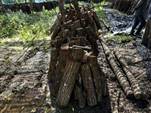
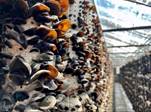
Figure 6 Black fungus (left:
log-grown; right: bag-grown)
Table 12
Planting statistics of black fungus in the case area (2024)
|
Township
|
Bag-grown black fungus (thousand
bags)
|
Log-grown black fungus (thousand
frames)
|
|
Tucheng
|
10,000
|
5
|
|
Qingfeng
|
2,000
|
12
|
|
Jundian
|
1,000
|
0
|
|
Baihe
|
1,000
|
10
|
|
Mengusi
|
500
|
10
|
|
Zhongba
|
500
|
5
|
|
Wanyuhe
|
0
|
8
|
|
Shahe
|
0
|
5
|
|
Total
|
15,500
|
55
|
The research and
development of the Fangxian black fungus case was conducted through a
seven-in-one approach integrating industry, academia, research, government,
association, farmers, and media. The collaboration among Fangxian
County Xincai Capital Operation Group Co., Ltd., the
College of Plant Science and Technology, Huazhong Agricultural University, IGSNRR,
CAS, the Fangxian County Government, the Agriculture
and Rural Affairs Bureau of Fangxian County, the Development and Reform Bureau
of Fangxian County, the Geographical Society of China, local villagers in
various towns of Fangxian County, and the Editorial Office of the Journal of
Global Change Data & Discovery ensured the success of this case.
During the R&D process, the Fangxian County Government and Fangxian County Xincai Capital Operation Group Co., Ltd. established a
unified production process archive for black fungus, documenting the entire
production cycle according to standardized requirements to facilitate
traceability management.
4.5 Harvesting,
Processing Management
Harvesting
and processing of black fungus follow standardized procedures to ensure product
quality and safety. According to the processing technical specification of
Fangxian black fungus (Q/FXME-003), processing plants must be located away from
pollution sources, and workshops must be equipped with facilities against
insects and rodents, as well as changing and disinfection rooms. Processing
personnel must hold valid health certificates and wear standardized work
clothes.
After
harvesting, raw materials are accepted strictly according to grade, color and
impurity levels. Qualified raw materials are spread to pre-dry to about
two-thirds moisture content, and then dried in dryers. A stepwise
temperature-rising method is used, starting from 30 ℃ and increasing by
5 ℃ every 3 h, with a final temperature not exceeding 45 ℃. Final
moisture content must be below 12%.
The processing
flow includes screening, drying, grading and packaging. Grading is based on the
completeness of ears, color, thickness and impurity content, and products are
classified into first, second, third and substandard grades. Packaging
materials must meet the sanitary standard GB 4806.7—2023, and product labels
must be clear and complete.
Finished
products are stored in dedicated warehouses, protected against mold and
insects. During transportation, direct sunlight and rain must be avoided, and
black fungus must not be transported together with toxic or hazardous goods.
According to differences in harvest seasons, black fungus is divided into
spring fungus (best quality), summer fungus (medium) and autumn fungus
(intermediate), and is managed separately to optimize product value.
Through
full-process technical control, the sensory quality, sanitary safety and market
competitiveness of Fangxian black fungus are effectively ensured.
4.6 Traceability
Technology for Fangxian Black Fungus
|
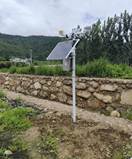 
Figure 7 GIES ground station for
Fangxian black fungus
|
Traceability
data for Fangxian black fungus mainly include 3 categories: cultivation and
production, environmental monitoring (ground stations), and processing and
storage. Through full-process data collection and management, product
traceability and quality assurance are realized. In the production link,
information such as strain ID, strain source and activity test reports is
recorded. Near real-time data collection is realized via GIES ground station
(Figure 7), enabling dynamic monitoring of the growth environment. 13
indicators are monitored: air temperature, wind speed, wind direction, air
pressure, humidity, soil temperature, soil moisture, total radiation,
atmospheric CO2, PM2.5, PM10 and noise.
Continuous monitoring provides data on crop growth, pest and disease
occurrence, and climate change. By linking these monitoring data with strain
IDs and plot information, visualization and fine-scale management of production
are enhanced, and robust data support is provided for risk early warning,
quality evaluation and storage/preservation. In the processing link, processing
parameters (drying temperature gradient, moisture control), quality grades and
microbiological indicators (e.g., Escherichia coli, Salmonella and other 5
pathogenic bacteria) are recorded. In the storage link, warehouse temperature,
relative humidity, real-time monitoring data and sampling results for quality
inspection are documented.
5 Discussion and Conclusion
The
black fungus cultivation area in Fangxian County is located in the northwest of
Hubei Province. Its unique natural environment has given rise to high-quality
black fungus with distinct geographical characteristics. To ensure the
high-quality development of Fangxian black fungus in the future, efforts can be
further strengthened in several aspects, including standardized management of
black fungus cultivation, quality assurance, and sustainable development of the
ecosystem. By addressing these issues, Fangxian black fungus can achieve
sustainable development, further enhance local economic development, and
contribute to rural revitalization.
Author Contributions
Yang, L. H. designed the
overall case study and implementation plan; Yang, D. H., Lin, Y. G., Deng, J.,
Liu, M. D., Chen, Z. H. and Shi, Z. coordinated the field investigation in the
case area; Yang, Y. L., Tian, M. C. and Zhang, F. G. provided data on ecological
environment, cultivation management and industrial operation; Meng, T. L.,
Wang, M. A., Fang, S. H., Ma, J., Chen, Y. B., Tang, L., Guan, J., Tang, S. B.,
Xie, R., Wang, H., Deng, M. and Liu, J. assisted in field surveys and sample
collection; Bian, Y. B. reviewed the paper; Yang, L. H., Cheng, X. Y., Yang,
F., Yang, Y. L. and Liu, R. participated in field investigations in the case
area and collected and analyzed water, log substrates, bag substrates and black
fungus samples; Yang, L. H., Cheng, X. Y. and Jiang, C. completed the
compilation of the dataset, mapping, and writing of the paper.
Acknowledgements
The
authors express their sincere thanks to leaders at all levels in Fangxian
County for their support and cooperation, and to all staff members who assisted
in the collection of water, log, bag substrate and black fungus samples. We
sincerely thank Liu, C., Song, X. F., Wang, Z. B. and Zhang, S. D. of the
Geographical Indication Research Center of IGSNRR, CAS, for their assistance
and helping in the project initiation and data collection.
Conflicts of Interest
The authors declare no conflicts of
interest.
References
[1]
Yang, Y. N., Zhang, S. Q., Liu, Y. J. Nutritional components and functions
of black fungus [J]. Agricultural Product Processing,
2024(15):91–93. DOI: 10.16693/j.cnki.1671-9646(X).2024.15.021.
[2]
Yang, L. H., Yang, D. H., Lin, Y. G., et al.
GIES case dataset on Fangxian black fungus interforest facility agriculture [J/DB/OL].
Digital Journal of Global Change Data Repository, 2025.
https://doi.org/10.3974/ geodb.2025.09.06.V1.
[3]
GCdataPR Editorial Office. GCdataPR data
sharing policy [OL]. https://doi.org/10.3974/dp.policy.2014.05
(Updated 2017).
[4]
Ming, C. C., Jia, M., He, W., et al. The development history and prospects
of edible fungi industry in Fangxian County [J]. Anhui Agricultural Science
Bulletin, 2021, 27(16): 33–34. DOI: 10.16377/j.cnki. issn1007-7731.2021.16.011.
[5]
Ji, D. C. Research on the current situation of utilization
and development of edible fungi resources in Fangxian County [D]. Wuhan: Wuhan
Polytechnic University, 2021. DOI: 10.27776/d.cnki.gwhgy.2021.000078.
[6]
Liang, W., Zhao, S, D. Research on the path for high-quality development of
the edible fungi industry in Fangxian County [J]. Journal of Hubei
Vocational and Technical College, 2023, 36(6): 42–45.
[7]
Ministry of Ecology and Environment of P. R. China, State Administration
for Market Regulation. Soil environmental quality risk control standard for
soil contamination of agricultural land (Trial) (GB 15618—2018) [S]. Beijing:
China Environment Publishing Group, 2018.
[8]
Ministry of Ecology and Environment of P. R. China, State Administration
for Market Regulation. Standard for irrigation water quality (GB 5084—2021)
[S]. Beijing: China Environment Publishing Group, 2021.
[9]
State Administration for Market Regulation, National Standardization
Administration. Standards for drinking water quality (GB 5749—2022) [S].
Beijing: Standards Press of China, 2022.
[10]
State Administration for Market Regulation, National Standardization
Administration Committee. Black fungus (GB/T 6192—2019) [S]. Beijing:
Standards Press of China, 2019.
[11]
National Health Commission of P. R. China, State Administration for Market
Regulation. National food safety standard—maximum levels of contaminants in
food (GB 2762—2022) [S]. Beijing: Standards Press of China, 2022.
[12]
Hubei Provincial Bureau of Quality and Technical Supervision. Standard for geographical
indicationproduct—Fangxian Black fungus (DB42T598—2010) [S/OL].
2010. https://std.samr.gov.cn/db/search/stdDBDetailed?id=91D99E4D522B2E24E05397BE0A0A3A10.
[13]
Sun, B., Sun, Y. C., Han, X. S.,
et al. Leucine supplementation alleviates immune and antioxidant function damage
in adult rats induced by early weaning [J]. The Journal of Nutrition, 2023,
153(5): 1607–1617.
[14]
Berguig, G. Y., Martin, N. T., Creer, A. Y., et al. Of mice and men:
plasma phenylalanine reduction in PKU corrects neurotransmitter pathways in the
brain [J]. Molecular Genetics and Metabolism, 2019, 128(4): 422–430.
[15]
Yusuf, M., Khan, T. A., AlBlooshi, F. S., et al. Unveiling the
protective role of silicon dioxide nanoparticles against copper-induced
oxidative damage in soybean plants through altered proline metabolism and antioxidants
[J]. Plant Nano Biology, 2025, 12: 100149.
[16]
Li, T., Yu, K. N., Wang, X. W., et al. Analysis of nutritional quality
of black fungus from 4 provinces [J]. Arid Agriculture
Science, 2025, 4(2): 140–147.
[17]
Guo, M. R. Key technologies for
high-quality and high-efficiency bagged cultivation of black fungus [J]. Southeast
Horticulture, 2023, 11(1): 66–69. DOI: 10.20023/j.cnki.2095-5774.2023.01.013.