DENG Zhidong1 LI Junfeng2 DUAN Junxiang1 WU Fan3 WANG Hongliang3 CHEN Yaya3 YE Peng4* WANG Shu5,6*
1. State
Grid Customer Service Center, Tianjin 300304, China; 2. State Grid Hubei
Electric Power Co., Ltd., Wuhan 430040, China; 3. SFMAP (Shenzhen) Co., Ltd.,
Shenzhen 518101, China; 4. College of Civil Engineering and
Transportation, Yangzhou University, Yangzhou 225127, China; 5. State Key
Laboratory of Geographic Information Science and Technology, Institute of
Geographic Sciences and Natural Resources Research, Chinese Academy of
Sciences, Beijing 100101, China; 6. Jiangsu Center for
Collaborative Innovation in Geographical Information Resource Development and
Application, Nanjing 210023, China
Abstract:
As an important carrier of industrial culture, industrial heritage requires
standardized spatial and attribute data to support its systematic protection
and management. Based on the lists of the 7 batches of National Industrial
Heritage sites from 2017 to 2025 published by the Ministry of Industry and
Information Technology of China, the authors obtained the geographic
coordinates of the relevant administrative regions via the MAP WORLD retrieval
service, and subsequently integrated attribute information, including the
heritage names, applying organizations, core items, and administrative
divisions, to construct the final dataset following rigorous data cleaning and
standardization processes. This dataset can provide fundamental data support
for the spatial analysis, value assessment, and digital preservation of
industrial heritage, thus demonstrating significant value for both academic
research and practical application. The dataset includes: (1) the spatial
distribution data of the 266 National Industrial Heritage sites, including
their respective provinces, municipalities, and counties; (2) the total number
of sites within each province; and (3) the total number of sites within each
municipality. The dataset is archived in .shp and .xls formats, and consists of
7 data files with data size of 1.16 MB (compressed into 1 file with 146 KB).
Keywords: National Industrial Heritage; national-level;
spatial distribution; China
DOI: https://doi.org/10.3974/geodp.2026.04.09
Dataset Availability Statement:
The dataset supporting this paper
was published and is accessible through the Digital Journal of Global Change Data Repository at: https://doi.org/10.3974/geodb.2026.03.03.V1.
1 Introduction
Amid the ongoing revitalization of old urban areas
and urban functional renewal in China, the conservation, transmission, and
adaptive reuse of industrial heritage have increasingly been recognized as a
global research focus within the field of urban planning. By definition, National Industrial Heritage (NIH)
is comprised of the significant remnants throughout China’s industrialization.
These remnants are evaluated and certified by the Ministry of Industry and
Information Technology of China (MIIT), and are
characterized by their core history, technology, society, and aesthetic values[1].
The core elements of NIH are defined as the comprehensive collection of all
tangible and intangible assets that effectively illustrate their distinct
industrial attributes. Specifically, tangible assets are primarily comprised of
physical structures utilized for production, storage, and transportation, such
as factories, workshops, mills, and mining sites. Furthermore, ancillary
industrial buildings designated for administration, scientific research, and
residential services are included, alongside physical resources such as
industrial machinery, production tools, office equipment, manufactured goods, and historical archives.
Conversely, intangible elements are categorized as immaterial industrial
cultural resources. These predominantly encompass specialized production techniques,
corporate management frameworks, and the local industrial ethos or corporate
culture[2].
The historical
imprint of industrial construction is preserved within industrial heritage,
which is recognized as the core resource embodying the essence of local
industrial culture and documenting the development trajectory of the sector. To
standardize practices related to industrial heritage, multiple specialized
policies have been successively introduced in China since 2006. Specifically,
documents such as the Notice on strengthening the protection of industrial heritage
and the Guiding opinions on promoting the development of industrial culture
were issued, providing a systematic framework for the preservation, management,
and operation of domestic industrial heritage. In 2017, with a focus on
comprehensive surveys and protective preservation, a specialized notice was
issued by the MIIT to officially launch the pilot application process for the
certification of NIH. In 2023, the relevant institutional
framework was further refined through the promulgation of the Measures for the management
of NIH by the MIIT. Within this document, operational principles and
implementation guidelines across various stages, including qualification
certification, daily maintenance, development and utilization, and regulatory
supervision, were explicitly defined[3]. As of 2025, 7 rounds of
industrial heritage evaluation and certification have been completed at the
national level, resulting in a total of 266 designated heritage sites. These
significant remnants embody traditional cultural contexts and the revolutionary
lineage of socialist industrialization, serving as comprehensive testaments to
the entire trajectory of industrialization in New China from its inception to
its development. Furthermore, scarce historical industrial resources have been
substantially safeguarded through subsequent salvage-based conservation
efforts. Consequently, through the enhancement of a standardized management
framework for NIH, not only can an exemplary industrial ethos be transmitted
and promoted to empower the long-term development of industrial culture, but
crucial practical significance is also achieved in elevating China’s industrial
cultural soft power and bolstering the comprehensive influence of Chinese
culture[4].
This dataset integrates spatial distribution data of all 266 NIH
sites nationwide, with statistical parameters covering heritage names, applying
institutions, core components, and geographic locations. It provides a solid
foundation for industrial heritage research and supports the excavation,
preservation, revitalization, and cultural inheritance of regional industrial
resources, demonstrating considerable scientific and practical value.
2 Metadata of the Dataset
The
metadata of Spatial distribution dataset of 266 National Industrial Heritage
items across 7 batches in China (2017–2025)[5] is summarized in
Table 1. It includes the full name, short name, authors, geographical region,
year of the dataset, temporal resolution, spatial resolution, data format, etc.
Table 1 Metadata
summary of the Spatial distribution dataset of 266 National Industrial Heritage
items across 7 batches in China (2017–2025)
|
Items
|
Description
|
|
Dataset full name
|
Spatial distribution dataset of 266 National
Industrial Heritage items across 7 batches in China (2017–2025)
|
|
Dataset short name
|
NIH_China_2017-2025
|
|
Authors
|
Deng, Z. D., State Grid Customer Service Center,
13913864188@139.com
Li, J. F., State Grid Hubei Electric Power Co., Ltd., 1607744@qq.com
Duan, J. X., State Grid Customer Service Center, 150121565@qq.com
Wu, F., SFMAP (Shenzhen) Co., Ltd., vance_woo@163.com
Wang, H. L., SFMAP (Shenzhen) Co., Ltd., 1936637988@qq.com
Chen, Y. Y., SFMAP (Shenzhen) Co., Ltd., 3150007286@qq.com
Ye, P., College of Civil Engineering and
Transportation, Yangzhou University, 007839@yzu.edu.cn
Wang, S., Institute of Geographic Sciences and Natural Resources Research,
Chinese Academy of Sciences, wangshu@igsnrr.ac.cn
|
|
Geographical region
|
China (currently unavailable for Hong
Kong, Macau, and Taiwan)
|
|
Year
|
2017–2025
|
|
Temporal resolution
|
Year
|
|
Spatial resolution
|
County
|
|
Data format
|
.shp, .xls
|
|
Data size
|
1.16 MB
|
|
Data files
|
266 NIH projects and their spatial distribution in
provinces, cities, and counties, the number of NIH projects in each province
and city
|
|
Foundations
|
National Natural Science Foundation of China
(42471503, 42301522); Chinese Academy of Sciences (XDB0740200-01); Ministry
of Science and Technology of P. R. China (2022YFF0711601); State Grid
(FT20240232)
|
|
Data publisher
|
Global Change
Research Data Publishing & Repository, http://www.geodoi.ac.cn
|
|
Address
|
No. 11A, Datun Road, Chaoyang District,
Beijing 100101, China
|
|
Data sharing policy
|
(1) Data
are openly available and can be free downloaded via the Internet; (2) End
users are encouraged to use Data
subject to citation; (3) Users, who are by definition also value-added
service providers, are welcome to redistribute Data subject to written permission from the GCdataPR Editorial
Office and the issuance of a Data
redistribution license; and (4) If Data
are used to compile new datasets, the “ten percent principle” should be
followed such that Data records
utilized should not surpass 10% of the new dataset contents, while sources
should be clearly noted in suitable places in the new dataset[6]
|
|
Communication
and searchable system
|
DOI, CSTR, Crossref, DCI, CSCD, CNKI,
SciEngine, WDS, GEOSS, PubScholar, CKRSC, OARL
|
3 Methods
3.1 Data Sources
The
lists of 7 batches of NIH from 2017 to 2025 were comprehensively collected.
These lists are sourced from relevant notices published on the official website
of the MIIT,
and the titles and release times of each notice are shown in Table 2.
3.2 Data Processing
Information
such as heritage names, addresses, and core components is primarily included
within the NIH lists published for each cohort by the MIIT.
Because geographical coordinate information
is omitted from these lists, the affiliated county-level administrative
regions were determined based on the reported address of each NIH site.
Geographical coordinates for the
Table
2 Relevant notices on the lists of NIH
|
Batch
|
Notice title
|
Time
|
Number
|
|
1
|
Announcement
of the MIIT on publishing the list of the first batch of NIH
|
Dec. 20, 2017
|
13
|
|
2
|
Announcement
of the MIIT on publishing the list of the second batch of NIH
|
Nov. 7, 2018
|
42
|
|
3
|
Announcement
of the MIIT on publishing the list of the third batch of NIH
|
Dec. 6, 2019
|
49
|
|
4
|
Announcement
of the MIIT on publishing the list of the fourth batch of NIH
|
Dec. 17, 2020
|
62
|
|
5
|
Announcement
of the MIIT on publishing the list of the fifth batch of NIH
|
Nov. 30, 2021
|
31
|
|
6
|
Notice
of the MIIT on announcing the list of the sixth batch of NIH
sites and the first and second batch of NIH sites
that have passed the review
|
Oct. 22, 2024
|
37
|
|
7
|
Notice
of the MIIT on announcing the list of the seventh batch of NIH sites and the third
batch of NIH sites that have passed the review
|
Oct. 17, 2025
|
32
|
administrative seats of these
county-level regions were obtained utilizing the retrieval service of MAP WORLD
(National Platform for Common GeoSpatial Information Services). Consequently,
spatial information for each NIH site was specified at the county level. To
ensure the requirement of data currency, the county-level administrative
regions to which the national heritage lists of each batch belong are based on
the administrative division codes of China on the National Database for
Geographical Names of China[7].
Due to
inconsistencies in the content of the released lists of NIH for each batch,
special processing is required in the following 3 aspects:
(1) In the official
announcements for the first through fourth batch of the NIH list, applicant
institutions were not specified. However, in the notification of the fifth to
the seventh batch of NIH list, as well as the notification of the first to the
third batch of NIH list that passed the review, the application unit was
specified. Consequently, within the final consolidated dataset, the “Declaring Agency”
field is populated for heritage sites in the first, second, third, fifth,
sixth, and seventh batch. Conversely, this field is designated as “Not available”
for sites within the fourth batch.
(2) Only a single
designated name was provided within the NIH lists for the first through fifth batch.
However, in the sixth and seventh batches of NIH
lists, both the application name and the approved name are included. Therefore,
in the dataset, the names in the notification are used as the heritage project
names for the first to fifth batch of NIH, while the approved names in the
notification are used as the heritage project names for the sixth and seventh
batch of NIH.
(3) Concurrently
with the announcement of the sixth and seventh batches, the lists of sites from
the first through third batches that had successfully passed reassessment were
released by the MIIT, thereby indicating that a dynamic management system for
these sites had been initiated. Consequently, based on the content of the
aforementioned notifications, fields for “Review Approved” and “Review Time”
were incorporated into each site entry within the dataset. Furthermore, because
the “Longjiang Forest Industry Huanan Forest Railway” (third batch) failed to
pass the reassessment conducted by the industry and information technology
authorities, the “Review Approved” field for this specific site was designated
as “No” within the dataset.
4 Data Results
4.1 Dataset Composition
The Spatial distribution dataset of 266 National Industrial Heritage
sites across 7 batches in China includes 2 parts: (1) Vector data of the
spatial distribution of NIH
(.shp); (2) Attribute data of NIH,
including heritage name, declaring agency, core items, and administrative
divisions (.xls). The field names and examples of the dataset are shown in
Table 3.
4.2 Data Results Analysis
At
the provincial level, the distribution of NIH exhibits a distinct regional
agglomeration effect (Figure 1). Sichuan Province ranks first with 22 sites
(8.3%), while Jiangxi, Shandong, and Liaoning Provinces tie for second place
with 16 sites (6.0%) each, followed closely by Jiangsu (15 sites, 5.6%) and Beijing (15 sites, 5.6%). Furthermore,
provinces in the central
Table 3 Attribute fields
of the dataset
|
No.
|
Field
|
Description
|
|
1
|
Index
|
1, 2, 3, ...
|
|
2
|
Batch
|
First batch, Second batch, Third batch,
...
|
|
3
|
Name
|
Zhangyu Wine-Making Company, Anshan Iron
and Steel Plant, Lüshun Dockyard, ...
|
|
4
|
Provincial Administrative Division
|
Shandong Province, Liaoning Province,
Jiangxi Province, ...
|
|
5
|
Municipal Administrative Division
|
Yantai City, Anshan City, Dalian City, ...
|
|
6
|
County Administrative Division
|
Zhifu District, Tiexi District, Lvshunkou
District, ...
|
|
7
|
Core Items
|
Dock, wood workshop, lifting warehouse,
dock authority, telegraph office, pump house, 1 dock gate, 3 bench vices, ...
|
|
8
|
Declaring Agency
|
Silk Road Holding Group Co., Ltd.,
Chongqing Industrial Museum Real Estate Co., Ltd., ...
|
|
9
|
Release Time
|
2017, 2018, 2019, ...
|
|
10
|
Review Approved
|
Yes, No
|
|
11
|
Review Time
|
2024
|
and
western regions, such as Hubei, Shaanxi, and Guizhou, each possess 11 to 13
heritage sites, accounting for 4.1% to 4.9% of the total, and this reflects the
unevenness and diversity in the regional distribution of industrial heritage,
indicating an equal emphasis on both the central and western regions and the
eastern coastal regions. This pattern is highly correlated with the course of
modern industrial development, as the provinces with a larger number of
heritage sites are predominantly key regions in the history of China’s
industrial development. Specifically, Sichuan, acting as the core area of the
Third Front Construction, has retained a substantial amount of heavy industrial
heritage, while Jiangxi and Shandong have formed heritage clusters due to the
emergence of modern national industries and resource-based industries, and the
quantity of heritage sites in traditional industrial bases like Jiangsu and
Liaoning also corroborates their historical industrial status. Consequently,
the quantity of heritage sites is directly related to the timing of local
industrial initiation, the industrial scale, and the historical status, thereby
embodying the spatial imprint of industrial heritage as a “living fossil of
industrial civilization”.
At the municipal level, the distribution presents a characteristic
pattern that is driven by core cities and supplemented by small and
medium-sized cities (Figure 2). Among prefecture-level cities, Jingdezhen (5
sites, 1.9%) and Kunming (5 sites, 1.9%) stand out prominently, as the former
has formed a characteristic cluster relying on its ceramic industrial heritage, while the latter has retained heritage imprints
due to the inland relocation of industries during the War of Resistance Against
Japanese Aggression. In addition, more than 10 cities, such as Changzhou,
Ganzhou, and Zunyi, each possess 4 heritage sites (1.5%), most of which are
important regional industrial hubs. Over 80% of the cities possess only 1–2
heritage sites, and these locations span small and medium-sized cities across
more than 30 provinces nationwide, indicating the extensive distribution of
industrial heritage at the municipal level, which encompasses both
resource-based cities (such as Daqing and Karamay) and traditional handicraft cities
(such as Jingdezhen and Weifang), thereby reflecting the diverse forms of
industrial civilization across different regions.
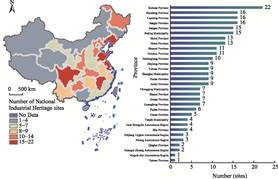
Figure
1 Spatial distribution map of NIH by
provinces of China
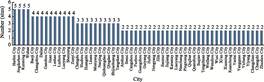
Figure
2 Statistical chart of the number of NIH
sites in some cities of China
Taken together, the
distribution of NIH not only continues the historical trajectory of modern
industry spreading from coastal areas to inland regions, but also reflects the
profound impact of national strategies, such as the Third Front Construction
and resource development, on the overall industrial layout. The combination of
concentration at the provincial level and dispersion at the municipal level
constitutes a three-tier distribution system consisting of core provinces, key
cities, and characteristic small and medium-sized cities, which provides clear
spatial guidance for the preservation and utilization of industrial heritage as
well as the inheritance of regional culture.
5 Discussion and
Conclusion
NIH
comprises valuable remnants accumulated during industrialization, encompassing
significant historical, technological, social, and artistic value.
Consequently, the systematic preservation and dynamic continuation of these
assets are heavily reliant upon standardized data. To construct this resource,
data pertaining to the 7 batches of NIH designated between 2017 and 2025 were
systematically compiled and standardized. Key attributes including heritage
names, declaring agencies, core items, and administrative divisions, were
incorporated, thereby generating a comprehensive dataset integrating both
vector and tabular formats. Furthermore, this dataset can provide fundamental
data for quantitative research in fields such as industrial heritage
preservation planning, the integrated development of culture and tourism, and
the inheritance of the industrial spirit, and it simultaneously supports
practical applications including GIS spatial analysis and the construction of
heritage value assessment models, ultimately aiming to achieve the desired
effect of facilitating the rescue-based preservation and sustainable
utilization of the “living fossil of industrial civilization”.
Author Contributions
Deng, Z. D., Li, J. F., and Duan, J. X. designed
the algorithms of dataset. Wu, F., Wang, H. L., and Chen, Y. Y. processed and
analyzed the data. Wang, S. made data validation. Ye, P. wrote the data paper.
Conflicts of
Interest
The authors declare no conflicts of interest.
References
[1]
Zhang, S. Y., Sun, J. Knowledge
graph analysis of National Industrial Heritage protection and reuse [J]. Architecture & Culture,
2025(3): 203–205.
[2]
Zhao, Q. N., Li, H. Research on
spatial differentiation characteristics and formation mechanism of National Industrial
Heritages [J]. Urban Problems,
2022(11): 54–64.
[3]
Zeng, C., Liu, P. L., Li, B.
H., et al. Temporal and spatial distribution characteristics and
influencing factors of industrial heritage in China: a case study of the four
batches of industrial heritage lists [J]. Tropical
Geography, 2022, 42(5): 740–750.
[4]
Chen, C. R., Cai, Y. N.
Advances in conservation and reuse of foreign industrial heritage based on
visual knowledge graph analysis [J]. Industrial
Construction, 2022, 52(5):
34–41.
[5]
Deng, Z. D., Li, J. F., Duan,
J. X., et al. Spatial distribution
dataset of 266 National Industrial Heritage items
across 7 batches in China (2017–2025) [J/DB/OL]. Digital Journal of Global
Change Data Repository, 2026. https://doi.org/10.3974/geodb.2026.03.03.V1.
[6]
GCdataPR Editorial Office.
GCdataPR data sharing policy [OL]. https://doi.org/10.3974/dp.policy.2014.05
(Updated 2017).
[7]
National Database for
Geographical Names of China. Administrative division codes [OL].
https://dmfw.mca.gov.cn/XzqhVersionPublish.html.