GIES at the FAO’s 80th Anniversary Celebration
in Rome
WANG Zhenbo* SONG Xianfang ZHANG Shidian
Institute of Geographic Sciences and Natural Resources
Research, Chinese Academy of Sciences, Beijing 100101, China
DOI: https://doi.org/10.3974/geodp.2026.01.03
From
October 10 to 15, 2025, the Geographical Indications
Environment & Sustainability (GIES) delegation organized by the
Institute of Geographic Sciences and Natural Resources Research, Chinese
Academy of Sciences (IGSNRR, CAS), actively participated a series of remarkable
activities in the FAO headquarter in Rome, Italy for celebrating FAO’s 80th
Anniversary, including the GIES products exhibition at the 1st Global
Exhibition on From Seeds to Foods of the Food and Agriculture Organization of
the United Nations (FAO), demonstration of the OCOP (One
Country One Priority Product) Regional Knowledge Platforms in the Asia and
Pacific region and the special forum on GIES technical applications, etc.
1 GIES Products at the 1st FAO Global Exhibition
From October 10 to 13, as one of FAO’s 80th Anniversary
activity for the global celebrations of World Food Day and the FAO’s 80th
Anniversary, the first FAO Global Exhibition, “From Seeds to Foods” was
successfully held at Porta Capena Park in Rome. The GIES technology developed
by IGSNRR, CAS and GIES products from 27 cases of 13 provinces of China, were
presented at the China Pavilion as one of the OCOP Regional Knowledge Platforms
in the Asia and Pacific Region.
With the theme “Better Production,
Better Nutrition, Better Environment, Better Life, leaving no one behind”, the
exhibition brought together over 500 agricultural products from more than 200
exhibitors from over 140 member countries. The GIES delegation was consisted of
scientists, professors, local government officers, entrepreneurs, and youth representatives
from Beijing, Panshi (Jilin Province), Fuzhou
(Jiangxi Province), and Xishuangbanna (Yunnan Province). The delegation
displayed more than 50 GIES products, including fish from Panshi
City (County), rice from Lanjia Village, ginseng from
Changbai Mountains, bamboo shoots from Le’an County, tea
from Jinuo ancient tree, black tea from Wuyishan City (County),black-bone
chicken from Taihe County, etc. (Figure 1). These products covered planting,
livestock, forestry, and fisheries. These products showed the progress of
environment protection and socioeconomic development as well as ecological
diversities of China.
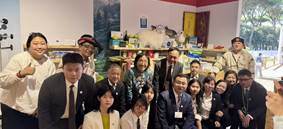
Figure 1 China hall at the first FAO global exhibition (2025, Rome)
2 GIES Forum
To share the application experience of
GIES technology in depth, IGSNRR, CAS hosted a special forum on GIES technical
applications during the exhibition. Representatives from the Le’an (Jiangxi)
government (a GIES case), scientists from the GIES planning team, entrepreneurs
from Panshi, and representatives from journals and media shared their
experience and models for sustainable development of GIES cases from different
perspectives (Figure 2).
GIES
integrates tools such as geospatial traceability, big data, the Internet of
Things, and artificial intelligence, building a full system that links
“production-environment-market- consumption”. It is implemented through a multi-stakeholder
team work together, with the goals to put into practice both the environment
protection and socioeconomic development with Four Betters framework. At
present, 27 GIES cases have been successfully identified in China. The GIES
technology has also understood and to be used in OCOP countries in the Asia and
Pacific Region, including Bhutan’s quinoa, Nepal’s large cardamom, Panama’s coffee
and Cambodia’s mongo. FAO representatives from Africa, Asia and the Pacific,
and Latin America also expressed their willingness to apply this technology in
their regional OCOP Initiative.
Dr. Ken
Shimizu, FAO representative for Bhutan and Nepal, said that Bhutan and Nepal
are the first countries in the world besides China to use GIES technology to
support the implementation of OCOP Initiative. He said: “This system will
greatly benefit quinoa farmers in Bhutan and cardamom farmers in Nepal, while
also protecting the environments of origin of these products. We thank IGSNRR, CAS
for providing capacity-building support to both countries, which continues our
long-term cooperation”. Rachmat Pambudy, Indonesia’s Minister of National
Development Planning, also said: “Applying the GIES approach is expected to
improve the recognition, value, and market competitiveness of special
agricultural products. Indonesia is now working to apply GIES comprehensively
to drive agricultural modernization”.
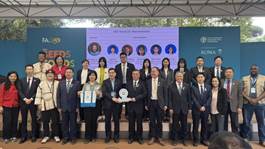
Figure 2 Group photo at the special forum on GIES
technical applications (2025, Rome)
3 Keynote Speech at the High-Level Event
|
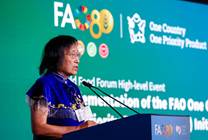
Figure 3 Professor
LIU Chuang delivered a keynote speech at the FAO High-level Forum on OCOP Implementation
©FAO/Giulio Napolitano
|
On October 15, the Fifth World Food Forum 2025 was held at
FAO headquarters in Rome. Professor LIU Chuang from IGSNRR, CAS, Chief
Scientist of the Geographical Indication Research Center, and Vice-Chair of the
OCOP Asia and Pacific Regional Organizing Group, was invited to attend the
High-Level Forum on OCOP Implementation, and delivered a keynote speech on
“GIES Supporting OCOP Implementation” (Figure 3). She pointed out that GIES is
a comprehensive technology package and tool chain, which is based on the principles
of open science, using big data, artificial intelligence, and the Internet of
Things to trace and identify geographical products and their environments of
origin, and to add brand value. It’s measure of success is a “triple-win”
model: farmers win income, consumers win health and the environment of origin win
beautiful. She indicated that the GIES tool chain has become an accelerator for
FAO’s global OCOP Initiative. Through promotion and application in OCOP member
countries, people learned more OCOP knowledge, tasted more OCOP products, and
bring more OCOP into people’s daily live and spirit.
4 Enhancing International Trade
On October 12, at
the EU-China Forum on Geographical Indications Agreement between EU-China was
held. The trade agreement of Le’an bamboo shoots between Jiangxi Guangya Food Co., Ltd. and an Italian international trading
company was signed. According to the agreement, the Italian international
trading company order for Le’an bamboo shoots worth up to USD 6.22 million
(Figure 4). This is a vivid example of the EU-China GI Agreement being put into
practice. It shows strong recognition of China’s GIES products in the European
market. It also marks the formal, large-scale entry of GIES products into the
international high-end market, creating a new milestone for EU-China GI
cooperation.
New partners for
South-South cooperation were expanded to deepen global development
collaboration. On October 14, the GIES delegation held talks with the
delegation from Bangladesh’s Ministry of Agriculture at FAO headquarters (Figure 5). The Bangladesh side clearly expressed its willingness to build
long-term cooperation with the GIES project. They hope to jointly promote
progress in food security, better nutrition, higher livestock productivity, and
sustainable agricultural development in Bangladesh. On the same day, the
delegation also attended the “Hand-in-Hand Initiative” Bangladesh Investment
Plan and Opportunities Forum, laying a solid foundation to expand cooperation
in more areas.
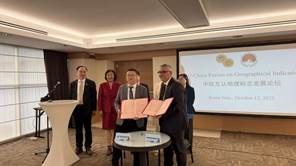
Figure 4 The signing of the export order for Le’an bamboo shoots (2025, Rome)
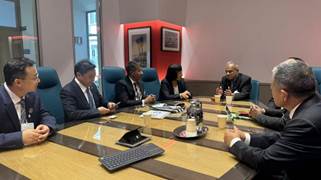
Figure 5 The IGSNRR, CAS delegation holds talks with
the Bangladesh
Ministry of Agriculture delegation (2025, Rome)
Strategic alignment
with FAO was further strengthened to build new cooperation mechanisms. On
October 15, the IGSNRR, CAS delegation met with Dr. XIA Jingyuan, Secretary of
the FAO global OCOP action and Special Adviser to the Director General. Dr. XIA
introduced FAO’s overall work and the OCOP action plan in detail. He highly
praised the GIES project and looked forward to deeper cooperation in technology
promotion, capacity building, and regional pilots, to jointly advance
sustainable agricultural development.
5 Youth Forum and GIES Future
At
the special forum on GIES technical applications during the FAO Global
Exhibition, youth representatives from middle schools demonstrated their
activities and understand about the Jinuo tea, Lanjia Village rice, and Yangxian black rice, etc. From the
unique youth perspective, they shared their deep understanding of the
relationship among the “From Seeds to Foods”, GIES and the Four Betters (Figure 6). Through real experiences and vivid storytelling, they told the
world the ecological and cultural stories behind GIES products. They showed the
awareness and responsibility of the younger generation in China toward
sustainable development, and received strong recognition and praise from guests
on site.
The GIES technology
has organized international forums for 3 consecutive years and deeply
participated in UN cooperation. It has built a systematic and regular platform
for international exchange and capacity building for youth to take part in
global governance. It has helped cultivate outstanding young talents with a
global vision. This shows GIES’s important role in youth capacity building and
talent development, and brings strong youth power for the future of sustainable
development.
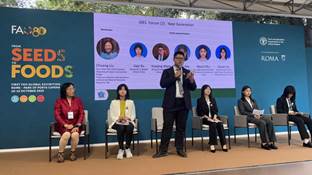
Figure 6 School students tell GIES story at the “From Seeds to Foods”
(2025, Rome)
6 GIES for a New Journey
Professor
SONG Xianfang, Director of the Geographical
Indication Research Center in IGSNRR, CAS, said that the GIES system shows
China’s commitment to innovation-driven sustainable development. It turns local
agricultural knowledge into a globally traceable and environmentally
responsible value chain, and vividly puts into practice FAO’s vision of Four
Betters.
From China’s local
communities to FAO headquarters in Rome, the GIES progress had been steady and
strong. Through the exhibition showcase, knowledge sharing in special forums,
innovative expression by youth, and a series of high-level meetings, GIES not
only shows China’s innovative solutions in linking ecological protection with
rural revitalization, but also reflects the shared responsibility of FAO and
China in using international cooperation to support the theme of global
agriculture: Four Betters. It also marks that its capacity building to support
FAO’s OCOP implementation is already among the leading efforts globally,
contributing practical “China solutions” to building a community with a shared
future for humankind (Figure 7).
As Professor LIU Chuang
indicated: “In the coming years, on the basis of technology transfer, capacity
building, and open sharing of data and knowledge, we will further strengthen
the work on case impact. Under the ‘triple-win’ model for farmers, consumers,
and the environment, we will practice the FAO Four Betters vision: Better Production,
Better Nutrition, Better Environment, Better Life, leaving no one behind”.
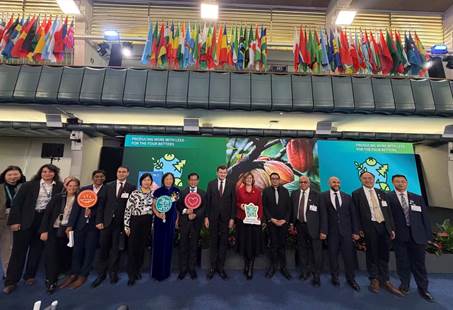
Figure 7 Group photo of the IGSNRR, CAS
delegation with FAO headquarters and
representatives from various countries (2025, Rome)