YU Wenyang1 LI Guoqing1 WU Bonan1 LU Yihang1 Bounheuang Yachongtou2
1.
Aerospace Information Research Institute, Chinese Academy of Sciences, Beijing
100190, China;
2.
Faculty of Social Sciences, National University of Laos, Vientiane 01080, Laos
Abstract: On
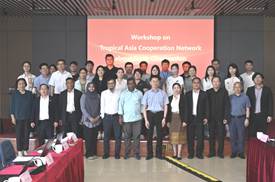
June 30, 2026, the National Earth Observation Data Center (NODA) hosted the
International Technical Workshop on Tropical Asia Cooperation Network about
Earth Observation at the Beijing Olympic Park Campus of the Aerospace
Information Research Institute, Chinese Academy of Sciences. The workshop
brought together over 10 international delegates from three countries—the
National University of Laos (Laos), Jagannath University (Bangladesh), and
Mahanakorn University of Technology (Thailand)—along with more than 50 Chinese
experts and scholars from research institutes, universities, national data
centers, and commercial space companies. The workshop featured in-depth
discussions on cooperation mechanisms for Earth observation data and the
development of localized data governance capacities in the Tropical Asia
region. The parties reached broad consensus on future collaboration directions,
including technical training, talent exchange, and joint research.
Keywords:
NODA; data governance; international
cooperation; Southern Asia; capacity building
DOI: https://doi.org/10.3974/geodp.2026.04.13
On
June 30, 2026, the International Technical Workshop of the Earth Observation Southern
Asia Cooperation Network was held in Beijing, hosted by the National Earth
Observation Data Center (NODA) of the Aerospace
Information Research Institute, Chinese Academy of Sciences. The workshop
centered on Earth observation cooperation in the Tropical Asia region, with a
particular focus on enhancing partner countries’ autonomous data governance
capacities and advancing the localization of data management, processing, and
services. The core strategic direction of the workshop was to shift from
traditional “data export” toward “capacity co-building”, aiming to achieve
two-way flow and long-term sustainable utilization of regional data resources.
Established in
2019, NODA is a national-level scientific data facility in China. It
coordinates 25 specialized sub-centers and manages resources from over 100
remote sensing satellites. In recent years, NODA has actively promoted
international cooperation with Tropical Asia countries including Laos,
Bangladesh, and Thailand. This International Technical Workshop was convened on
the basis of these existing collaborations, addressing the practical needs for
regional data governance capacity enhancement.
More than 10
international delegates from three countries—the National University of Laos
(Laos), Jagannath University (Bangladesh), and Mahanakorn University of
Technology (Thailand)—together with over 50 Chinese experts and scholars from
the National Earth Observation Data Center, Hainan Satellite Data and
Application Research Center (China National Space Administration), Institute of
Geographic Sciences and Natural Resources Research, Chinese Academy of Sciences
(IGSNRR, CAS), Zhengzhou University, Zhongke Satellite Technology Group Co.,
Ltd., and Spacety Co., Ltd., participated in the workshop.
The workshop was
chaired by Professor LI Guoqing, Director of the National Earth Observation
Data Center. In his opening remarks, Director LI pointed out that building
localized data governance capacity is a core
issue in Earth observation cooperation in the Tropical Asia region. He
emphasized that the cooperation should drive the transition from traditional
remote sensing data sharing toward collaborative capacity building in data
governance. He stressed that helping partner countries establish independent
data management systems and achieving two-way flow and sustainable utilization
of regional data resources are the primary goals of this cooperation. Director
LI also introduced NODA’s overall strategy and recent progress in promoting
international cooperation in Earth observation data.
During the technical exchange sessions, participants
engaged in in-depth discussions on scientific data cooperation and data
governance capacity enhancement. International delegates presented the current
status of remote sensing data applications and localization needs in their
respective countries. Thematic discussions were held on topics including remote
sensing intelligent processing technologies, representative remote sensing
satellite data products, Analysis Ready Data (ARD) products, and scientific data
publishing and sharing.
Dr. Somkhit
Boulidam from the National University of Laos introduced the current status of
remote sensing data applications in agricultural monitoring in Laos, noting
that limited data access channels and insufficient local processing
capabilities are the main bottlenecks. Dr. Manop Aorpimai from Mahanakorn
University of Technology shared Thailand’s progress in the field of remote
sensing and case studies of localized applications. Dr. Mohammad Abdul Quader
from Jagannath University presented the needs and technical challenges of
remote sensing applications in flood disaster monitoring in Bangladesh.
The participants
also discussed ways to enhance partner countries’ localized data governance and
application capabilities through technical training, talent exchange, and
standardization alignment. Representatives from Zhengzhou University presented
research findings on remote sensing intelligent processing technologies.
Professor LIU Chuang from the IGSNRR, CAS, delivered a technical report on
scientific data publishing and sharing. Delegates from various countries shared
their research progress in application areas including remote sensing-based
crop yield estimation, landmark habitats and agricultural product management,
and natural disaster emergency response.
 A fundamental consensus reached at the workshop was that localized
data governance capacity serves as a foundational condition for regional
cooperation. Participants agreed that sharing experiences and technical
approaches in data governance among countries will help Southern Asia countries
gradually develop autonomous capabilities in data application. All parties
expressed their commitment to taking this workshop as an opportunity to deepen
cooperation in data governance capacity enhancement, joint research, and talent
development, jointly advancing the development of the Tropical Asia Earth
Observation Cooperation Network to provide data support for regional
sustainable development.
A fundamental consensus reached at the workshop was that localized
data governance capacity serves as a foundational condition for regional
cooperation. Participants agreed that sharing experiences and technical
approaches in data governance among countries will help Southern Asia countries
gradually develop autonomous capabilities in data application. All parties
expressed their commitment to taking this workshop as an opportunity to deepen
cooperation in data governance capacity enhancement, joint research, and talent
development, jointly advancing the development of the Tropical Asia Earth
Observation Cooperation Network to provide data support for regional
sustainable development.
 The workshop laid a solid
foundation for the development of the Southern Asia Earth Observation
Cooperation Network. It was decided that the first round of technical training
programs for Tropical Asia countries would be launched in the second half of
2026, with joint research initiatives to be carried out in priority areas including
agricultural monitoring and disaster emergency response.
The workshop laid a solid
foundation for the development of the Southern Asia Earth Observation
Cooperation Network. It was decided that the first round of technical training
programs for Tropical Asia countries would be launched in the second half of
2026, with joint research initiatives to be carried out in priority areas including
agricultural monitoring and disaster emergency response.